Cambodia has no major amusement parks — we explain honestly why, and what to see instead: Angkor Wat, Battambang's bamboo train, the Garden City water park, Aeon Mall, national parks and the islands off Sihanoukville.
Cambodia has not a single amusement park at the level of Disneyland, Universal Studios or even Vietnam’s VinWonders — and, honestly, this is not the question you should travel to the country for. Cambodia’s tourism industry is built around Angkor, the largest temple complex on the planet, and not around roller coasters, and the best answer to the query “amusement parks in Cambodia” is not a list of rides but an honest explanation of what really exists in the country and what is not worth looking for.
Why Cambodia has no major amusement parks
The difference with neighbouring countries is easily explained: Thailand, Vietnam and especially China have noticeably larger economies, a more numerous middle class with money for regular domestic family holidays and decades of more developed tourist infrastructure. Cambodia went through the devastating rule of the Khmer Rouge in 1975–1979, which threw the country’s economy and infrastructure back by decades, and the subsequent recovery went primarily around the asset the country really had in abundance — the temples of Angkor, a UNESCO World Heritage site and one of the planet’s main archaeological sights.
As a result Cambodia’s tourist economy took shape around cultural and historical tourism rather than around Western-style entertainment infrastructure. Large international amusement park operators — Disney, Universal, even regional companies like Chimelong or Vingroup — simply don’t see in Cambodia a market comparable in size with the neighbouring countries and don’t invest in building their own venues here.
Angkor Wat: Cambodia’s real “park”
If you take the word “park” literally — as an enclosed territory with sights — the closest analogue of a theme park in Cambodia is the Angkor Archaeological Park near Siem Reap: hundreds of temples on an area of several hundred square kilometres, built by the Khmer Empire between the 9th and 15th centuries. The single ticket — the “Angkor Pass” — costs 37 dollars for one day, 62 dollars for three days (not necessarily consecutive, within a week) and 72 dollars for seven days within a month, and covers not only Angkor Wat itself but all the temples of the complex, including the more distant Beng Mealea, Kbal Spean and Banteay Srei.
Tickets are sold both at the box offices at the western entrance of the complex and through machines in the Heritage Walk Mall in Siem Reap itself, accepting practically any cards — from Visa and Mastercard to Alipay and WeChat Pay. For families with children Angkor is more an educational adventure than entertainment in the usual sense: climbing ancient steps and studying bas-reliefs is more interesting to older children and teenagers than to the smallest, who find it harder to bear the heat and long walks between temples.
Angkor Wat itself is only one, albeit the largest, temple of the complex, and limiting yourself to it alone is a common mistake of a first visit. A couple of kilometres to the north lies Angkor Thom, the fortified city of the Khmer kings with four gates decorated with giant stone faces, and in its centre is the Bayon temple with 54 towers, each carved with several of the same smiling faces turned to all points of the compass. Farther on is Ta Prohm, a temple deliberately left partly taken over by the jungle: the roots of strangler figs literally grow through the stone vaults and walls, and it is this view that was used as the setting for the film “Lara Croft: Tomb Raider” in 2001. Banteay Srei, the “Citadel of Women”, stands out among the other temples for its pink sandstone and some of the finest, jeweller-quality carving in the whole complex — because of the hardness of the material, the craftsmen could carve far smaller details than on the grey sandstone of the other buildings.
The classic first-day route is the “small circuit” (Angkor Thom, Bayon, Ta Prohm) by tuk-tuk with a local driver, who usually takes a fixed fee for the day regardless of the number of stops. Sunrise over Angkor Wat is the most widely publicised but still workable option: the gates open at 5 a.m., and you should arrive at the main temple in advance to take a spot by the left pond, from where the classic shot with the towers reflected in the water is obtained. Those not ready to get up in the dark should take into account that by day in the dry season the temperature on the open stone platforms easily passes 35°C, and water is no less important an element of equipment than the ticket.
The Battambang bamboo train: the world’s only attraction of its kind
The norry, or bamboo train, in Battambang is a rare case of a truly unique Cambodian attraction with no analogue anywhere else in the world. The story of its appearance is directly connected with the country’s tragedy: after the Khmer Rouge destroyed the railway infrastructure, local residents assembled simple platforms from bamboo on a pair of metal wheels taken from old military equipment and fitted a small motor to them — a practical solution to a transport problem devised out of desperation, not for tourists.
The rails along which the platforms roll today are themselves left over from the French colonial era — part of the railway line that once connected Phnom Penh with Poipet on the Thai border. When the first tourists began arriving in the country in the late 1990s and early 2000s, the norry quickly turned from a spontaneous transport solution into a tourist attraction in its own right: a bamboo platform on tank wheels accelerates to 40 km/h along single-track rails through rice fields and villages, and if another such “train” is coming the other way, one of them has to be literally dismantled on the spot to let the oncoming one pass.
The ride costs about 5 dollars per person when shared with other tourists or about 10 dollars for the whole platform if you want to ride alone or in a small group without outsiders. For travellers who have already visited Angkor and are looking for something fundamentally different — not a temple but living history literally assembled from improvised materials — the bamboo train remains one of the most authentic experiences you can have in the country at all.
The route is short — about 7 km one way between the villages of O’Dambong and Wat Kor, and a ride there and back with a stop in the middle usually takes 20–30 minutes each way. At the end point of the route tourists are usually met by locals with a small improvised market of souvenirs and drinks — another way in which this originally purely utilitarian construction has been built into the local economy. The line itself is part of what was once the single Royal Railway of Cambodia, which before the Second World War connected Phnom Penh with Bangkok; today real freight trains occasionally run along the adjacent tracks, which operate as a proper line, and in that case the norry is simply taken off the rails, the train passes and it is put back. It is best to go in the first half of the day, before the midday heat, and it is about 3 hours by car from Siem Reap to Battambang, so for a day trip with a visit to the norry it is sensible either to spend the night in Battambang itself or to allot this day separately from the busy programme of the Angkor temples.
Garden City Water Park: the country’s largest water park
Garden City Water Park in Phnom Penh, about 15–20 minutes from the city centre by the Independence Monument, is Cambodia’s largest water park and one of the few venues in the country that really lay claim to the title of “amusement park” in the usual sense. The grounds occupy about 7 hectares, and the number of slides and attractions is stated at about 38 — from fast slides for adults and teenagers to calmer zones like a lazy river and a children’s play area.
Among the themed zones are Wave Paradise with a wave pool, Water Empire with more grown-up slides, Children’s Paradise for the smallest, as well as separate sections Mekong River and Whirlpool Valley. The park positions itself as a safety-oriented venue — with professionally trained lifeguards and a first-aid team, which should be taken as a sensible plus for families with children used to stricter safety standards in other countries of the region.
In internal logistics Garden City Water Park works like the water parks in neighbouring countries: at the entrance you are given a chip wristband to which a deposit for food and drinks inside is linked — paying cash on the grounds is inconvenient and not always possible. There are lockers for belongings and changing rooms, but towels are usually not included in the entrance ticket price and are rented separately, so bringing your own towel is a small but useful saving. The best time to visit is weekdays: at weekends, especially in the afternoon, the park fills up noticeably with local families from Phnom Penh, for whom it is one of the few available formats of active leisure with children in the city.
Aeon Mall: indoor entertainment when it is too hot outside
The Aeon Mall shopping centre in Phnom Penh — the first and largest mall of such a scale in the country — combines shopping with a full entertainment floor: an ice rink (about 10 dollars an hour), bowling, karaoke zones, a large arcade with gaming machines and a Major Cineplex cinema with VIP halls and 4DX format. For families tired of the heat or caught by a sudden tropical downpour, this is a reliable fallback for a few hours in an air-conditioned space — a rare combination for a country where such entertainment infrastructure is generally poorly developed.
The children’s play zone and a separate arcade floor make Aeon Mall a convenient option for families with younger children who don’t need intense rides — it is more a format of “spend a couple of hours in the cool with entertainment” than a full day at a park.
Aeon in Phnom Penh also has a second, newer location — Aeon Mall Sen Sok City, opened later than the first mall and located closer to the north-western districts of the city. There, in addition to the standard shopping-centre set of entertainment, a separate water zone, Water Garden, operates — an open-air pool with several slides, closer in format to a family water park than to an entertainment floor. For tourists staying in Phnom Penh’s historic centre by the riverfront, the first Aeon Mall is usually more convenient geographically, while Sen Sok City suits those already heading towards the international airport or living in the city’s northern districts.
Phnom Penh beyond rides: what people see instead of parks
Since the capital’s purely entertainment infrastructure is limited to shopping centres and one water park, it is worth understanding what tourists actually fill a day in Phnom Penh with — and this is one more illustration of the fact that Cambodia bets on history rather than rides. The Royal Palace with the Silver Pagoda (whose floor is indeed laid with several thousand silver tiles) is the capital’s main architectural complex, the active residence of the King of Cambodia, part of which is open to visitors. The National Museum next to the palace holds the world’s largest collection of Khmer art — sculpture, bronzes and ceramics spanning more than fifteen hundred years of the country’s history, from the pre-Angkorian period to modern times.
At the other end of the emotional spectrum are Tuol Sleng (the former S-21 prison) and the Choeung Ek Memorial, the “Killing Fields”: places directly connected with the genocide under the Khmer Rouge, which hundreds of thousands of tourists visit every year not for entertainment but to understand the country’s recent history, which largely explains why Cambodia has no large entertainment industry to this day. For those travelling with small children these two places are usually recommended to be skipped or visited without them — the content is designed for an adult audience.
A lighter-in-mood sight is the hill and pagoda of Wat Phnom in the centre of the city, from which, according to legend, the very name Phnom Penh comes (“the hill of [a woman named] Penh”); in the evening local residents gather on the square around the hill, street food vendors work, and the place turns into a living city square rather than a museum object.
Sihanoukville and the islands: a beach, not a ride, holiday
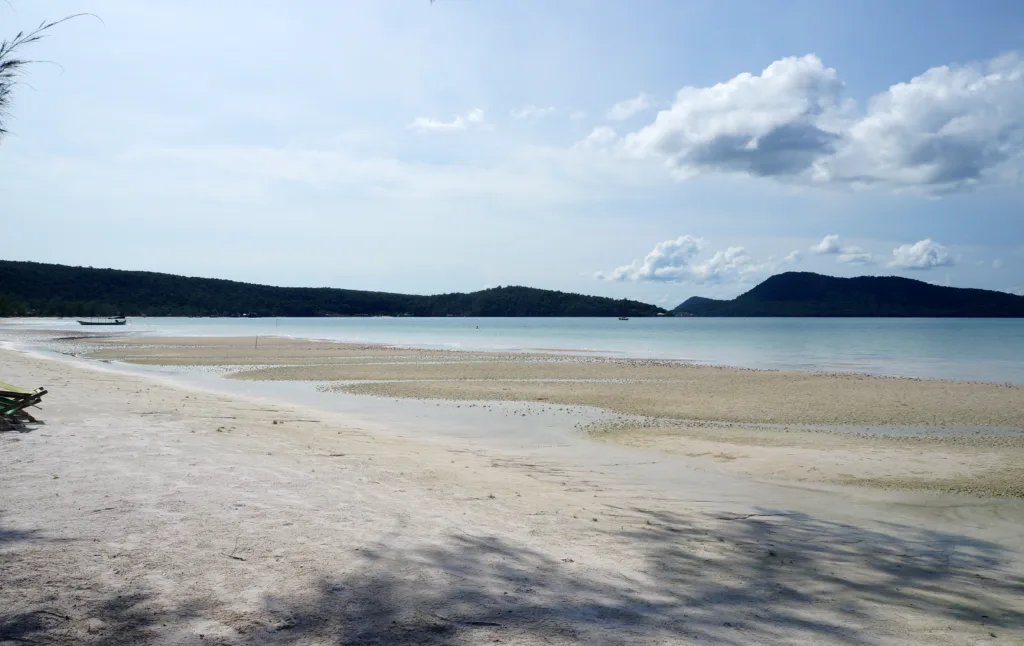
Cambodia’s southern coast is another example of how the country offers a completely different, non-ride format of holiday where neighbouring Thailand or Vietnam would offer a full amusement park at a resort town. Sihanoukville as a city has in recent years acquired an ambiguous reputation because of large-scale casino development linked to Chinese investment, but the main reason to go to this area is not the city itself but the islands off the coast: Koh Rong and Koh Rong Samloem with white sand and clear water, to which tourists are taken by speedboats or ferries in about 30–45 minutes.
On the islands there is not a hint of Western-type entertainment infrastructure — the bet is entirely on natural beach rest, snorkelling, diving and, in season (roughly November to March, on moonless nights), watching bioluminescent plankton glowing in the water when it moves. For families looking for an active format “alongside the beach”, this is more a destination for snorkelling and short sea trips than for rides in the usual sense.
You can reach the islands in two ways: by speedboat from the central pier of Sihanoukville (tickets are sold right at the quay and through hotels) or, for a calmer budget, by slow ferry, which takes longer but costs noticeably less. Most beach resorts on Koh Rong are concentrated on one shore of the island, and on the other, which can be reached only by boat or along a forest path, there are noticeably quieter and less crowded beaches, to which local operators increasingly offer separate day tours with snorkelling stops at several points along the coast.
National parks as an alternative to rides
What replaces amusement parks in other countries of the region is in Cambodia often replaced by national parks and natural areas. Bokor Mountain in the south-west of the country, with its famous ruins of an abandoned French colonial resort of the 1920s and long walking routes through relict forests that take four to seven hours to complete, is a popular destination for those looking for an active day in nature instead of rides. The resort at the top of the mountain was built by the French in the 1920s as a place of respite from the heat for the colonial administration, was abandoned after independence and the Civil War, and today its faded concrete buildings — an abandoned church, a casino, the Bokor Palace hotel — have themselves become a visual attraction, a kind of ghost town at an altitude of over 1,000 metres, from which in clear weather there is a view of the Gulf of Thailand.
Ream National Park (Preah Sihanouk) near the coast of Sihanoukville offers mangrove thickets, tropical birds and stretches of coast with coral reefs, into which dolphins and dugongs sometimes swim. Another option for an active holiday is Kirirom National Park, closer to Phnom Penh (about 2.5 hours by car), with waterfalls, pine trees at altitude (a rarity for a tropical country) and a far cooler microclimate than on the plain — a popular weekend destination for the capital’s own residents, not only for foreign tourists.
The format of such a “rest instead of a park” is typical of Cambodia as a whole: instead of artificially built attractions, the country offers genuine natural and historical sites that demand more physical activity and are less like the classic American format of a theme park.
The road to Bokor Mountain is a paved serpentine, accessible on a rented motorbike or as part of an organised tour from Kampot; the latter option is more convenient for those not ready to ride a motorcycle themselves along a mountain serpentine with sharp bends and fog in the upper part of the climb, which is not rare here even in the dry season. The town of Kampot itself at the foot of the mountain is another stop interesting in its own right: with early-20th-century colonial buildings, a riverfront along the river of the same name and plantations of Cambodian pepper, which many chefs consider one of the best varieties in the world and which is sold right at local markets and on farms open to tourists.
When to go and how to combine with neighbouring countries
The dry season in Cambodia lasts roughly from November to April and divides into two periods different in feel: a cool (by local standards) stretch from November to February, when the daytime temperature stays around 27–32°C, and a noticeably hotter March–April, when the thermometer on Angkor’s open platforms often exceeds 38–40°C — a hard time for long walks around the temples. The rainy season falls in May–October: rain more often comes as short but heavy downpours in the second half of the day rather than continuously for days, so the first half of the day in this period can quite well be planned for activities like Angkor or the bamboo train.
Since Cambodia itself, as shown above, has no amusement parks at the level of the neighbouring countries, the logical strategy for families planning a big regional route is to place the classic attractions (Dream World and water parks in Thailand, VinWonders and Sun World in Vietnam) on the neighbouring legs of the trip, and to build the Cambodian part of the route around what is really strong here: Angkor, the bamboo train, Phnom Penh’s cultural sights and a beach holiday on the islands off Sihanoukville. Direct flights connect Siem Reap and Phnom Penh with Bangkok, Ho Chi Minh City and Hanoi, which makes such a combination logistically simple.
A separate practical detail that concerns any spending inside the country, including tickets to Angkor and to the attractions in this article: Cambodia’s official currency is the riel, but in fact in everyday circulation, especially in tourist places, the US dollar dominates. Prices for tickets, excursions and in many cafés are initially quoted in dollars, ATMs often dispense precisely dollars, and riels are used mostly as “small change” for sums under one dollar. For the trip it is enough to have a little cash in dollars with you for places where cards are not accepted — small family water parks, local tuk-tuks and the souvenir rows by the bamboo train work mostly with cash.
An honest recommendation: what to expect from the trip
If the goal of the trip is specifically amusement parks in the spirit of Disney, Universal or Thailand’s Dream World, Cambodia is not the right choice among the countries of the region. But if you consider the trip more broadly — as getting to know the genuine history, architecture and nature of the country — the set of impressions here turns out no poorer, just fundamentally of a different kind: temples instead of slides, a bamboo train instead of roller coasters, relict forests instead of artificial scenery.
For families whose regional route already includes a stop in Thailand or Vietnam with full-fledged amusement parks, it is sensible not to try to find something similar in Cambodia but to plan here a fundamentally different part of the trip — around Angkor, nature and culture — and leave the classic entertainment for the route’s neighbouring countries.
Frequently asked questions
Are there Disneyland-level amusement parks in Cambodia? No, the country has not a single large international-level theme park — neither from a local nor from a foreign operator.
Which is the largest water park in Cambodia? Garden City Water Park in Phnom Penh — about 7 hectares of grounds and about 38 slides and attractions.
What is the bamboo train in Battambang? An attraction unique in the world — a bamboo platform on tank wheels rolling along colonial rails, which grew from a spontaneous post-war transport solution into a popular tourist attraction.
How much is a ticket to Angkor Wat? 37 dollars for one day, 62 dollars for three days within a week, 72 dollars for seven days within a month — the ticket covers all the temples of the complex, not only Angkor Wat itself.
Where should I go with children on a rainy day in Phnom Penh? To the Aeon Mall shopping centre — there is an ice rink, bowling, an arcade and a cinema, all indoors with air conditioning.
Is it worth going to Cambodia for amusement parks? No, neighbouring Thailand or Vietnam are better for that — Cambodia is more about the temples of Angkor, nature and genuine history than about rides.
How many days should I allow for Angkor? At least two days for the “small” and “big” circuits of the main temples, but for a fuller acquaintance, including the distant Beng Mealea and Banteay Srei, it is more comfortable to allow three days — the most popular three-day Angkor Pass is designed for exactly this period.
Can I get to the bamboo train without a tour? Yes, the line in Battambang is easily reached by tuk-tuk from the city in 10–15 minutes, ticket purchase and the ride itself are arranged on the spot, without advance booking.
Is it safe to swim off the Sihanoukville islands? Yes, the water around Koh Rong and Koh Rong Samloem is clear and generally calm, which makes them a popular destination for snorkelling and short sea trips in addition to a beach holiday.
See also: Angkor Wat: tickets, the best temples, sunrise, when to go to Cambodia, Siem Reap: where to stay near Angkor Wat.