Angkor is not one temple but a park of 400 square kilometres. Which ticket to take, which temples are worth your time, whether to go for sunrise, how much a tuk-tuk costs and how to survive the heat.
Angkor is not a single sight but an archaeological park of about 400 square kilometres with hundreds of temples. It is exactly this that breaks newcomers’ plans: people come to “see Angkor Wat” for half a day and discover that around it lies a whole medieval city.
Let’s work out how to plan a visit in a human way: how many tickets to take, which temples are really worth your time, whether to go for sunrise and how not to collapse from the heat by eleven in the morning.
How many days to allow
The honest answer depends on how interested you are in archaeology, but the guidelines are these.
| Ticket | What you will manage | Who it is for |
|---|---|---|
| 1 day | Angkor Wat, Bayon, Ta Prohm — the “small circuit” | if you are passing through and time is strictly limited |
| 3 days | + the grand circuit, Banteay Srei, sunset from a hill | the optimum for most people |
| 7 days | + distant temples, repeat visits at different times of day | for the enthusiastic |
The three-day ticket is valid for 10 days from first use, the seven-day one for a month. That is, the days do not have to run consecutively, and this is important: between visits you can arrange a day off, which in the local heat is very sensible.
A practical tip: don’t try to see everything. After the fifth or sixth temple in a day they stop being distinguishable, and this is called “temple burnout”. Two or three sites in the morning and one in the evening is far better than ten in a row.
What this actually is
Understanding the context changes the impression radically — without it the temples remain just beautiful stones.
Angkor was the capital of the Khmer Empire, which from the 9th to the 15th century controlled most of Southeast Asia. At its height, by various estimates, up to 700–900 thousand people lived here — which made Angkor one of the biggest urban agglomerations of the pre-industrial world, comparable with the capitals of Europe and China at the time.
Everything rested on water. The Khmer built a giant system of canals and reservoirs — the barays — which allowed several rice harvests a year to be gathered. The rectangular lakes you will see on the park map are not decorative ponds but engineering structures a thousand years old.
Temples were built as models of the universe: the central tower symbolises the sacred Mount Meru, the surrounding walls the mountain ranges, the moat the world ocean. That is why the large temples have such strict symmetry and a stepped structure.
Religion changed: the early temples are Hindu, dedicated to Vishnu and Shiva, the later ones Buddhist. On some buildings traces of alterations are visible, when images of one tradition were replaced by another.
The empire fell into decline by the 15th century — probably because of a combination of climate change, the destruction of the water system and wars. The city emptied, the jungle swallowed the buildings, but Angkor was never completely “forgotten”: local monks lived at the temples in the following centuries. It became widely known in the West in the 19th century thanks to the notes of French explorers.
Today Angkor is a UNESCO World Heritage site and the main symbol of the country: its silhouette is on Cambodia’s national flag. It is the only national flag in the world with an architectural structure.
The main temples
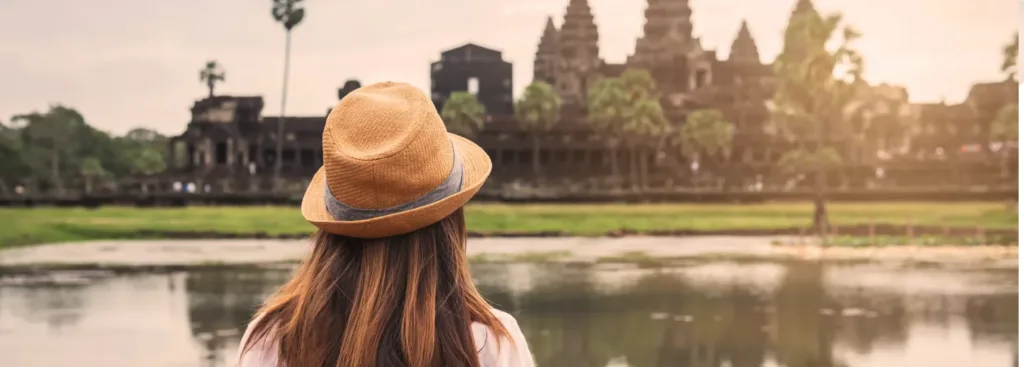
Angkor Wat. The largest religious structure in the world and what people come here for. It impresses with its scale and bas-reliefs — a gallery with scenes from the Hindu epic stretches for hundreds of metres. Note that the temple faces west rather than east like most: that is why the façade is beautifully lit in the second half of the day.
Bayon. Inside the city of Angkor Thom. Famous for towers with giant stone faces that look at you from any point. Many call it the strongest impression of the trip — stronger than Angkor Wat itself.
Ta Prohm. The very temple entwined with the roots of giant trees. It was deliberately left partly uncleared to show what the ruins looked like when they were discovered. It is crowded almost always, so it is better to come early.
Banteay Srei. 30 kilometres from the main group, of pinkish sandstone, with incredibly fine carving — considered the summit of Khmer craftsmanship. Small, but worth the trip.
Pre Rup and Phnom Bakheng. Temple-mountains that people climb for the sunset. Phnom Bakheng is closer and therefore overcrowded; Pre Rup is calmer.
Preah Khan. Large, labyrinthine and noticeably less crowded than the main three. A good choice for the second day.
Sunrise: to go or not
Sunrise over Angkor Wat is Cambodia’s most famous picture, and the question about it is asked most often.
What awaits you. Getting up at 4:30, arriving at five, and you are one of several hundred people by the pond in front of the temple. People stand tightly packed, with phones over their heads. The spectacle itself really is beautiful: the silhouette of the towers gradually emerges against the pinkening sky, reflected in the water.
An honest assessment. If you are going for one day — yes, it’s worth it: it is the only chance, and at the same time you get into the temple before the heat and before the buses. If you have three days — you can calmly postpone sunrise to the second or third day, when you have already got your bearings.
A life hack against the crowd. Most people gather at the left (northern) pond. At the right one there are noticeably fewer people, and the view is almost the same. And one more thing: many leave straight after sunrise — if you linger for half an hour, you will find yourself in an almost empty temple in soft morning light.
Sunset, by the way, is underrated: it is no worse and there are fewer people.
How to get around the park
Distances are large: between temples from one to thirty kilometres. You cannot cover the park on foot.
| Transport | Price per day | Features |
|---|---|---|
| Tuk-tuk | $18–25 | optimal: shade, wind, the driver waits at each temple |
| Tuk-tuk with distant temples | $30–40 | with Banteay Srei and remote sites |
| Bicycle | $3–7 | romantic but hard in the heat; only the small circuit |
| Car with air conditioning | $40–60 | for heat, families and the elderly |
| Electric bicycle | $10–15 | a compromise between a bicycle and a tuk-tuk |
A tuk-tuk is the standard and best option. It is convenient to hire a driver for the whole day: he takes you between temples, waits outside, keeps water in a cool box and suggests where it is best to go now to miss the buses. Agree on the price and the list of temples in advance.
Do you need a guide? Angkor is history, and without explanations most bas-reliefs remain just a pattern. A licensed guide costs $35–50 a day. At least for the first day it is worth taking one, after that you can walk on your own.
How to get to Siem Reap
Angkor is near the city of Siem Reap, and you can get there in three ways.
By plane. Siem Reap has an international airport that receives flights from Bangkok, Ho Chi Minh City, Hanoi, Kuala Lumpur and Singapore. There are no direct flights from Russia, so the journey in any case goes via one of Asia’s hubs. A convenient scheme is to combine Cambodia with Thailand or Vietnam in one trip.
By bus. From Phnom Penh — 6–7 hours, from Bangkok — about 8–9 hours with a border crossing. Cheap, but long and tiring.
Overland from Thailand. A popular option for those already in Bangkok. Note that there are queues at the border, and intermediaries work around the crossing offering “visa help” for extra money — the visa is arranged at the border itself or online in advance, and there is no need for helpers.
It is best to stay in Siem Reap: from the town to the main entrance of the park is about 15–20 minutes by tuk-tuk.
Practical little things
The ticket is named and has a photograph. It is taken right at purchase, so you cannot buy a pass for someone else. The ticket is checked at the park entrance and selectively at individual temples — carry it with you all day and don’t crumple it: a damaged pass may not be accepted.
Children under 12 enter free, but they need a passport to confirm their age.
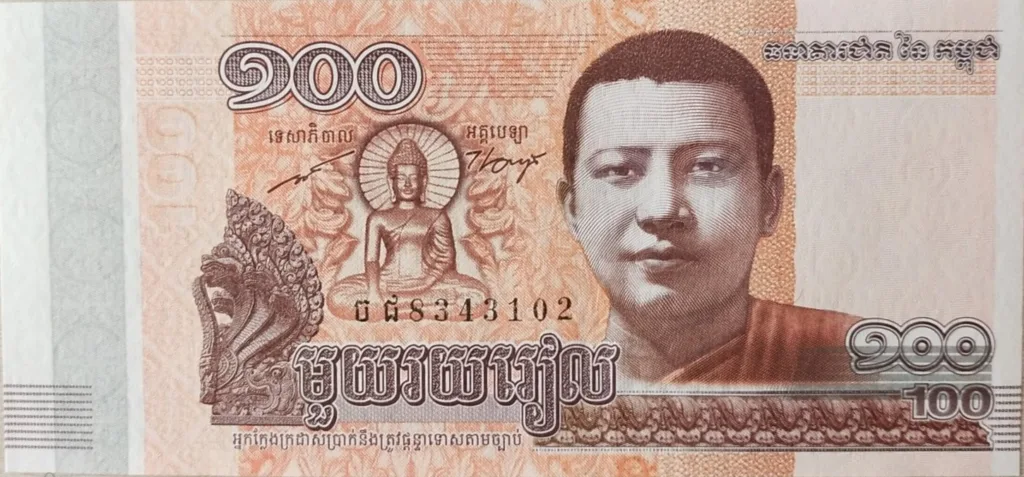
Money. In Cambodia dollars and riel circulate in parallel: large sums are quoted in dollars, change under a dollar is given in riel. Tickets, tuk-tuks and guides are priced in dollars. Cash is needed almost everywhere; there are ATMs in Siem Reap, but they charge a fee.
Toilets and water. The large temples have both, the distant ones do not. When planning a trip to Banteay Srei or remote groups, take water with a reserve.
Connectivity. Mobile internet works in the park, and a local SIM card is inexpensive and sold at the airport. An alternative for those who don’t want to deal with it on arrival is to arrange a plan in advance in the eSIM catalogue on Trip.com, where you pay in roubles. Do download an offline map of the park: deep in the complex the coverage drops out in places.
What to see besides temples
Siem Reap deserves at least one day without archaeology — it unloads the head between temples.
Tonle Sap lake with floating villages: houses, schools and shops stand on the water, and the lake level changes severalfold between seasons. Choose villages farther from the town — the nearer ones are heavily commercialised.
The Angkor National Museum is a good idea before visiting the temples: it explains who the Khmer were, what the scenes on the bas-reliefs are and why temple-mountains were built. After the museum the stones begin to read.
The Night Market and Pub Street — the town’s evening life, souvenirs, massage, cafés.
The Landmine Museum and museums devoted to the country’s recent history. Heavy, but an important part of understanding Cambodia.
How to survive the heat
This is not a trifle but the main practical factor. It is hot and humid in Siem Reap all year round, and there is almost no shade in the park.
Work to the sun’s schedule. Set out at 5:00–5:30, see temples until 10:00, go back to the hotel for the middle of the day, set out again after 15:00. This is the only scheme in which you won’t run out of steam on the second day.
Drink more than seems necessary. A litre and a half to two for the morning is the norm. Water is sold at every temple, but it is cheaper to bring your own.
A hat and cream. The sun here is harsh, and the climbs up open steps are long.
Comfortable shoes. The temples have many steep stairs with high, uneven, in places slippery steps.
Dress code and rules
Angkor is a working religious site, and the rules are strictly observed, especially at Angkor Wat.
Shoulders and knees must be covered. This is not a recommendation: you will not be let onto the upper level of Angkor Wat with bare shoulders or in shorts above the knee. A light shirt and long shorts or a skirt solve the problem.
Don’t climb on the ruins outside marked routes and don’t touch the bas-reliefs.
Be quiet near monks and people praying, and photograph people only with permission.
Don’t buy anything from children and don’t give them money: it supports the practice of sending children to sell instead of going to school. If you want to help, there are local organisations.
How much a trip to Angkor costs
| Item | Price |
|---|---|
| 3-day ticket | $62 |
| Tuk-tuk, 3 days | $60–75 |
| Guide for a day | $35–50 |
| Accommodation in Siem Reap per night | $15–60 |
| Food per day | $10–25 |
In total three days at Angkor cost about $200–280 per person including accommodation and food. The main item is the ticket, and you cannot save on it: it is named and checked at the entrance to every temple.
How to plan three days
The scheme that works best and removes “temple burnout”.
Day one — the small circuit. Start with Angkor Wat early in the morning, then Angkor Thom with Bayon, then Ta Prohm. This is the main three, and it takes the whole morning. After lunch a rest, in the evening sunset from Pre Rup.
Day two — the grand circuit and distant temples. Preah Khan, Neak Pean, Ta Som, the eastern baray. There are noticeably fewer people and the temples are more varied. If you take Banteay Srei, allow a separate half-day for it — it is thirty kilometres away.
Day three — to taste. Either a return to places you liked in different light, or sunrise if you haven’t seen it yet, or a day off with Tonle Sap lake and the museum.
It is useful to pause between days: the three-day ticket is valid for ten days, and nobody makes you go consecutively. A rest day in the middle noticeably raises the enjoyment of the third day.
And a general tip worth all the others: arrive at opening, at five in the morning. The first two hours in the park are fundamentally different from the rest of the day — cool, soft light and almost no buses.
In short: frequently asked questions
Where do I buy a ticket? Only at the official Angkor Enterprise centre in Siem Reap or on their website. Everything else is resale or fakes. The centre opens at 5 in the morning, so you can buy a ticket on the day of sunrise too.
When is the best time to go? November to February: dry and not so hot. March to May is the hottest. In the rainy season the greenery is brighter, the moats are full of water and there are fewer people — but downpours are daily.
Can I go with children? Yes, but allowing for the heat and stairs. Two temples in a morning is quite enough.
Is there food inside the park? Yes, at the large temples cafés and stalls with drinks and simple dishes operate. Prices are about twice the town’s, but tolerable. It is still more convenient to bring water and a snack in advance — especially if you go to distant temples, where there is almost no infrastructure.
Do I need a separate day for Siem Reap? Yes, it is worth it: the floating villages on Tonle Sap, the museum, the night market and local cuisine — the town complements the temples quite well.
Do I need to book a ticket in advance? No, there are usually no queues at the ticket offices, and there are no discounts for early purchase. Buying online is convenient only in that it saves time on the day of sunrise.
Can I take photographs inside the temples? Yes, without restriction except at individual shrines with signs. Tripods and drones require permission, and drones over the park are forbidden.
Where is Angkor Wat? In Cambodia, near the city of Siem Reap in the north of the country — which is the nearest city with an airport, from which everyone goes to the temple complex.
Is it worth taking a one-day tour from Bangkok? Categorically not: the road will take longer than the sightseeing. Angkor deserves at least two nights in Siem Reap.
What if a ticket is left unused? The days of three- and seven-day tickets do not burn at once: you have 10 and 30 days respectively to use them.