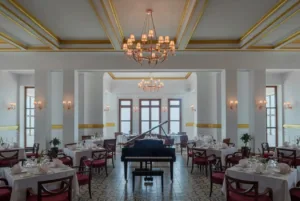
Le Bokor Palace on the Bokor Plateau is a French casino resort of 1925, abandoned after 1975 and the hero of the film "City of Ghosts". Restored in 2018.
At the top of Bokor Mountain, among clouds and the ruins of an abandoned French resort, stands a hotel that twice in its history turned into a ghost — and twice was reborn. Le Bokor Palace is the direct heir of the 1925 casino hotel, whose history has absorbed French colonialism, a reforming king and the Khmer Rouge all at once.
A resort for the colonial elite, 1925
The Bokor Plateau at an altitude of over 1,000 metres above sea level was favoured by Cambodia’s French colonial administration in the 1920s by the same logic that determined the fate of dozens of other hill resorts of colonial Asia — from Dalat in Vietnam to Shimla in British India: it is noticeably cooler up there than in the scorching lowland part of the country, which makes it a natural place for rest for European officials and their families. The hotel with a casino opened in 1925 and quickly became a symbol of French colonial leisure in Cambodia — a place people came to not so much for Cambodia itself as for a temporary escape from it into familiar European luxury at a safe distance from the malarial lowlands.
Revival under King Sihanouk
After Cambodia gained independence the resort did not fall into decline at once — in the early 1960s King Norodom Sihanouk, himself keen on the idea of modernising the country and its tourist potential, initiated the restoration and expansion of the complex, adding a new casino. For Sihanouk hill resorts like Bokor symbolised the ability of independent Cambodia to offer the same level of luxury as the colonial era, but now under a national rather than French flag — a gesture characteristic of his rule as a whole.
Abandonment and “City of Ghosts”
The resort’s second revival proved short-lived. With the Khmer Rouge coming to power in 1975 and the total collapse of Cambodian statehood and economy that followed, the Bokor resort, like almost all of the country’s tourist infrastructure, was abandoned for decades. The empty casino with peeling walls, fog wandering through the corridors and a view of the jungle below became one of the most recognisable images of abandoned Cambodia — so much so that in 2002 the ruins of the resort became the central subject of the documentary “City of Ghosts”, which cemented Bokor’s reputation as one of the most atmospheric abandoned structures in Southeast Asia.
Restoration and life under the name Le Bokor Palace
A new chapter of the story began in 2015, when the Cambodian hotel group Sokha Hotels undertook the restoration of the historic building. The work took three years and ended with the opening of the hotel under the name Le Bokor Palace in 2018 — a luxury hotel that kept its colonial look outside with completely modern fittings inside: a spa centre, a 24-hour fitness centre, bicycle rental, a French-cuisine restaurant and a free shuttle around the mountain plateau within a radius of up to 5 km.
Today the hotel stands literally 100 metres from the border of the Bokor National Park nature reserve — a neighbourhood that turns a trip to Le Bokor Palace into not just a stay in a historic building but a full base for getting to know the mountain plateau, its misty forests and panoramic views of the Gulf of Thailand.
Not to be confused with the namesake below, in Kampot
The shared word “Bokor” in the name regularly confuses travellers planning a route around the region: Le Bokor Palace stands directly on the mountain, on the territory of the reserve, while the Bokor Mountain Lodge, already familiar to readers of our site, is located below, in the town of Kampot itself, by the river, and has no direct relation to the mountain plateau — these are two completely different accommodation properties with a shared word in the name but different geography, history and level.
An honest caveat
The only guest review available to us at the time of preparing the article is critical: the guest describes a half-hour wait at a closed reception desk and in the end a refusal of check-in. We give this assessment as it is, rather than selecting only the positive — at the same time we note that a single negative experience does not always reflect the typical level of service, especially for a hotel that reopened relatively recently after a large-scale restoration. We recommend confirming the booking and check-in time directly with the hotel before the long climb to the plateau.
What next
If you are planning a route around the Kampot — Bokor region as a whole, also look at The Columns in Kampot itself — restored colonial shophouses run by one family, a good option for staying overnight below before or after the climb to the plateau.
Prices, room availability and the range of services may change — check the current information before your trip.