The Tuol Sleng Genocide Museum in Phnom Penh: a former school that became the Khmer Rouge's S-21 prison. History, the trial of Duch and how to prepare for a heavy but important visit.
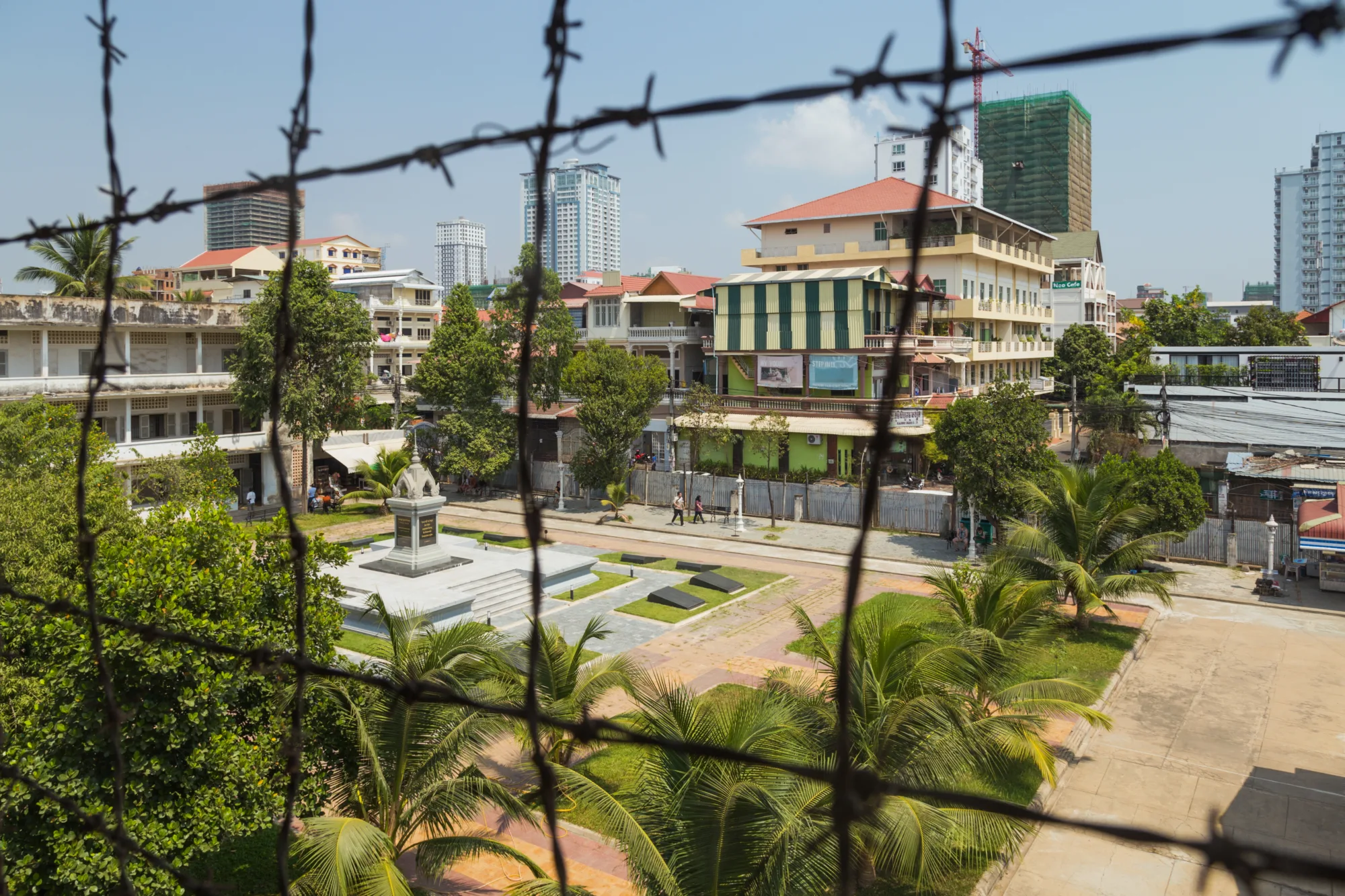
At first glance it is an ordinary school — three low concrete buildings around a courtyard with a pull-up bar and trees, built in 1962 as an ordinary city high school in Phnom Penh. That is why the first impression of Tuol Sleng is almost always deceptive: nothing in the architecture suggests that from April 1975 to January 1979 S-21 operated here — the Khmer Rouge’s main secret interrogation centre, through which, by various estimates, up to 20,000 people passed and no more than a dozen came out alive. Today it is a genocide museum — not a tourist attraction in the usual sense but a place of memory, which people visit not for an experience but to understand what happened to the country in under four years.
What happened here between 1975 and 1979
After the Khmer Rouge under Pol Pot took Phnom Penh in April 1975, the former Tuol Svay Prey school was converted into a secret prison under the code name S-21. Classrooms were turned into cells with bars on the windows, gym equipment in the yard into interrogation devices, and the whole perimeter was surrounded by an electrified barbed-wire fence so that desperate prisoners could not take their own lives before the regime decided to do so. Through S-21 passed, by researchers’ estimates, some 20,000 people — teachers, doctors, monks, former officials and, at a late stage, the regime’s own functionaries who came under suspicion of treason. Most prisoners were forced to sign confessions to non-existent crimes against the revolution, after which almost all were sent to execution outside the city, to a place later known as Choeung Ek. Only a handful managed to survive S-21 — as a rule those few whose narrow professional skills, such as the ability to paint portraits of Pol Pot or repair equipment, turned out to be needed by the camp itself.
Why it became a museum rather than a demolished building
After the fall of the Khmer Rouge regime in January 1979, the new government decided not to destroy S-21 but to preserve it as documentary evidence — partly because the camp’s own archives turned out to be exceptionally detailed: the guards kept photographic records of virtually every incoming prisoner, which ended up as one of the most complete documentary traces of crimes of the 20th century. It is precisely these thousands of black-and-white photographs — rows of faces of people who did not yet know what awaited them — that make up today perhaps the heaviest and most important part of the museum’s exhibition. Alongside the photographs, the cells, instruments of interrogation and stands with personal stories of both victims and the few survivors have been preserved — among them Chum Mey and Bou Meng, whose memories formed the basis of several books and of witness testimony at the subsequent tribunal.
Justice that came decades later
A full international tribunal for the crimes of the Khmer Rouge — special chambers in the Cambodian courts supported by the UN — began work only in 2006, almost three decades after the fall of the regime. The commandant of S-21, known as Duch, became one of the few high-ranking functionaries to stand trial and acknowledge his role in the system; he was sentenced to life imprisonment. For many Cambodians, the very existence of the museum and the subsequent trial became part of a long and unfinished process of public recognition of the tragedy that almost every adult generation in the country went through — by various estimates, during the years of Khmer Rouge rule between one and a half and two million people died of hunger, overwork and executions, about a quarter of the population of Cambodia at the time.
How to prepare for the visit
This is probably the most emotionally heavy place you will encounter on a trip around Southeast Asia, and you should prepare for it accordingly. The audio guide included in the ticket price leads around the grounds in a calm, informative tone and lets you stop where you need more time; many visitors admit that they go through some rooms with photographs of victims or former torture cells faster than planned — and this is a perfectly normal reaction, nobody obliges you to hurry. The dress code here is not a formality: clothing must cover shoulders and knees as a sign of respect for the place and the memory of the dead. Loud talk, laughter, selfies against the exhibition — this is not behaviour that is appropriate here, even if there are no formal bans on photography in most rooms. Many travellers, especially with children under twelve or thirteen, prefer either to skip the visit or to carefully choose what to show the child — the exhibition has not been cut or softened for tourists.
Whether to combine it with Choeung Ek
Tuol Sleng and the Choeung Ek memorial, widely known as the “Killing Fields”, are logically connected — it was there that most S-21 prisoners were sent after interrogation — and many tour companies offer a combined half-day tour, about four hours including the road. This is a sensible format for those who want a fuller picture of what happened, but emotionally it is a heavy combination — if you feel that a single day will be too much, it is wiser to spread the two visits over different days of the trip rather than fit yourself to the tour schedule.
FAQ
Is it worth going to Tuol Sleng at all during a holiday in Cambodia? It is a personal choice, but for many travellers understanding the country’s recent history is an important part of respectful acquaintance with Cambodia, not just “beach” tourism; the museum helps you understand what practically every older generation of Cambodians went through.
How much time is needed for the visit? On average an hour and a half to two hours with an audio guide, without rushing — some visitors spend more time here, stopping at the documentary stands.
Can I take photographs inside? There are no formal bans in most rooms, but it is more appropriate to refrain from posed photos and selfies — this is a place of memory of real people, not a tourist attraction.
Is the museum suitable for visiting with children? The exhibition is not adapted for children and is emotionally quite heavy — most guides recommend it for teenagers aged 12–13 and older, taking the child’s individual readiness into account.
Do I need to buy a ticket in advance? No, tickets are sold directly at the museum’s box office at the entrance, and queues are usually small.
Opening hours and ticket prices may change — check the current information before your visit.