A guide to China's night markets: Guijie and Wangfujing in Beijing, Huimin Street in Xi'an, fish markets in Sanya — what to eat, how to haggle and not fall for a scam.
A night market in China is not a souvenir attraction for tourists but part of the city’s everyday life: local people come here for dinner after work, not only to take photos against a backdrop of signs. The format lives in every big city of the country but looks different — from fish counters in the south to skewer streets in the north. Let’s work out what to try, where to go in Beijing, Xi’an and Sanya, and how not to pay three times too much for a prawn.
What a night market in China actually is
It is an open (more rarely covered) trading street or square that comes alive when darkness falls: by day it may be an ordinary pedestrian zone or a half-empty row of stalls, and in the evening dozens or even hundreds of points with food, souvenirs and clothes. Such places usually work from 17:00–18:00 to 22:00–23:00, in the tourist high season sometimes until midnight; each market has its own specific hours and it is worth checking on the spot.
The range divides into two big categories. The first is street food: grilled meat on skewers, flatbreads, noodles, seafood by weight, sweets. The second is goods: souvenirs, clothes, jewellery, electronics, sometimes counterfeit copies of brands. At large markets these two flows are often physically separated into different rows or zones.
The format grew out of ordinary daytime “wet markets” (food stalls), which towards evening were spontaneously supplemented with takeaway food for workers returning home. Over time city authorities officially formalised some of these places as tourist “food streets” — with a single sign, lighting and sanitary control, while some remained district markets that a tourist reaches rather by accident. The difference is noticeable at once: on a formalised tourist street prices are more often shown, at a district market almost never, and it is usually tastier and cheaper there, but you have to communicate by gestures.
Night markets by city
Beijing: Guijie and Wangfujing
Guijie (鬼街, “Ghost Street”) in the Dongzhimen area is one of the best-known “edible” streets in Beijing: more than 150 venues are concentrated on it, about 90% of them restaurants and cafés. The name comes from traders who in the old days opened their shops before dawn by the light of oil lamps — hence the “ghostly” association. The street’s speciality is spicy Sichuan cuisine: crayfish in spicy sauce, frog legs, Wanzhou-style fish. The venues on Guijie work practically round the clock, not only in the evening.
Wangfujing Snack Street is a more touristy format: over a hundred stalls with snacks, souvenirs and handicrafts next to the Haoyou World shopping centre on Wangfujing Street, within walking distance of the metro station of the same name. This is also the most widely circulated picture of China in travel blogs: skewers of scorpions, seahorses and other exotica on ice. Trying them is more of an attraction than gastronomy — but that is exactly what people come here for.
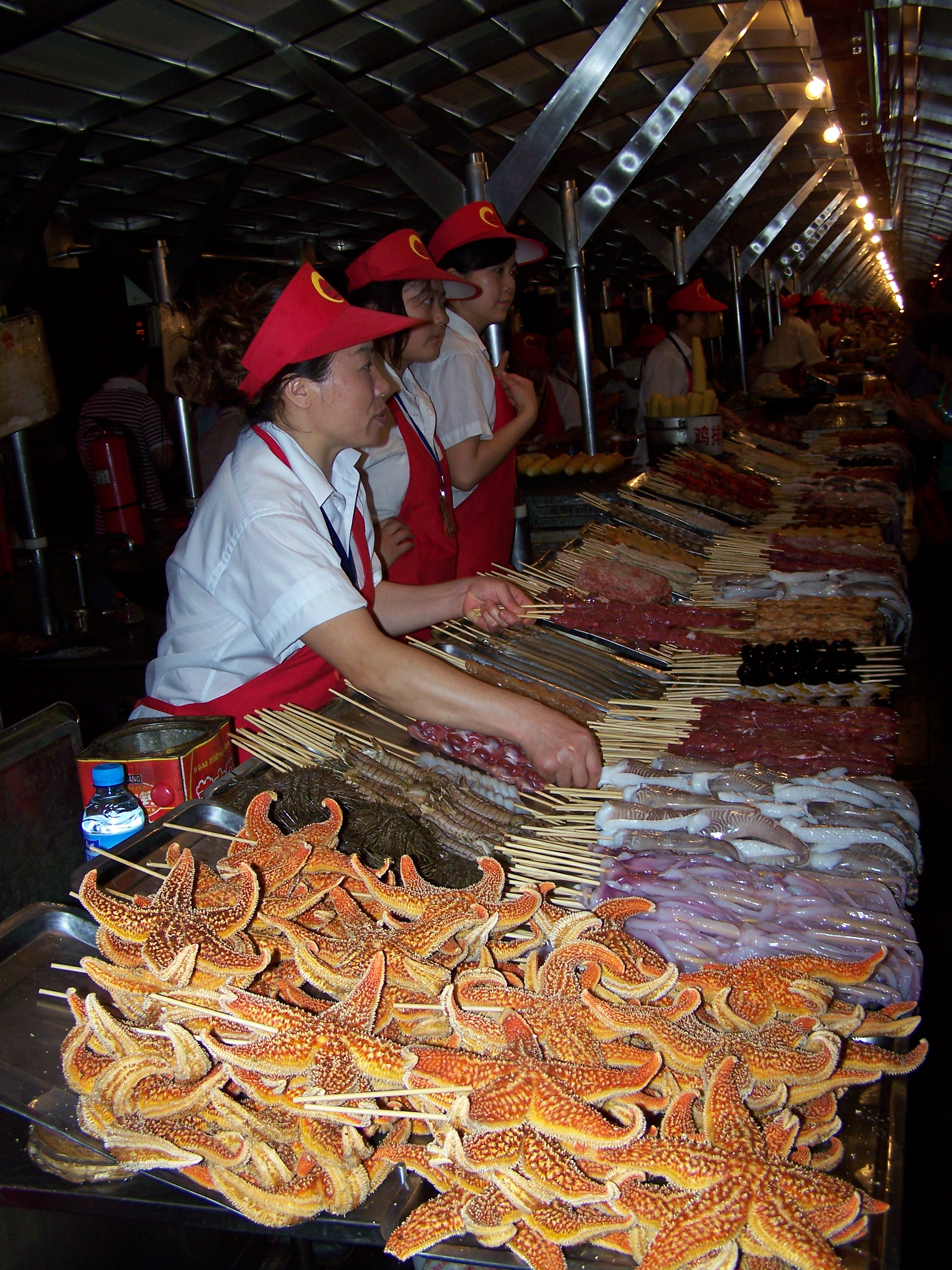
The difference between the two Beijing streets is crucial for planning an evening: on Guijie people eat sitting down, ordering full dishes in a restaurant, and allow an hour to an hour and a half for it, while Wangfujing is a “walk through and try” format, where in 30–40 minutes you can really go round the main stalls with takeaway skewers.
Xi’an: the Muslim Quarter
Huimin Street (回民街) is a historic Muslim quarter in the centre of Xi’an that unites several streets: Beiyuanmen, Beiguangji Street, Xiyangshi and Dapiyuan. After 18:00 the quarter lights up garlands of lanterns and turns into one of the densest night markets in the country in terms of food — they cite a figure of about 300 kinds of snacks here. It makes sense to move around the quarter purposefully: Xiyangshi is famous for paomo (a soup with crumbled flatbread) and its fried version, Beiyuanmen for steamed buns, and Dapiyuan for cold liangpi noodles. Besides food, spices, tea and souvenirs referring to the local Muslim culture are sold on Huimin Street.
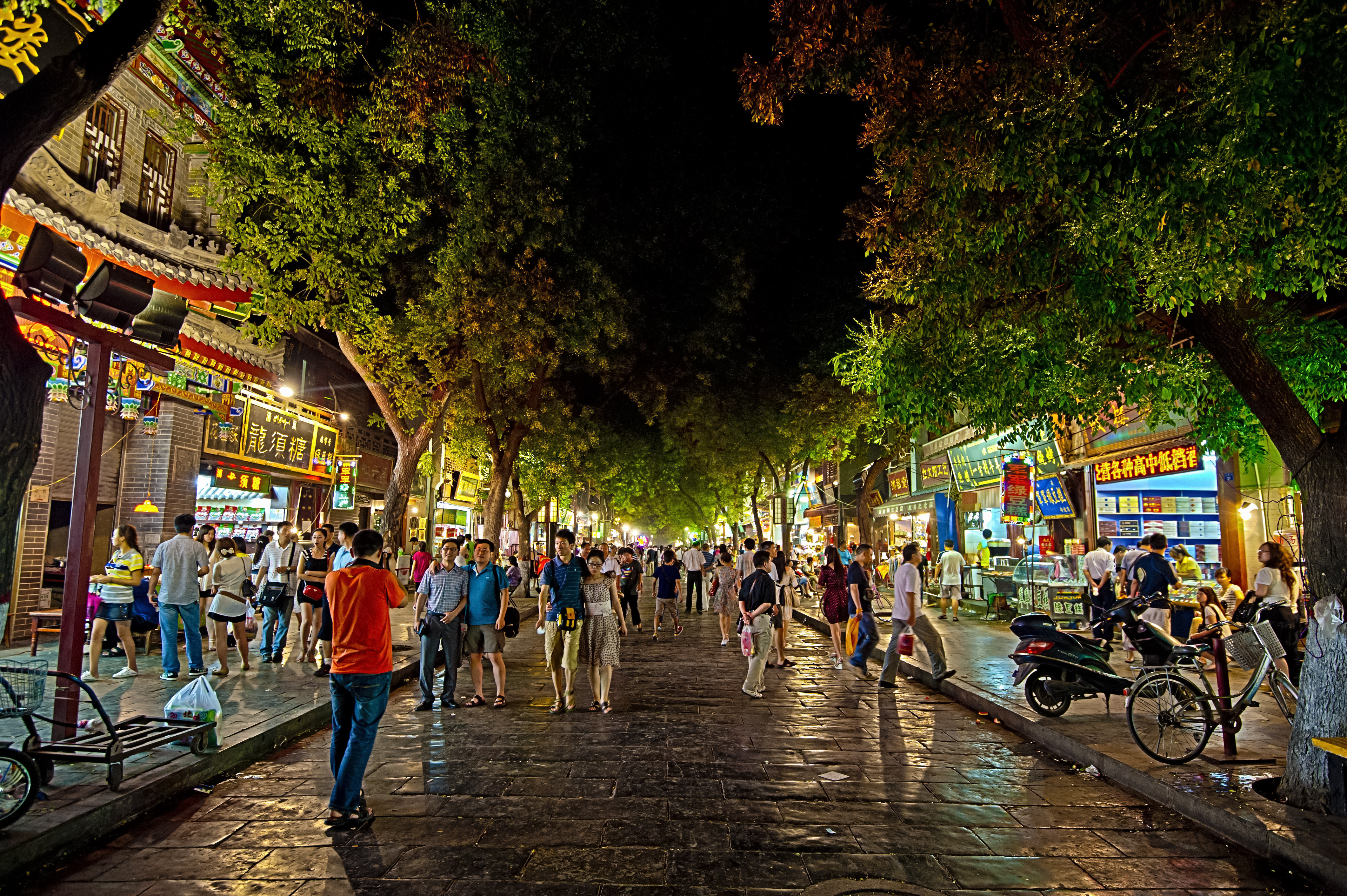
The quarter neighbours the Drum and Bell Towers in the very centre of Xi’an, so it is logical to build the evening as a pair: first the towers at sunset, then Huimin Street for dinner. Because of the compactness of the streets it is easy to get lost in the crowd here at weekends and on holidays — if you travel with children, it is worth agreeing a meeting point in advance in case the group is split.
Sanya: Hainan’s fish markets
In Hainan the night market format is shifted towards seafood. The “First Market” (第一市场, First Market) in Sanya grew out of an ordinary fish market and remains a place where you can yourself pick fish, prawns, crabs and shellfish at a counter and then hand the catch to a neighbouring little restaurant to cook — this scheme of “choose yourself — cooked in front of you” is the essence of the local night trade. Besides food, the First Market sells coconut carving, pearl jewellery and other local souvenirs.
The second most popular option is the night market by Dadonghai beach, divided into themed zones: grill and seafood, drinks, Taiwanese street food, jewellery rows and a children’s zone. For more on beaches, parks and the practical side of a holiday in Sanya see the separate guide to Hainan on AsiaRoutes.
The night market format in Hainan as a whole is noticeably less “street” than in Beijing or Xi’an: a considerable part of the venues are not stalls but proper open-air little restaurants with a hob on the tables, where seafood bought by weight next door is brought and cooked at the table. This is convenient for families with children — you don’t have to eat standing or on the go — but such a dinner usually costs more than a skewer from a stall in the north of the country.
Street food: what to try and how regions differ
Although the make-up of the stalls depends greatly on the city, there is a set of dishes found at almost any night market in the country:
- Chuanr (串儿) — lamb or chicken skewers generously sprinkled with cumin and chilli; a classic of northern China, especially Xinjiang and Beijing.
- Jianbing (煎饼) — a thin pancake with egg, spring onion, a crispy cracker inside and sauce, rolled into a convenient “envelope” for eating on the go.
- Tanghulu (糖葫芦) — hawthorn berries or other fruit on a skewer in a hard caramel glaze; the contrast of sour and sweet is a signature northern snack.
- Chou doufu (臭豆腐) — “stinky tofu”, fermented and fried to a crispy crust, with chilli and pickled vegetables; the smell puts people off, the taste is usually milder than you expect.
- Grilled or steamed seafood — dominates in coastal cities like Sanya, Xiamen or Qingdao: oysters, prawns, crabs, squid.
A general rule: the farther north the city, the more often lamb, noodles and flour products are on the menu; the farther south and closer to the sea, the more seafood and tropical fruit. A broader overview of the country’s cuisine is in the article “Food in China” on AsiaRoutes.
How a tourist should behave
Haggling. At markets with souvenirs and clothes haggling is the norm, especially where the price is not written explicitly. It is harder with food: street food often has a fixed price per portion or per skewer, and haggling is inappropriate — but you should always confirm the price BEFORE ordering, especially if the item is sold by weight.
Hygiene. A busy stall with a queue of locals is usually more reliable than an empty one — high turnover means products don’t sit around. It is sensible to avoid raw or half-raw seafood and drinks with ice from unverified sources, especially in the first days of the trip, until the body has adapted.
Souvenirs. The goods rows of night markets have many identical souvenirs wandering from one counter to another across the country — fans, magnets, silk scarves, jade crafts. A simple question to the seller, “where was this made”, helps tell a truly local item (coconut carving in Hainan, ceramics in Xi’an) from imported mass-market goods — often the seller himself will point to the mass source of the goods without hesitation if asked directly.
Payment. In China the main way of paying is Alipay and WeChat Pay QR codes, which even street traders use. A foreigner without a linked Chinese card should think through a payment method in advance — details and life hacks are gathered in the article “Payment in China”. Cash yuan at a night market still comes to the rescue: small points are not always ready to accept a QR from a tourist wallet, and change from a large note sometimes becomes a problem — it is worth carrying smaller notes.
Typical scams on tourists
Night markets are not the most dangerous place in China, but it is here that people most often try to profit from a tourist who has a poor grasp of prices.
| Scheme | The catch | How to avoid it |
|---|---|---|
| Sale by weight (斤, jin ≈ 500 g) | The price on the menu is given per 500 g, not per portion or piece — the final bill for seafood may turn out many times larger than expected | Ask for the total cost of the dish before the product is taken to the kitchen; watch the weighing |
| No price tags | At a stall without a price list the price for a tourist may be named several times higher than for locals | Ask the price aloud before ordering, go by what locals standing nearby pay |
| A “tea ceremony” near the market | Friendly students invite you to “practise English” and call you for tea — the bill ends up at hundreds of dollars | Politely decline offers from random “students” to go somewhere with them |
None of these schemes is unique to night markets — the same is found at tourist attractions across the country. The basic defence is one: ask the price aloud before ordering and don’t be shy about asking again if something is not shown explicitly.
A separate category of risks is not fraud but ordinary crush: at peak hours (after 19:00 at weekends) the density of people on popular streets like Huimin Street or Guijie is high, and this is worth bearing in mind if you travel with small children or have things you would be sorry to lose in a crowd. It is sensible to keep your bag and phone in front of you rather than behind — a general recommendation for any crowded place in Asia, not something specific to China.
When to go: time of day and season
The optimal window for a visit is from 18:00 to 21:00: the market has already fully opened and warmed up, but the peak of crowd density has not yet arrived. It is also worth coming right at the opening, around 17:00, if the aim is to have time to haggle in peace and photograph the still-empty rows before the influx of evening guests.
Seasonality is most noticeable in the north: in Beijing and Xi’an in winter (December–February) some street counters either close earlier than usual or move under awnings and into glazed pavilions — working in sub-zero temperatures in the open air is unprofitable for both sellers and visitors. In summer, on the contrary, the markets in the north work longer and are crowded almost until midnight. In Sanya the climate is even all year round, so seasonality there affects mainly the tourist flow rather than opening hours: in peak months (January–February, July–August) the First Market and Dadonghai are more crowded and more expensive than in the shoulder season.
Tourists’ impressions
On the whole reviews of China’s night markets agree on one thing: they are more about atmosphere and variety of flavours than perfect service — noisy, cramped, smoky from the grills, and there is a pleasure in exactly that. The “choose yourself at the counter — see how it is cooked” format at Sanya’s markets is regularly named by tourists as one of the most memorable impressions of Hainan — in few places in Asia can you so literally control the path of the food from the counter to the plate.
Frequently asked questions
Can I pay in cash at a night market in China?
Yes, cash yuan are still accepted almost everywhere, although the main way of paying remains Alipay and WeChat Pay QR codes. It is worth carrying notes of small denominations — there are sometimes difficulties with change at small points.
Do I need to haggle at a night market?
For souvenirs and clothes — yes, especially if the price is not shown explicitly. For street food haggling is usually inappropriate: most dishes have a fixed price per portion, and it matters more to confirm it in advance than to try to bring it down.
Which night markets in China are the best known for a tourist?
Among the most recognisable are Beijing’s Guijie (Ghost Street) and Wangfujing Snack Street, the Muslim Quarter Huimin Street in Xi’an and Sanya’s fish markets in Hainan, including the First Market and the night market by Dadonghai.
Is it safe to try street food at night markets?
Generally yes, if you follow simple rules: choose points with a queue of locals, avoid raw seafood and ice of dubious origin, especially in the first days of the trip.
Do night markets in China work all year round?
Yes, but the make-up and operating hours change with the season — in summer the markets usually work longer and more actively, in winter in northern cities some points close earlier or move into enclosed pavilions.
Conclusion
A night market is one of the most honest ways to understand how an ordinary Chinese city lives and eats: without an English menu, without a hotel markup, but with queues of locals and the smell of street grills. If you go without inflated expectations of service and with the habit of confirming the price before ordering, it is hard to be disappointed here — and trying more dishes in one evening than in a week of restaurants is quite possible.