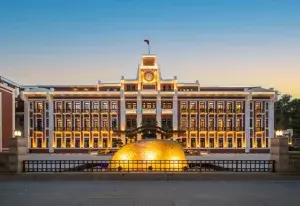
Nanjing Centre Hotel opened in January 1930 – among its guests during the Republican era were Zhou Enlai, Zhu De, opera star Mei Lanfang, and US Ambassador John Leighton Stuart.
Opened in January 1930 on Zhongshan East Road, this hotel has hosted Zhou Enlai, Zhu De, opera star Mei Lanfang, and US Ambassador John Leighton Stuart — a guest list encompassing figures from completely different eras of Republican China. Nanjing Centre Hotel retains the appearance of the 1929 building almost unchanged.
The 1929 Building on Zhongshan East Road
The hotel was built in 1929 and opened in January 1930 on Zhongshan East Road — one of the main thoroughfares of what was then the capital of the Republic of China, which at that time was Nanjing. The name itself on the building’s sign was written by Cheng Suyuan — a political figure from the Republican era, whose calligraphy has become part of the historical value of the structure.
Guests From Different Eras of Republican China
The list of documented hotel guests encompasses figures from completely different backgrounds: future Premier of the State Council of the People’s Republic of China Zhou Enlai and military leader Zhu De, the famous opera singer Mei Lanfang — one of the leading figures in 20th-century Peking Opera — and US Ambassador to China John Leighton Stuart. Such a diversity of guests speaks to the hotel’s status as a place where politics, diplomacy, and culture intersected in the Republican capital.
A Building That Survived a Change of Power
In 1949, with the establishment of the People’s Republic of China and the end of the era of the Republic of China, the building was neither demolished nor radically rebuilt — a rare fate for such structures in the context of the sweeping changes in ownership of that period. The hotel continued to operate, and a major restoration preserving its original appearance was carried out in 1995, with another update added in 2023.
Behind the Presidential Palace of the Republic Era
The hotel’s location – right behind the Presidential Palace of the Republic of China era, just 200 meters from Daminggung Metro Station – makes it a convenient base for exploring Nanking’s republican heritage, including the nearby Southern Library and Kesian Lane.
What Guests Say
Guests in reviews describe the hotel as “wonderful,” noting its Republic of China-style decor and convenient location right in the city center. One guest praised the wide selection of pillows but noted slight street noise as the only downside. Another guest honestly admitted to being worried about plumbing issues in a century-old building, but was pleasantly surprised by the comfortable water pressure and functioning drainage. One guest, who booked a room for a concert nearby, described the attentive service in detail – a fruit plate upon check-in, milk and cookies in the evening – noting only an uncomfortable pillow and occasionally unreliable air conditioning.
What’s Next
For a trip to Nanking by high-speed train, you’ll need this guide “China Train Stations: How Not to Confuse the Station in Beijing, Shanghai, Xi’an and Guangzhou”.
Prices, services included, and program details at the hotel may change – please check for current information before booking.