The Harbin Ice and Snow Festival: the world's largest ice park, built from 250,000 cubic meters of Songhua River ice. Dates, ticket prices, what to see and how to dress at −30°C.
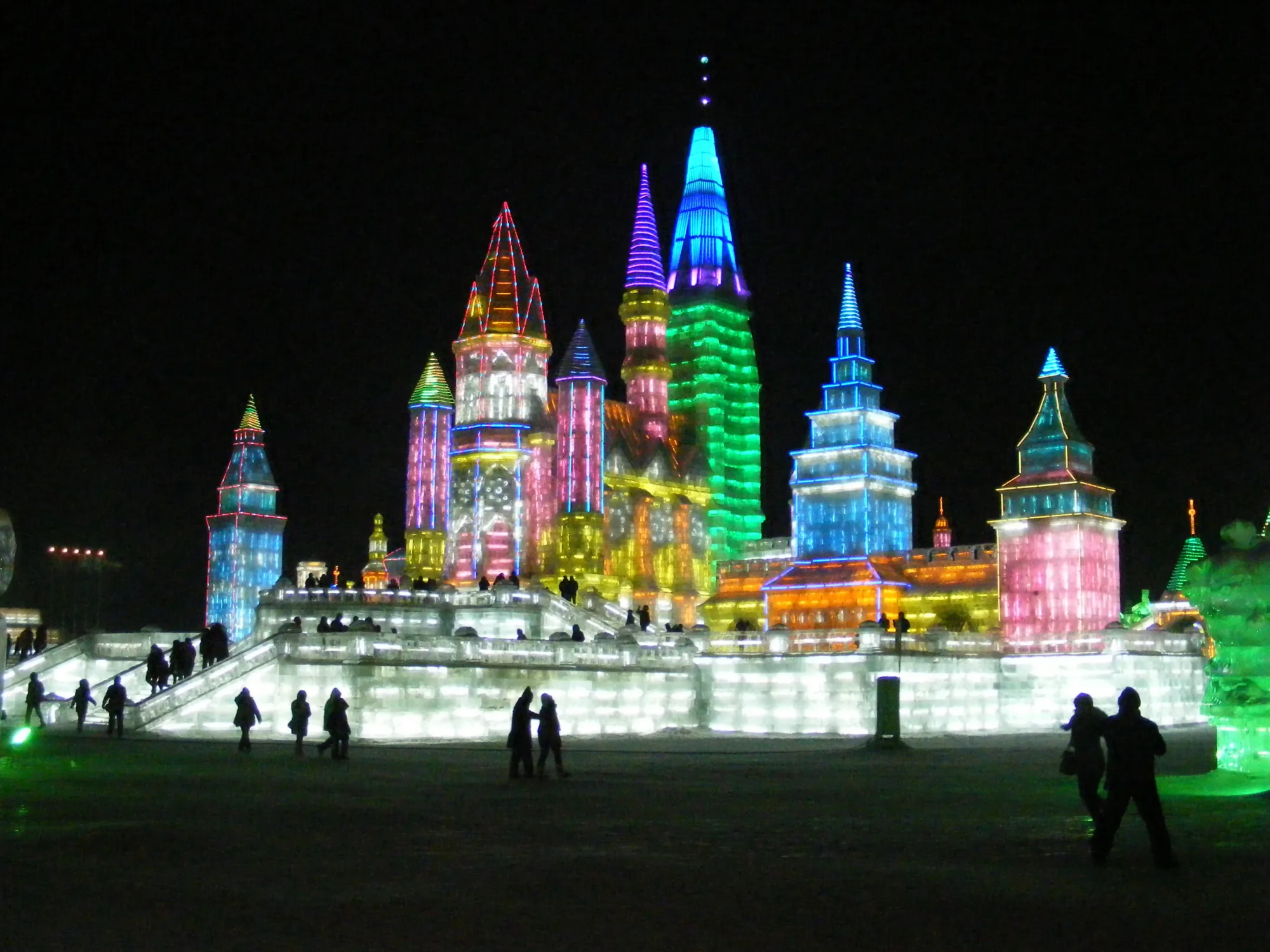
Minus twenty-eight on the thermometer, the steam from your mouth freezes faster than you can exhale, and all around is a whole quarter of translucent ice castles, lit from within in blue, crimson and green, as if someone had taken an entire city and carved it out of Songhua ice. This is not scenery and not a special effect: every winter in Harbin, in the northeast of China, a temporary city is literally built from river ice and compacted snow — with towers the height of a six-story building, slides, labyrinths and an ice opera where in the evenings performers appear in fur coats over their costumes. The Harbin Ice and Snow Festival is the largest event of its kind in the world, and seeing it at least once is worth enduring a real Siberian frost deep in mainland China.
From ice lanterns to a Guinness world record
The history of the festival began far more modestly than you might think looking at today’s ice skyscrapers. In 1963 the residents of Harbin — a city that Russian engineers built as a junction station of the Chinese Eastern Railway back in the late 19th century and which still preserves a surprisingly European historic center — began carving simple ice lanterns and placing them in parks, simply to brighten the long polar darkness a little. The tradition was interrupted by the Cultural Revolution, when any mass popular festivities fell under suspicion, and only in 1985 was the festival officially revived, already as a city festival. Since then the count has gone on for decades: the scale grew year by year, the sites expanded, engineered structures with internal lighting appeared in place of handmade lanterns, and the festival was eventually officially certified by the Guinness Book of Records as the world’s largest ice and snow park — a status that Harbin retains today.
How a city is built from a river
The most amazing thing in Harbin is not the scale of the finished sculptures but where they come from at all. Every December about three hundred workers — builders and nearby farmers for whom it is seasonal income — go out onto the ice of the Songhua River in a place where the current is slow and the water especially clear, and saw out blocks 60–90 cm thick by hand from the frozen surface of the river. In total about 250,000 cubic meters of ice are harvested in this way over a season — a figure that is hard to imagine until you see in person the trucks carrying ice blocks one after another from the river to the construction sites. Then the blocks are stacked on top of each other like a giant construction set, fastened, trimmed by hand and LED lighting is built inside — which is why in the evening the whole ice city doesn’t just turn white in the dark but literally glows from within in different colors, including the famous towers 40–50 meters high that can be seen several blocks away.
What to see: three fundamentally different parks
A mistake many tourists make is to come to Harbin for one day and try to fit everything in at once. In fact the festival is several separate sites of different character, and it is worth understanding the difference in advance. Harbin Ice and Snow World is the main and best-known area, working only after dark: this is where those very ice castles, towers and whole streets lit from within stand, the reason everyone goes to Harbin in winter. The Sun Island International Snow Sculpture Art Expo, located on an island in the middle of the Songhua, works by day and is devoted not to ice but to snow — here gigantic, sometimes many-meters-high sculptures are carved from compacted snow with no lighting at all, and this is the place to go for quality daytime photos. And in Zhaolin Park in the city center you can see a more intimate but most historic version of the festival — it was from here in 1963 that everything began with simple ice lanterns. The picture is rounded out by the pedestrian Central Street (Zhongyang Dajie) with cobblestones and early 20th-century European architecture, along which smaller ice sculptures are also placed in winter — a pleasant bonus for those who simply walk around the city between the main sites.
Tickets, timing and how not to turn the visit into a marathon in the cold
There is no single ticket for all the sites — entrance to Ice and Snow World and to the snow sculpture park on Sun Island is paid separately, and in practice almost nobody offers combined passes. The peak price of an adult ticket to Ice and Snow World is about 330 yuan, with VIP options with a shorter wait in the queue for popular attractions like the ice slides — from 988 yuan. A ticket to Sun Island with the snow sculptures costs less, about 198 yuan. The best time to visit is from January to early February, when all the sites are already working at once and the ice structures have reached their maximum size: in December, right after the opening, part of the exposition may still be unfinished. A sensible format for the visit is not to try to walk the whole park in one evening but to count on two to three hours per site with a break in a warm room, since prolonged time in a −30°C frost is physically tiring even in the right clothing.
How to dress so the festival doesn’t become an ordeal
Harbin’s frost is not the familiar “cold” but a full Arctic temperature, which most tourists from the warm countries of Asia have never prepared for at all. The basic rule is layering: thermal underwear next to the skin, a fleece or wool middle layer, and over it a down jacket rated for at least −30°C, not a city “winter” jacket from a temperate climate. Windproof, waterproof trousers over ordinary pants are a must, as are winter boots with high insulation and a non-slip sole (the ice paths in the park are literally made of ice), a balaclava or a mask covering the face, thick mittens — not gloves, since fingers in gloves freeze much faster — and protective goggles against the wind. Chemical hand and foot warmers, which in Harbin are sold literally on every corner, are not a tourist whim but a way to hold out outdoors for more than forty minutes. And a separate tip for those who wear glasses: in the cold the lenses instantly fog up and frost over when you enter a warm room, so keep a dry cloth at hand.
Practical tips
The most convenient way to get to Harbin is by plane — there are direct flights from Beijing, Shanghai and Guangzhou, with a flight time from Beijing of about two hours. From Taiping Airport to the city center it is about 40–50 minutes by taxi or express bus. It is better to stay near Central Street or close to it: from there you can walk to Zhaolin Park, and to Ice and Snow World and Sun Island you can get by taxi in 15–20 minutes. Tickets for the main sites in high season (especially for the Western New Year holidays and Chinese New Year) are sensibly bought in advance online, since on peak days there can be long queues at the ticket offices in the cold. And lastly: despite the harsh climate, Harbin is also a city with a rich Russian-Chinese architectural heritage, the Cathedral of St. Sophia and cozy coffee shops on Central Street, so even in the breaks between the ice parks you won’t be bored.
FAQ
When does the festival take place in 2026–2027? The main site, Ice and Snow World, usually opens around December 20–24, the official opening ceremony is in early January, and the park works until the end of February — the exact dates are announced each year closer to the season, so it is worth checking the current information before buying tickets.
How cold is it really there? The usual temperature at the height of the season is −25 to −30°C, on some frosty days the thermometer drops to −35…−40°C, and with wind it feels even colder — this is not the exaggeration of guidebooks but entirely real figures that you need to prepare for in advance.
Which park should I go to if my time is limited to one evening? Definitely Ice and Snow World — it is there that the ice castles and towers lit from within are located, the reason Harbin became world-famous, whereas the snow sculptures on Sun Island are better seen by day on a separate visit.
Do I need to buy tickets in advance? On peak dates — yes, especially for Chinese New Year and the Western New Year holidays, when long queues can form at the ticket offices in the cold; buying online in advance saves both time and nerves.
Can I go with children? Yes, Ice and Snow World has ice slides and easier attractions for families, but you should realistically assess a child’s endurance of severe frost and limit the time of continuous stay outdoors.
The opening dates, ticket prices and festival schedule may change from year to year — check the current information before your trip.
Harbin hotels: all hotels · near Central Street.