The 高铁 network is the world's biggest: up to 350 km/h, e-tickets, a passport instead of paper. A breakdown of carriage classes, boarding at the station and how to buy a ticket.
A high-speed train is the fastest and most predictable way to travel between Chinese cities. Beijing — Shanghai, more than 1,300 km, the train covers in about 4.5 hours — and allowing for the road to the airport, check-in and security this is often faster than a plane. A general overview of transport in China — city transport, taxis, what to install before the trip — is in the article transport in China: how to buy a train ticket and what else you need to know, which also has detailed step-by-step instructions for 12306 and Trip.com. Here is a separate practical guide specifically to 高铁 (gaotie, “high-speed rail”): how the network is arranged, how carriage classes differ, what happens at the station and how not to get confused by the letters G, D, T and K before the train number.
Scale and speed: figures worth knowing
China’s high-speed rail network is the biggest in the world: its length exceeds 50,000 km, which is more than 70% of all high-speed railway track on the planet. The network connects more than 50 large cities and grows by 2,000–3,000 km a year; by 2030 the authorities plan to bring it to 60,000 km as part of a total rail network of 180,000 km.
The flagship “Fuxing” trains (CR400) on dedicated tracks hold a cruising speed of 300–350 km/h — this is the speed at which most routes between big cities run, including Beijing — Shanghai. In individual tests trains have been accelerated higher, but in commercial operation the guide is 350 km/h.
A separate story is the Shanghai Maglev, a magnetic levitation train that carries passengers from Pudong airport into the city. It is the fastest commercial train in the world: in a special high-speed mode it accelerates to 431 km/h, although in the ordinary daily timetable it runs a little slower. The maglev has nothing to do with the 高铁 network — it is a separate 30-kilometre line, more of an attraction and a convenient transfer than part of the intercity network.
The network continues to develop: alongside the by-now familiar “Fuxing” trains China is testing next-generation CR450 trains, which have exceeded 450 km/h in tests — if the trials end successfully, the commercial speed of ordinary services may rise. For a tourist planning a trip now this does not change practice: buy a ticket and calculate journey time by the current 300–350 km/h, not by advertising headlines about records.
G, D, T, K: what the letters before the train number mean
The letter at the start of a train number is no accident but the type of train and, in essence, a promise of speed. For high-speed travel in China the first two rows of the table are of interest.
| Letter | What it means | Speed | Tracks |
|---|---|---|---|
| G — Gaosu (高速, “high speed”) | Flagship high-speed trains | 300–350 km/h | Dedicated high-speed lines |
| D — Dongche (动车, “electric multiple unit”) | Fast but not the fastest | 200–250 km/h | Often share tracks with ordinary trains |
| C — Chengji (城际, intercity) | Short suburban legs between neighbouring cities | 160–200 km/h | Mixed |
| Z / T / K | Ordinary trains: non-stop night, express, fast | up to 160 km/h | Ordinary tracks |
In practice a tourist almost always chooses a train with the letter G — it is faster, more modern and runs more often on popular routes. D is worth considering if there is no G train on the needed route or the tickets have run out: it is slower, but still a comfortable electric train, not an old-style open-plan carriage. Z/T/K is a different story: night trains with sleeping berths, relevant for long-distance destinations that 高铁 has not yet reached — a subject for a separate conversation.
How to buy a ticket: 12306 or Trip.com
The detailed step-by-step instructions — registration and passport verification in the official 12306 app, fees and payment with a Mir card via Trip.com — are already covered in the article transport in China, and there is no point repeating them in full here. Briefly on the difference for those choosing between the options:
| Method | Commission | Payment with a Russian card | When available |
|---|---|---|---|
| 12306 (official) | None | No, an international card is needed | After passport verification (from a few hours to 1–2 working days) |
| Trip.com | Yes, per ticket | Yes, Mir and SBP | Immediately after registration |
Both options give the same electronic ticket tied to your passport number — at boarding it is the passport that matters, not where the ticket was bought. One nuance worth considering already at the purchase stage: the choice of carriage class and seat affects the price more strongly than the choice of how to buy — we cover this below.
Carriage classes: second, first and business
Most G and D trains have three classes, and the difference between them is not only in price but in the very configuration of the cabin.
| Class | Seat layout | Price difference | What you get |
|---|---|---|---|
| Second (economy) | 3+2 per row | Base | A standard seat, the most affordable option |
| First | 2+2 per row | About 20–70% more expensive than second | A wider seat, more legroom, quieter |
| Business | 1+2, convertible seats | 3–5 times more expensive than second | A seat that reclines almost flat, access to a separate waiting area at the station |
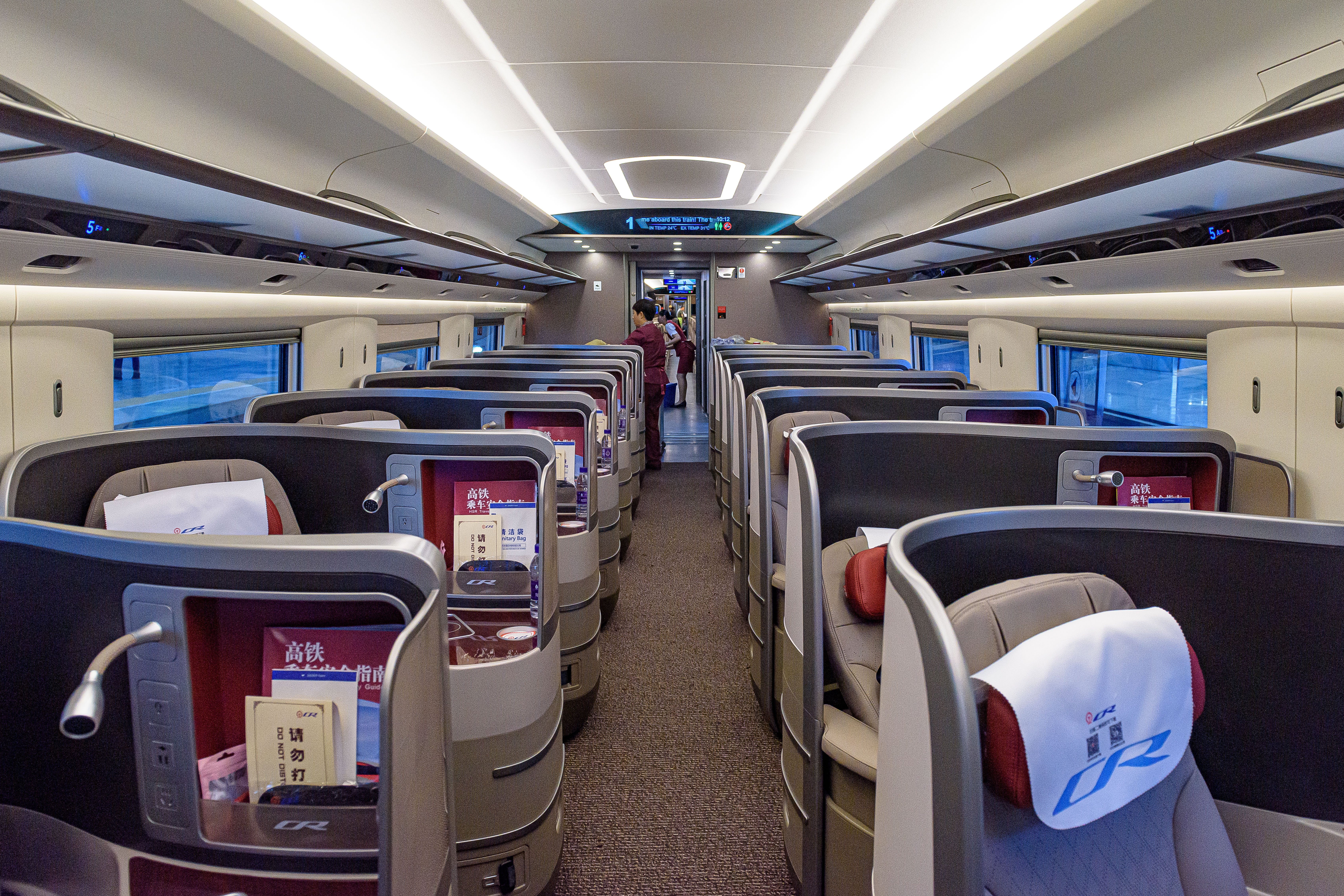
A money guide on the busiest route, Beijing — Shanghai: a second-class seat costs about 550 ¥, first class about 930 ¥. Business class on the same route is a figure of a different order, and people usually take it not for status but for the chance to get some sleep on a long leg like Beijing — Guangzhou (about 8 hours).
For most tourist routes second class is a perfectly normal choice: the seats are comfortable by the standards of a European train, and the difference from first class is felt mainly on legs of 4–5 hours. A supplement for first class makes sense to consider for long legs or if you travel with children, where an extra 10–15 cm of seat width and quiet really decide the matter.
On some routes between Beijing and Shanghai there is also a “premium first class” — an intermediate step between first and business, wider than ordinary first but without lie-flat seats. Such a ticket turns up not on every service and not on every route, so it is not worth relying on when planning — if you see this option when buying, treat it as a pleasant bonus rather than a separate strategy.
Boarding at the station: passport, security, not a single piece of paper
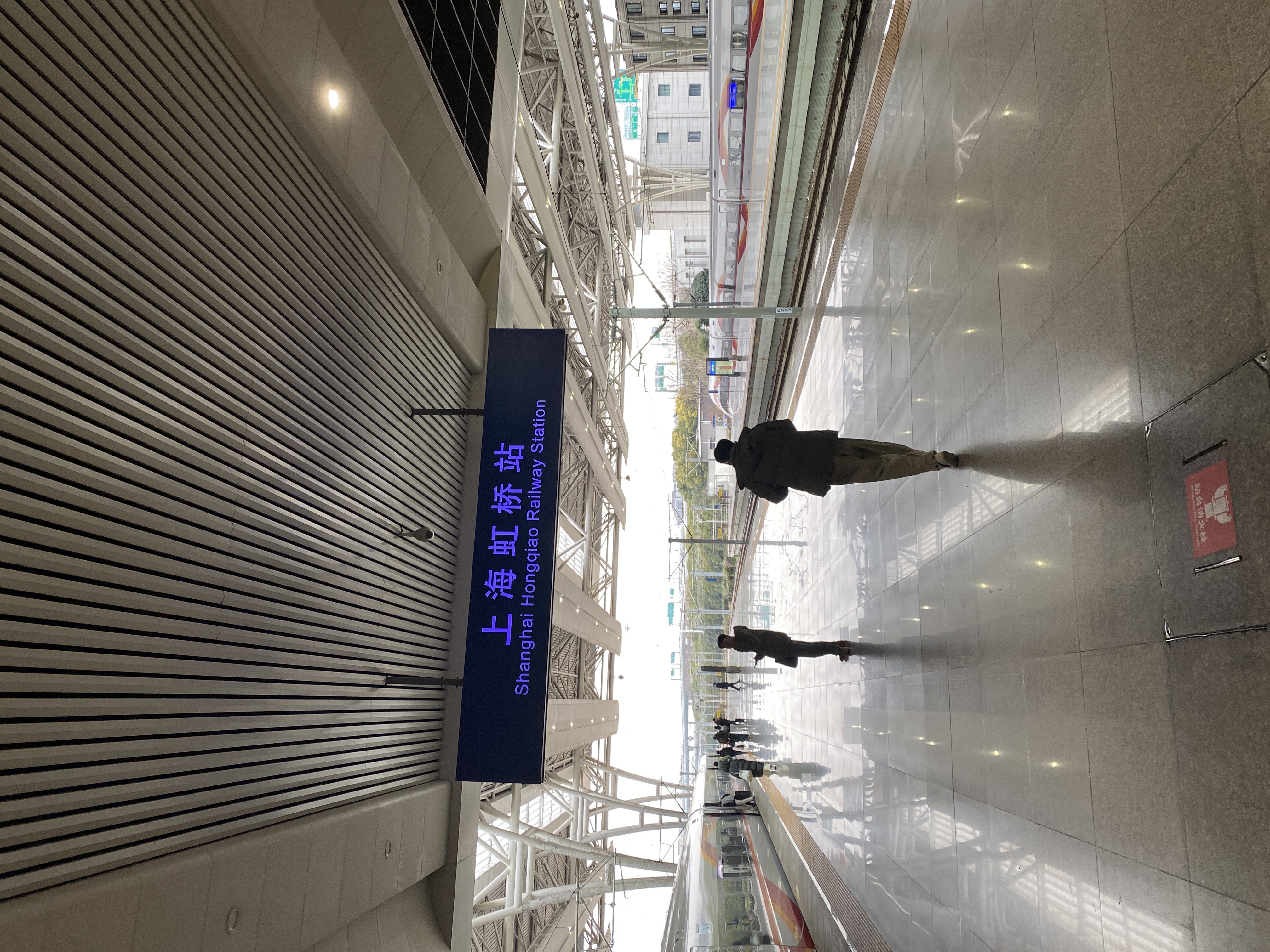
Tickets in China have long been all electronic — there is no need to print or keep a paper slip. At the entrance and on the platform you need to show one document — the same passport with which the ticket was bought. The turnstile system checks the passport directly against the electronic purchase record.
Then comes the typical route through the station:
- Arrive in advance. For an ordinary station an hour in hand is enough, but at large hubs like Beijing West or Shanghai Hongqiao (which are in effect separate terminals on an airport scale) allow 1.5–2 hours, and on holidays no less than 1.5 hours in any case.
- Security at the entrance. Baggage onto the X-ray belt, yourself through the metal-detector frame, sometimes a manual search is added. The procedure is similar to an airport’s, but usually quicker.
- Passport control at the turnstile. You tap your passport (sometimes together with a face scan) on the terminal, the turnstile checks the data against the ticket and lets you onto the platform.
- Boarding by time. The gates at the departure station usually open 15–30 minutes before departure, at intermediate stations about 15 minutes, and close a few minutes before the train leaves. A latecomer will not be let through the turnstile, even if the train is physically still standing at the platform.
Hand luggage — without any formal baggage check into a luggage van, everything travels with you in the cabin. A guide to the norms is a weight of up to 20 kg and a sum of dimensions within about 130 cm (the size of an average suitcase); flammable, explosive items and bladed weapons are forbidden, as on any public transport.
Practical tips: food, luggage, comfort on the way
Most G and D trains have a bistro car or a trolley with food and drinks that passes through the train several times during the journey — but the range is modest and designed more for a snack than a proper lunch. A sensible strategy is to pick something up at the station before boarding: the waiting halls of big stations usually have enough takeaway food points.
You may bring your own food and drinks on the train — it is not an airport with liquid restrictions. The only thing to remember is that strong smells (for example durian) in a closed carriage may be inappropriate, and some carriers directly ask that it not be brought on board.
The racks for hand luggage above the seats are designed for a smaller suitcase; for bulky things there are roomier racks at the entrance to the carriage. If you travel with a suitcase of 20+ kg or with two bags per person, allow slightly more time for boarding — you have to carry things in and find a place yourself, there are no porters on the platform.
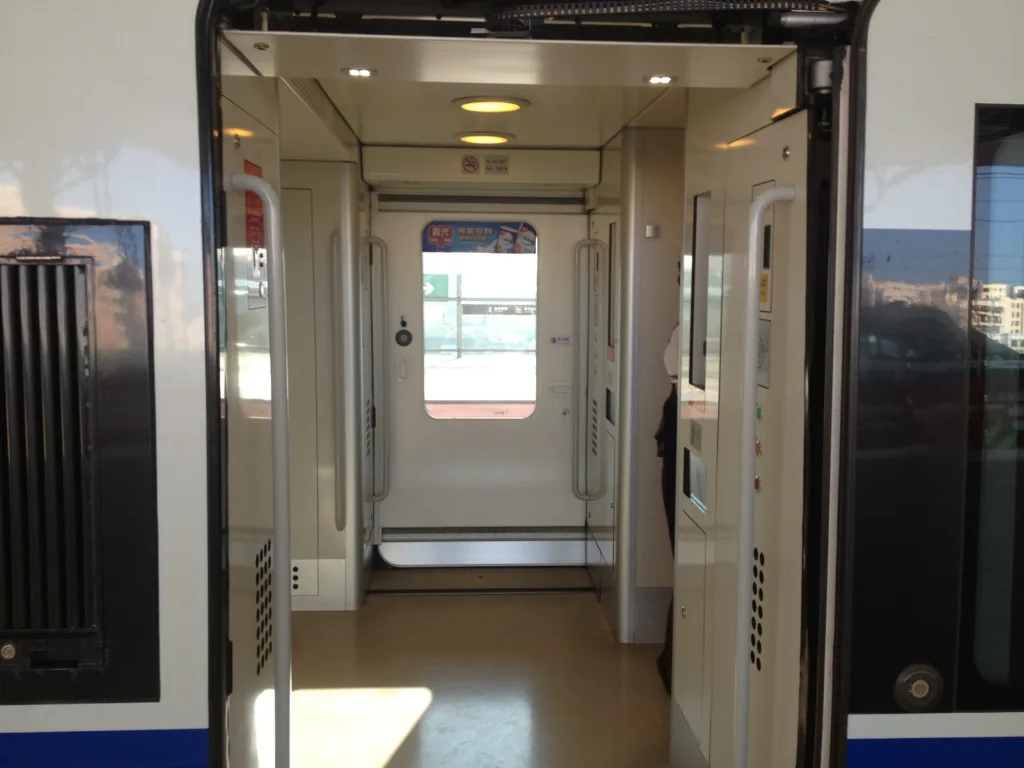
Most seats have a socket for charging a phone or laptop — usually near the window or in the armrest, but with a Chinese-style connector, so a compact adapter will come in handy on the trip not only in the hotel. Mobile coverage and internet on the way generally work, although at speed and in tunnels (and there are many on the routes) the connection may drop out for a few seconds — don’t count on video calls as something stable. There are toilets in every carriage, and a cooler with hot and cold drinking water in the vestibule between carriages: Chinese passengers actively brew noodles and tea right on the train, it is part of the local travel culture rather than a rarity.
Tourists’ impressions
For those used to railways in Europe or Russia, the main impression of 高铁 is not so much the speed itself as the smoothness of the ride and punctuality: the train departs and arrives on schedule to the minute, and at 300 km/h you can calmly work on a laptop or drink tea in the carriage without spilling it. According to travellers’ reviews, the most unexpected thing is “quieter than the metro”.
Among practical points tourists most often note the convenience of the process itself: there is no need to print a ticket, no need to check baggage in advance, and the huge stations that at first frighten with their scale are in fact well backed up by signs in Latin letters and platform numbers visible from afar. The second most popular observation is the contrast with expectations: many go to China wary of the language barrier, but the interface of ticket apps, the boards at stations and the announcements on the train are duplicated in English, so you can quite do without knowing Chinese — being able to show a booking QR code or a station name on your phone solves almost any hitch.
The only thing to be morally prepared for is the scale of the stations themselves. Beijing West or Shanghai Hongqiao are comparable in area and crowd to an average airport rather than to the station building familiar from Russia, and the first visit may slightly overwhelm. After one trip the logic of the station is read quickly — the waiting halls are grouped by train and gate numbers, and getting lost is harder than it seems at the entrance.
Frequently asked questions
Do I need to print a high-speed train ticket?
No. The ticket is electronic and tied to your passport number — it is the passport that is presented at the turnstile. A paper version is required neither at the entrance nor on the way.
Can I just go to the ticket office and buy a ticket on the day of travel?
Technically yes, with a passport at the ticket office of any station. But on popular routes like Beijing — Shanghai tickets for the day of departure, especially at weekends and on holidays, are often already sold out online. For G trains it is more reliable to buy in advance through 12306 or Trip.com.
Which carriage class to choose for a first trip?
Second class is a normal choice for most routes lasting up to 3–4 hours. First class makes sense for longer legs or if quiet and extra centimetres between rows matter to you.
What happens if I am late for departure?
The turnstiles and gates close a few minutes before the train leaves; after that you cannot get onto the platform, even if the train is still visible. A ticket for a missed train, as a rule, is forfeited — rebooking is possible only in advance, before boarding closes.
Can I bring food and drinks on board?
Yes, there are no restrictions on liquids as on a plane. There is an unwritten rule to avoid strong-smelling products like durian in a closed carriage.
How is a high-speed train better than a plane over short distances?
On routes up to 4–5 hours long (for example Beijing — Xi’an or Shanghai — Hangzhou) the train often wins on total journey time: stations are usually closer to the city centre than airports, and check-in and security take minutes rather than an hour and a half.
Is there Wi-Fi on the train and does mobile internet work at speed?
Some trains have free Wi-Fi, but the quality is unstable. Mobile coverage generally works, but at high speed and in tunnels, of which there are many on the routes, short interruptions are possible — don’t plan the trip around an important video call.
Can I change a seat or return a ticket after buying?
Yes, both 12306 and Trip.com offer returns and exchanges of tickets, but some time before departure and usually with a small fee — the rules and exact deadlines are worth checking in the app at the time of purchase, as they change periodically.
What next
Before booking tickets, make sure the formalities are settled: the visa-free regime for Russians and its conditions are in the article China visa, and ways to pay on the spot, including the same online ticket purchase, in the article payment in China. For the rest of transport inside cities — metro, taxis, DiDi — see the general guide transport in China.