Sanya, in the south of Hainan Island, has established itself as Asia’s main “beach hit” for Russians: direct charter and scheduled flights go from Moscow, Yekaterinburg, Novosibirsk, Irkutsk and Krasnoyarsk, the flight takes 8–10 hours, and on arrival a passport and a return ticket are almost all you need. Hainan has visa-free entry for up to 30 days; in practice this is arranged through the host side (a travel agency or a hotel that submits the group list), so a package tour or a confirmed hotel booking greatly simplifies passing the border. A separate visa for a short holiday is not required.
The weather decides half the success of the trip. September is hot (+30…+32 °C by day), humid, the water is +29 °C, but this is still the tail end of the typhoon season: there may be days with a wall of rain, and on beaches open to the ocean (above all Haitang Bay) — big waves and rip currents. October is still rainy: by the climate norm about 236 mm of precipitation and 13–14 rainy days at +31 °C by day, but air humidity falls and the sea stays warm (about +28 °C). November begins the dry season: precipitation of about 74 mm, about +30 °C by day, the sea about +26 °C; one of the most pleasant months for the beach. Month-by-month details are in the article “Weather in Sanya by Month”. December–February is the peak season: sunny, +22…+27 °C, but in January the north wind arrives, the water cools to +22…+24 °C, and swimming becomes “bracing” for many; meanwhile hotels are at their most expensive, and at New Year and the Chinese Spring Festival prices and occupancy are at their maximum. March–April are again comfortable and drier than summer; May sees the heat build (+31…+33 °C) with high humidity. June–August is the hottest and most humid time (about +32 °C by day, humidity 84–85%), with frequent thunderstorms and downpours and a growing risk of typhoons.
Hence a simple logic: if you want warm sea and a minimum of surprises — aim for November or March–April (dry months with a warm sea); if you travel in winter for the sun and to “escape the minus” — take a bay sheltered from the wind and don’t count on long swims in January; if you travel in September — choose a bay with a gentle entry and calm water, not the open ocean.
And then the main fork arises: Sanya is not one beach but four very different bays, stretched across almost 60 km along the coast. They differ in water, prices, atmosphere and distance from the airport so much that a mistake in choosing the bay can spoil the whole holiday. Let’s go through each.
A brief geography of Sanya: how the resort is laid out
Sanya Phoenix International Airport (SYX) is located on the western edge of the city, on the shore of Sanya Bay. From here to the bays:
- Sanya Bay — 5–15 minutes, taxi ¥30–50.
- Dadonghai — 20–30 minutes, taxi ¥55–75.
- Yalong Bay — 35–50 minutes, taxi ¥90–120.
- Haitang Bay — 45–60 minutes, taxi ¥130–170.
Prices are approximate, by the meter, season 2026/27; more expensive at night and at rush hour. There is always an official taxi at the terminal exit; cashless payment through Alipay/WeChat gives an honest fare, while for cash they sometimes ask for more. The Chinese analogue of Yandex Taxi — the DiDi app (with an English interface) — works fully, and you can call a car right from the hotel.
Public transport is cheap: city buses 8, 25, 27, 28, 29 link the airport, Sanya Bay, the centre and Dadonghai, fare ¥2–10. To Yalong Bay and Haitang Bay the most convenient are express buses or the high-speed railway: a ring line (环岛高铁) has been laid around the island, with three stations within Sanya — Sanya (near the centre and Sanya Bay), Yalong Bay and Haitang Bay. The train between them takes 8–15 minutes and costs ¥10–25, which in winter traffic is faster and cheaper than a taxi. A fast ring road runs along the coast, so transfers between bays are predictable in time outside rush hour.
Sanya Bay: proximity to the airport, sunsets and a budget holiday
Features of the area and the beach
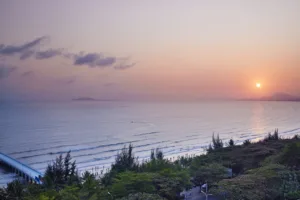
Sanya Bay has the longest coastline in Sanya, about 22 km of continuous beach from the airport almost to the city centre. Along the whole bay stretches a pedestrian park zone with coconut palms — the famous “Coconut Dream Corridor”. An important nuance: the strip of sand here is narrow, the palms grow along the embankment rather than at the water itself, and there is little shade on the beach. The water is shallower and murkier than in the eastern bays, the entry is sandy and very gentle — a long way to walk to deep water. But from here opens the best view in the city of the Phoenix Bridge and the “sails” of Phoenix Island lit up in the evening, and sunsets over the water are the area’s calling card.
Pros and cons
| Pros | Cons |
|---|---|
| The cheapest accommodation and food in Sanya | Shallow, somewhat murky water |
| 5–15 minutes from the airport | A noisy seaside road along the hotels |
| Many shops, pharmacies, markets, cafés | Little shade on the beach, a narrow strip of sand |
| Developed city infrastructure nearby | Windy in winter — it “blows you off” the beach |
Infrastructure and entertainment
Within walking distance is Luhuitou (“The Deer Turned Its Head”) Park on the cape of the same name: a viewing platform with a giant deer statue and a panorama of the whole city, lit up in the evening. In the evenings along the Coconut Corridor stalls and small night markets spring up with fruit, coconuts, kebabs and souvenirs. The large Seafood Market No. 1 (First Market) and the “duty-free” shopping quarter near the centre are 10–15 minutes by taxi. Russian-speaking travel agencies, exchange offices and clinics are also concentrated here.
Top 3 current hotels in Sanya Bay, 2026–2027
- Sanya Phoenix Island Resort & Spa — that very complex of “sails” on a man-made island at the river mouth, formally on the border of Sanya Bay and the centre. A large room stock, interiors of luxury “on a Chinese scale”, a spa, several restaurants, pools with a view of the city. Its own beach is narrow, and swimming is more comfortable in the pool. A booking nuance: some of the complex’s towers are privately owned apartments rented through intermediaries, so you should book only the hotel building itself through trusted systems, checking that it is a hotel room and not an “apartment from the owner”. Suitable for those who value a status view and a city location over a “beach” holiday.
- Pullman Oceanview Sanya Bay Resort & Spa — a large chain resort of an international brand (Accor) on the first line of Sanya Bay: a large territory, several pools, a spa, a kids’ club, panoramic rooms with views of the sea and sunset. Meals are buffet breakfasts and several restaurants on site, with street cafés and food courts around. A good balance of “international 5* quality for reasonable money for Sanya”; suitable for families and couples who need a predictable chain hotel without paying extra for the prestige of the eastern bays. From the same range in Sanya Bay are DoubleTree by Hilton Sanya Bay and Four Points by Sheraton Hainan Sanya Bay.
- Vienna Hotel (Sanya Bay) / Metropolis Hotel (Sanya Bay Coconut Dream Corridor) — typical representatives of the dense cluster of budget chain hotels along the Coconut Corridor (Vienna is a large mid-level Chinese chain, Metropolis a local 4*). Small but clean rooms, breakfast included on some rates, 3–7 minutes across the road to the beach. Meals are off the premises, in neighbouring cafés and food courts. This is the choice for independent tourists and those who want to spend their budget on excursions and seafood rather than the hotel.
Dadonghai: the Russian soul, city bustle and parties
Features of the area and the beach
Dadonghai is a compact bay within the city limits, south-east of the centre. The beach is about 1 km, the sand is yellow-golden, the entry is a bit steeper than at Sanya Bay, the water is clearer but still urban — the embankment, road and dense development are right alongside. The atmosphere is “Hainan of the nineties and noughties”: lots of signs in Russian, cafés with Russian menus, massage parlours, fruit stalls. This is the area most settled by Russian tourists, where it is easy to communicate and not feel lost.
Pros and cons
| Pros | Cons |
|---|---|
| Many cheap cafés and Russian-language service | Cramped, crowded, little privacy |
| City centre, everything within walking distance | Water cleaner than Sanya Bay but murkier than the eastern bays |
| Clearer water than at Sanya Bay | Almost no real luxury on the first line |
| Easy to get to and leave | City noise, can be loud at night |
Infrastructure
Within walking distance is the Summer Mall (Xiadu) shopping centre with shops, a cinema and a food court, dozens of seafood restaurants (the classic scheme: you buy fish/prawns/lobsters at the market, and they cook them for you at a café for a separate cooking fee), pharmacies, exchange offices and massage salons. From here it is close to the centre of Sanya, the Sanya River embankment and the “duty-free” quarter. A good base for independent trips around the island — the bus station and city bus routes are nearby.
Top 3 current hotels in Dadonghai, 2026–2027
- JW Marriott Hotel Sanya Dadonghai Bay — essentially the only full-fledged top-level international 5* within walking distance of Dadonghai beach. A modern high-rise building, panoramic rooms with a view of the bay, a rooftop pool, a spa, several restaurants, a club floor. The beach is across the road and the park zone. Suitable for those who want international service and a sea view but still want to live in the centre, not in the “resort reservation” of the eastern bays.
- Mandarin Oriental, Sanya — located not in Dadonghai bay itself but on the closed Xiaodonghai cape between Dadonghai and Yalong Bay, 10 minutes by taxi. This is a secluded luxury resort with villas, private coves, an award-winning spa and one of the best services on the island. An option for couples and those who want quiet and a high class but with the possibility of getting to Dadonghai’s city life in 10 minutes.
- Pearl River Garden Hotel Sanya or Vienna International Hotel (Sanya Dadonghai) — solid 4*-level city hotels deep in the area, 5–10 minutes’ walk from the beach. Pearl River Garden is a large resort complex with a pool and garden, Vienna a compact chain option. Breakfast on some rates, with all of Dadonghai’s infrastructure around. A choice for active tourists who only sleep in the hotel and spend the day on excursions, in cafés and on the beach.
Yalong Bay: reference beaches, white sand and the premium segment
Features of the area and the beach
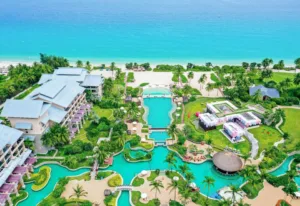
Yalong Bay is a “national resort area”, 25 km east of the city. A horseshoe-shaped bay about 7 km long with the whitest and finest sand on the whole coast, a gentle entry and the cleanest, clearest water in Sanya. Along the beach are coconut palms and a well-kept park strip, and the development consists only of hotels, with no city bustle. This is where people are taken for “postcard” photos of Sanya’s beach.
Pros and cons
| Pros | Cons |
|---|---|
| The best sea and beach in Sanya | The highest prices for accommodation and food |
| Top international brands nearby | “Dead” in the evening — all life is inside the hotels |
| Clean, well-kept, safe | Far from the city (taxi ¥90–120, ~40 minutes) |
| Gentle entry — good with children | Few budget options |
Infrastructure
In the area are the Sanya Aquarium, the “Tropical Paradise Forest Park” (Yalong Bay Tropical Paradise Forest Park) with suspension bridges and viewing platforms (part of the film “If You Are the One” was shot there), several golf courses, and the Yalong Bay shopping gallery with restaurants and shops. For eating outside the hotel the choice is modest and not cheap — most guests dine at their resorts’ restaurants or order delivery.
Top 3 current hotels in Yalong Bay, 2026–2027
- The Ritz-Carlton Sanya, Yalong Bay — classic “palatial” luxury: colonnades, large lagoon pools, an extensive territory, a strong Ritz Kids club, a spa, several fine-dining restaurants. First line, gentle entry to the water. Ideal for families with children and those who want a “flawless classic five-star” without experiments.
- Hilton Sanya Yalong Bay Resort & Spa — one of the largest resorts in the bay by area: an extensive green territory, a series of connected lagoon pools, a wide choice of restaurants and bars, a spa, a kids’ club. Suitable for those who like to “get lost” on the grounds, with many pools and activities — both families and groups. Of the same level in Yalong Bay are Sanya Marriott Yalong Bay Resort & Spa and Sheraton Sanya Yalong Bay Resort.
- The St. Regis Sanya Yalong Bay — intimate luxury with St. Regis’s signature butler service, refined interiors, private poolside cabanas and one of the best beach stretches in the bay. More of an “adult”, romantic vibe. Let us note separately two common misconceptions: The Sanya EDITION and Grand Hyatt Sanya are located not in Yalong Bay but in Haitang Bay — don’t mix them up when booking.
Haitang Bay: 免税 (Duty-Free), giant resorts and hot springs
Features of the area and the beach
Haitang Bay is the newest and most “showy” area, 30+ km north-east of the city. The coastline is long and straight, the hotels stand on huge plots, and there are kilometres between neighbouring resorts. This is Hainan “on a Las Vegas scale”: the largest duty-free shop in China, CDF Mall (Haitang Bay International Shopping Complex), has been built here. An important warning: Haitang Bay’s beach is open to the ocean, the entry drops quickly to depth, and in September–October swimming here is genuinely dangerous — big waves, rip currents. In these months you should swim only in hotel pools or go to sheltered Yalong Bay.
Pros and cons
| Pros | Cons |
|---|---|
| The newest and most luxurious resorts on the island | Dangerous swimming in autumn (waves, rip currents) |
| Water parks, aquariums, huge territories | Everything is very far: 45–60 minutes from the airport |
| China’s largest duty-free | Complete isolation — almost nothing outside the hotel |
| Space, few people on the beach | The highest total trip spending |
Infrastructure
The main attraction is CDF Mall: perfume, cosmetics, watches, bags, alcohol and jewellery at prices below the mainland’s; under the Hainan duty-free quota a tourist can take out a significant amount of goods a year (the limit changes periodically, check on the spot). Nearby are the Nantian Hot Springs (Nantian Hot Spring): a large park with several dozen pools of different temperatures and mineralisation, where people are taken for half a day or a day. Some resorts have water parks and aquariums (see the hotels below).
Top 3 current hotels in Haitang Bay, 2026–2027
- Atlantis Sanya — the best choice in Sanya for families with children. On site are the Aquaventure water park with slides, the The Lost Chambers aquarium with tunnels and tens of thousands of fish, a lagoon with marine life, and a separate kids’ club. It is logical to come here precisely in September–October: while the ocean storms, children spend the day in the water park and pools. The room stock is huge, there are many restaurants, but both prices and crowds in season are high.
- Rosewood Sanya — the opposite pole: a quiet, designer resort for adults and couples. Large rooms and villas with terraces, private pools in some categories, a world-class spa, a calm long stretch of beach, gastronomic restaurants. There is no children’s entertainment or “action” here — people come for seclusion, style and service.
- The Sanya EDITION — a fashionable resort of the EDITION brand (Marriott) with minimalist design, a famous huge lagoon pool with islets, bars and an “adult” evening vibe with music. Popular with young couples and those who follow trends. As alternatives of the same level in Haitang Bay — InterContinental Sanya Resort (a lagoon resort, privacy), Grand Hyatt Sanya Haitang Bay Resort & Spa (a huge territory, architecture), Sheraton Sanya Haitang Bay Resort, Sofitel Sanya Leeman Resort.
Comparison table of the bays
| Bay | Beach and water | Prices (2026/27) | Who it suits | From the airport |
|---|---|---|---|---|
| Sanya Bay | A long narrow beach, shallow, somewhat murky, little shade; the best sunsets | € (low) | Budget, independent travellers, transit, lovers of city life | 5–15 min |
| Dadonghai | An urban beach of ~1 km, average water, slightly steeper entry | €–€€ | Russian-language service, the centre, parties, economical holiday | 20–30 min |
| Yalong Bay | The reference: white sand, clear water, gentle entry | €€€ (high) | Premium, families with children, the “perfect sea”, calm | 35–50 min |
| Haitang Bay | A long open beach, deep, dangerous in autumn; new resorts | €€€–€€€€ | Luxury, water parks, duty-free, isolation, the “hotel city” | 45–60 min |
Tips for 2026–2027: how to pay, call a taxi and communicate without knowing Chinese
Payment. Russian and any Visa/Mastercard cards do not work in China — neither in terminals nor in ATMs. A working scheme:
- In advance, while still in Russia, install Alipay and/or WeChat Pay, pass verification with your international passport and link a card. A card of the UnionPay international payment system issued by Russian banks can be linked to Alipay/WeChat (it is offered, in particular, by Gazprombank, Rosselkhozbank, Primsotsbank, Solidarnost and a number of others — check the current list before the trip). Inside Alipay there is also a “tourist” mode, Tour Pass, with a prepaid balance.
- You need to do this at home: in China the traffic filtering system turns installing apps and receiving an SMS code into a quest of its own. Test the setup before departure with a small payment.
- Keep a reserve of cash yuan with you (withdraw at the airport on arrival with a UnionPay card or exchange). Cash is accepted everywhere, while card linking doesn’t work for everyone — you need to understand this in advance and not tie the whole trip to it.
- On the spot, almost everywhere you pay by QR code: you show your code to the cashier or scan the seller’s code and enter the amount.
Transport. Install DiDi — the Chinese analogue of Yandex Taxi with an English interface; payment by linked card or cash to the driver, route and price visible in advance. At hotels and sights there is also always an ordinary metered taxi.
Navigation. Google Maps does not work correctly in China. Download offline Maps.me (or Organic Maps) maps in advance in Russia, and for online navigation and building transport routes — the Chinese Amap (Gaode / 高德地图): it has a basic English mode and knows everything about local buses and metro-like lines.
Language. For translating on the go, the most convenient is the built-in translator with a camera in WeChat (point it at a menu or sign) or a translator app with an offline Chinese pack. Staff at hotels in the eastern bays speak English, in Dadonghai often Russian, and at markets and in small cafés — by gestures and through the phone.
FAQ: tourists’ common questions about Sanya
Can you swim in Sanya in January 2027? Yes, but with reservations. The air by day is +22…+26 °C, sunny, but the water cools to +22…+24 °C and feels cool to many, especially in the morning and with a north wind. In January it is most comfortable in the sheltered bays — Yalong Bay and Dadonghai; at open Sanya Bay it is windy. You can sunbathe and go into the water; long swims are a matter of taste.
Are jellyfish dangerous in September? Isolated burns from stinging jellyfish are possible in the warm months, more often after rains and on “urban” beaches (Sanya Bay, Dadonghai). Deadly species near Sanya are extremely rare. Hotel beaches usually have barrier nets and a first-aid kit with table vinegar (which neutralises a burn). In Yalong Bay, thanks to the clean flowing water, there are noticeably fewer jellyfish.
Which bay should a family with small children choose? For swimming — Yalong Bay (gentle entry, clean water, calm sea). For a “hotel-entertainment” — Haitang Bay, Atlantis Sanya (a water park and aquarium inside). Dadonghai and Sanya Bay suit children in terms of infrastructure, but the water there is murkier.
Is it worth going in September? You can, if you understand the risks: heat, humidity, possible rainy days and the tail of the typhoon season, and at Haitang Bay dangerous waves. The pluses are prices below peak and a warm sea. The optimal strategy for September: stay in Yalong Bay or in a hotel with a big water park/pools and watch the forecast.
How do I get between bays without a taxi? Between the Sanya — Yalong Bay — Haitang Bay stations a high-speed train runs (8–15 minutes, ¥10–25) — in winter traffic it is the fastest and cheapest way. Plus express buses and city routes 8, 25, 27, 28. Within a bay — DiDi or an electric scooter rental.
Do I need cash yuan if I have Alipay? Yes, definitely keep a reserve. Linking UnionPay cards to Alipay/WeChat doesn’t work for everyone and can “fall off”; cash is accepted everywhere, and at small cafés and with street vendors it is sometimes the only option.
Hotels by bay: Sanya hotels · Dadonghai · Yalong Bay · Haitang Bay · Sanya Bay.
Air and sea temperature, rain and typhoon risk by month — in the article “Weather in Sanya by Month”.