钟点房 is Asia's youngest and fastest-growing love hotel format: western- and wuxia-themed rooms, the We Love Hotel chain in Shanghai and an honest nuance about registering a foreign passport.
A bed shaped like a gondola, a bathtub with a screen for watching a series right in front of the rim, a room decorated after a classic wuxia novel with swords on the wall — Chinese “hourly rooms” (钟点房, zhōngdiǎnfáng) are younger than their Japanese and Thai counterparts, but are growing faster than both: an industry that did not exist fifteen years ago has over the last decade spread from Shanghai and Beijing into cities of a much smaller scale in the country’s central provinces.
An industry that didn’t exist a decade and a half ago
The format of hourly room rental for couples in China is a relatively new phenomenon by the region’s standards: mass spread began only in the 2010s, whereas the Japanese and Thai counterparts have existed since the 1960s–70s. Nevertheless growth has been rapid — themed hotels for couples open not only in Shanghai and Beijing but in cities of far smaller scale: for example, in 2015 such a hotel opened in Zhuzhou, Hunan Province — a city hard to call a tourist centre. This indicates that demand comes from within Chinese society itself, not tailored to foreign tourists — above all from young couples, students and office workers who simply have no separate housing in which to be alone.
Themed rooms — the Chinese version of the genre
As in Japan, visual excess is part of the format, but with its own recognisably Chinese set of references. In the rooms of the Shanghai chain Ai Zhi Yuan Movie Hotel (Jing’an district) you can find western suites with cowboy hats and saloon swing doors or, conversely, erotically charged interiors with red velvet and wooden panels — prices here start from 90–350 yuan for a three-hour block and 200–700 yuan for a night. Nearby, at the Houhai Theme Hotel, about 60 rooms are designed in themes from “Pirates of the Caribbean” to abstract light installations, and at the same city’s Man Zhi Ya Theme Hotel there is a whole line of rooms with references to ancient Roman aesthetics. The media also record themes more specific to the region — rooms after “Titanic” with a bed on a miniature copy of the ship or “Tarzan”-style rooms with a replica treehouse, found in hotels of the format outside the capital cities.
We Love Hotel: a chain whose name leaves no questions
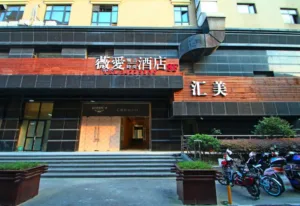
Among dozens of local venues the We Love Hotel chain stands out — with several branches across Shanghai and, importantly for a foreign guest, real listings on Trip.com. The branch on Wujing Road in the Minhang district is a three-star hotel with romantically decorated rooms, soft lighting and baths with a TV right in front of the rim, “to watch a series while bathing”, as the chain itself describes it. The second branch, on Taopu Road in the Putuo district, is more compact — 41 rooms with air conditioning and cable TV, the same emphasis on privacy instead of classic hotel service.
A practical detail that is important to know in advance
PRC law on the administration of entry and exit obliges hotels to register a foreign guest’s passport data and transmit it to the local public security bureau within a day of check-in. Formally, all legally operating hotels are obliged to accept foreigners — since May 2024 the relevant PRC agencies have directly forbidden refusing foreign guests on the pretext of lacking a “permit to receive foreigners”. In practice, however, many small budget establishments of this specific format — including some themed hotels for couples — simply lack the software and trained staff to enter a foreign passport into the registration system, because of which they may refuse not out of ill will but for technical reasons. That is exactly why for a foreign guest it is safer to choose larger chain options like We Love Hotel, already integrated into the usual international booking systems, than to walk “off the street” into a small local establishment.
FAQ
Will a foreigner be let into such a hotel with an international passport? Formally yes, the law requires foreign guests to be accepted everywhere, but in practice some small establishments refuse because they lack the technical ability to register a foreign passport — chain hotels like We Love Hotel, available on Trip.com, are more reliable in this sense.
How does the Chinese format differ from the Japanese and Thai? Above all in the age of the industry (mass growth began only in the 2010s) and the theming of the rooms — here references to Western pop culture (westerns, “Titanic”) and Eastern historical subjects are more often found at once, rather than a single architectural tradition as in Japan.
Is it true that such hotels exist even in small cities? Yes, and this distinguishes China from the other countries of our series: the format has spread far beyond Shanghai and Beijing, down to cities like Zhuzhou in Hunan Province — demand comes from the local population, not from the tourist flow.
Can I book a room online in advance? At chain establishments like We Love Hotel — yes, through Trip.com; at smaller local hotels booking more often goes through Chinese services like Meituan or Dianping, which are less convenient for a foreigner without the language.
Prices and conditions may change — check the current information with the specific hotel before your trip.