A guide to the MINISO chain in China for tourists: what to buy, how much it costs in yuan, what makes the MINISO LAND flagship format notable and how MINISO differs from its competitor Nome.
The bright red MINISO (名创优品) signs are found in China on almost every corner — in shopping malls, near subway stations, in airports. For a tourist it is one of the most convenient sources of inexpensive souvenirs, cosmetics and household odds and ends: you go in for 15 minutes “just to look” and come out with a bag of purchases. This article covers what the chain is, what is worth buying there, how much it costs in yuan and where to go for the biggest selection.
What MINISO is and why it is worth a look
MINISO is a Chinese retail chain in the “designer department store at low prices” format: cosmetics, accessories, home goods, stationery, toys and collectible figures under one roof. The format is similar to Japanese fixed-price stores (DAISO) and in part to MUJI, but with a much wider range of licensed collaborations and “blind boxes” — because of which the chain has become popular with collectors around the world in recent years.
The advantage for a tourist is that MINISO is practically everywhere: in shopping malls, near subway stations, at train stations and airports, on pedestrian tourist streets in the centers of large cities. You don’t need to look for a store specially — it will almost certainly turn up on the way between two attractions. It is a convenient place to settle the question of souvenirs and small gifts without spending a separate day on it, and at the same time to pick up a forgotten small item like a charger, an umbrella or travel cosmetics.
The history and scale of the chain
The chain was founded in 2013 in Guangzhou by the entrepreneur Ye Guofu — the first store opened in a basement space, and he formulated the idea of the format under the impression of Japanese specialist stores of inexpensive quality goods. Growth was rapid: within the first year the number of points passed 300, by 2015 it passed 1,000, and in the same year the chain entered the international market with a store in Singapore.
Today MINISO Group is a public company: since October 2020 its depositary receipts have traded on the New York Stock Exchange (ticker MNSO), and since July 2022 the shares have also been listed on the Hong Kong Stock Exchange (code 9896). The overwhelming majority of stores operate not directly but under a franchise — which partly explains why the chain spread so quickly through the malls and streets of Chinese cities.
According to the group’s financial statements, at the end of 2025 the chain had 8,485 stores worldwide, of which 4,568 in mainland China under the MINISO brand itself and 3,583 abroad. The company states a long-term goal of a network of 10,000 stores by 2027, with more than 70% of the new points opened in 2025 coming in overseas markets: MINISO is clearly betting on international growth, not only on saturating the Chinese market.
MINISO LAND — flagship stores of the new format
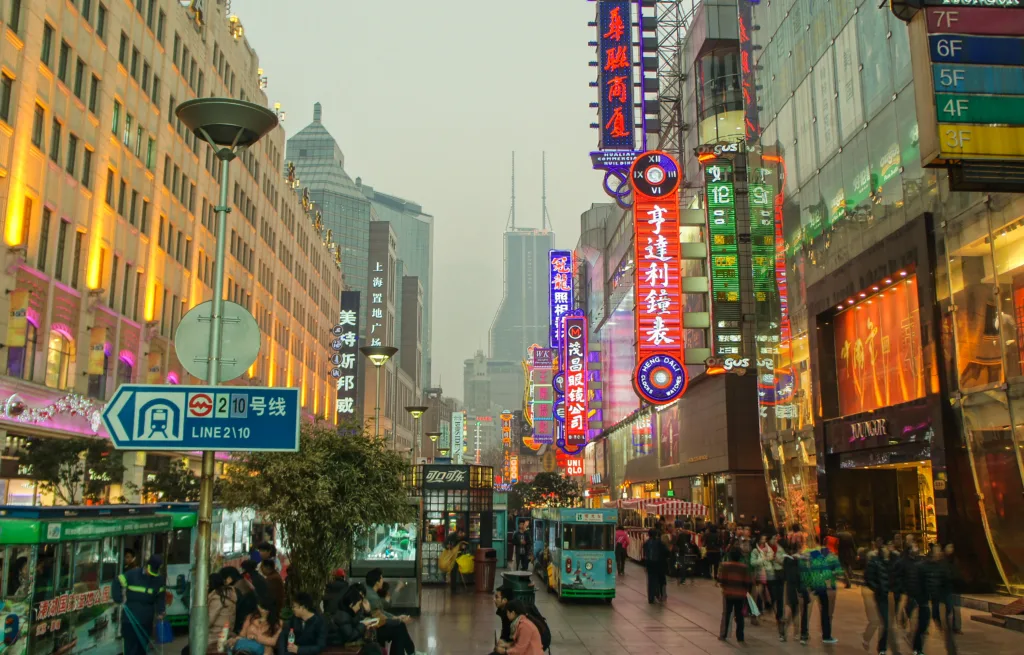
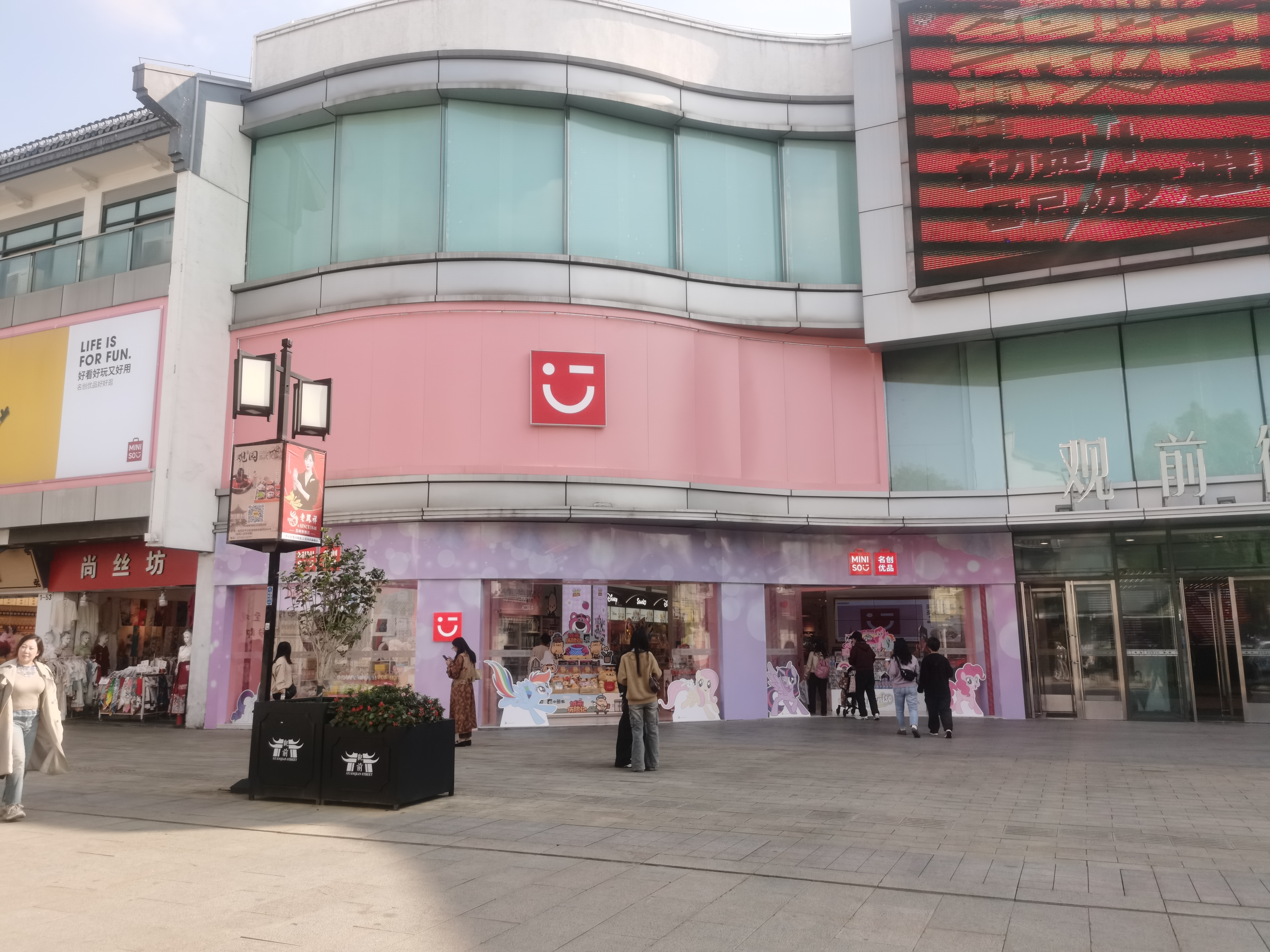
Besides the ordinary small points, the chain has a format of large flagship stores, MINISO LAND — with an expanded assortment, themed zones for individual licenses and a more museum-like, “immersive” interior design. The first and best-known such store opened in November 2024 in Shanghai on East Nanjing Road (No. 479, Huangpu district) — a pedestrian tourist street in the very center of the city, a couple of minutes’ walk from the East Nanjing Road subway station (lines 2 and 10). The store occupies three floors with a total area of about 2,000 sq. m and is positioned as the world’s first fully “IP-immersive” flagship of the chain.
In such stores, besides the usual assortment, separate zones are set aside for specific licenses (anime, pop culture, children’s franchises), there are more exclusive and limited items, and themed window displays and photo zones. The design of the Shanghai flagship has already been noted at professional architecture awards — the store was built not simply as a retail point but as part of the brand’s marketing strategy of turning a shopping trip into entertainment in itself.
The chain has also opened similar large-format stores in other cities and countries — for example in Vancouver and Toronto, on the same “store as an attraction” principle with thousands of SKUs and collaborations with several licenses at once. If on your way you come across a sign that is not an ordinary MINISO but specifically MINISO LAND or MINISO SPACE, it is worth looking in: there is usually the widest selection of collaborations and the only chance to find limited series that will not be in an ordinary store near your home.
What to buy: categories and prices
MINISO’s assortment rests on a “budget” pricing policy — historically the chain was built around items at 10 yuan, and a significant share of items still cost around that. Approximate price ranges by category:
| Category | Examples of goods | Price, yuan |
|---|---|---|
| Small accessories and stationery | hair ties, keychains, pens, stickers, makeup bags | ≈ 10–20 |
| Home goods | mugs, organizers, textiles, small tableware | ≈ 15–40 |
| Cosmetics and skincare | masks, brushes, mini perfume, hair products | ≈ 20–50 |
| Small electronics | headphones, cases, power banks, desk lamps | ≈ 30–100 and up |
| Blind boxes and figures | collectible series by license | from ≈ 39 and up |
The yuan-to-ruble rate fluctuates, so it makes sense to convert into rubles right on the spot at the current rate — the sums in yuan do not change, and an exact conversion quickly goes out of date. According to the chain’s own statistics, the overwhelming majority of goods in Chinese stores cost less than 50 yuan, so the budget for a “run” through MINISO usually turns out modest, unless you get carried away with the collectible series.
Among practical categories, what a tourist finds most useful are travel odds and ends: folding umbrellas, power banks and cables, travel kits for cosmetics, washing and carrying liquids in hand luggage. Among souvenirs — everything with recognizable characters: mugs, keychains, badges, soft toys and stationery with prints. Seasonal and limited lines deserve a separate look — for national holidays, major film premieres or franchise anniversaries the chain releases capsule collections that will be gone from the shelf in a month.
Collaborations and blind boxes: why it is addictive
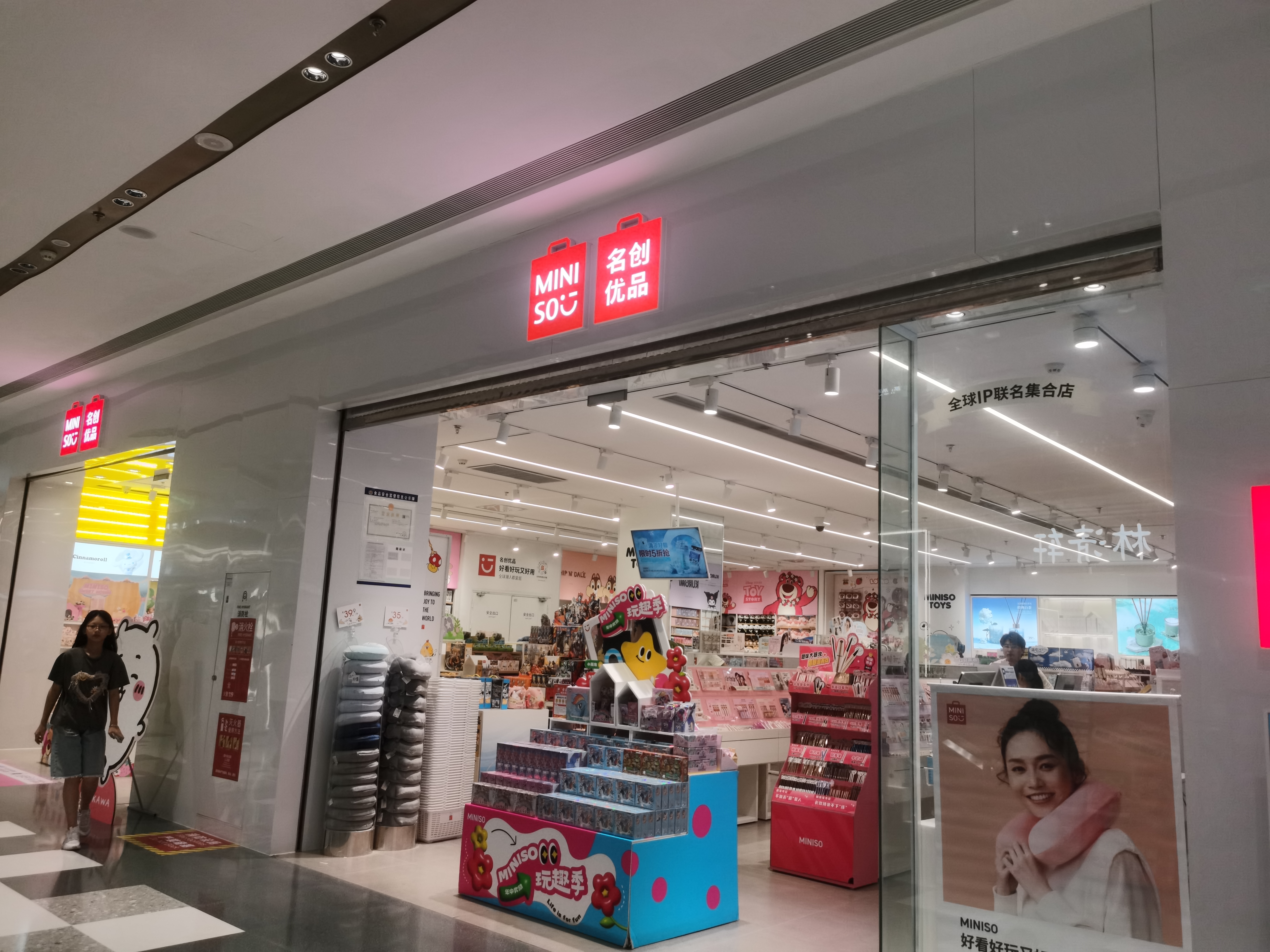
MINISO is actively developing licensed collaborations — according to the company’s own data, the chain has partnerships with more than 150 well-known brands and universes, including Disney, Sanrio (Hello Kitty, Kuromi and other characters), Chiikawa, Harry Potter, Barbie and Snoopy. The assortment for specific licenses is regularly updated and differs from store to store — in the MINISO LAND flagships and themed pop-up points the choice is always wider than in an ordinary small point in a residential district.
A separate and very noticeable part of the assortment is blind boxes: collectible figures and mini toys packaged so that the specific variant from the series is not known in advance. The format has become one of the chain’s key growth drivers in recent years and works on the same collecting thrill that made the whole blind box genre popular in China in general (in this segment MINISO has plenty of competitors, the best known of which is Pop Mart). If you are not planning to collect a whole series, be prepared that walking away with a single box rarely happens: the excitement of “what if this very one has the rare variant” pulls you in quickly.
A practical tip: if a particular collaboration interests you in advance, it is worth checking the assortment on social media or on the chain’s official website before the trip — the lines are sold in limited runs and sell out first in flagship stores and in large cities, while in small points the character you want may simply not be there.
MINISO vs Nome: what is the difference
On the same shelves of China’s inexpensive home goods market the NOME (诺米) brand operates — also recognizable, also in a close price category, but with a more pronounced emphasis on Scandinavian minimalist style in home goods and textiles, whereas MINISO bets on licensed collaborations and collectible items. The two brands do have a shared and rather tangled history: in 2018 there was a trademark dispute between the companies over the rights to the NOME name, and in 2020 MINISO sold its stake in the NOME business to structures linked to the chain’s founder Ye Guofu — that is, today it is an independent competing brand, not a MINISO sub-brand.
The practical conclusion for a tourist is simple: if you need souvenirs, collectible figures and something with a recognizable character first of all — that is MINISO; if you are interested in more restrained home goods and textiles — it is worth looking into NOME too, since both formats often sit side by side in the same malls. In the same malls you will almost certainly find Pop Mart as well — MINISO competes with it not on home goods but precisely for the buyer of blind boxes and collectible figures, so if you like you can compare prices and assortment in one walk through the floors.
What shoppers say
In tourist and shopper reviews MINISO is most often described as “a store where it is easy to get stuck for half an hour”, with a large choice of small things for gifts and for yourself — from stationery and accessories to cosmetics and electronics in the recognizable designs of characters like Hello Kitty, Kuromi or the Minions. The store is often called a little paradise for those who like assorted trinkets and don’t mind touching everything before buying.
Among the downsides the same thing is regularly mentioned: in popular stores in tourist zones and malls there are noticeable queues at the checkouts and crowding in the aisles, especially on weekends and during the launch of new collaborations. Separately, keep in mind that MINISO is the mass segment: the quality of the goods is exactly what you expect from an inexpensive chain, with no pretensions to premium, and this matches the expectations of most shoppers, who come in for a cute trinket rather than an item for years.
A practical checklist before going to MINISO
- Bring a means of payment that definitely works in China — cash yuan or a mobile payment (details in our guide to paying with Alipay and WeChat Pay in China).
- If you are looking for the widest selection of both collaborations and blind boxes, go for the large MINISO LAND / MINISO SPACE flagships in big cities rather than the first small store you come across.
- Ask about current promotions at the checkout — the chain regularly runs promos on specific categories and series.
- For large purchases it makes sense to keep receipts and check the tax-free conditions — how this works in China is covered in the article on tax-free for tourists.
- If you are collecting a series of blind boxes, decide the budget in advance — the collecting thrill pulls you in faster than it seems.
- It is convenient to look for the first point near subway stations in the city center or in a big mall — Nome and Pop Mart stores are usually right nearby if you want to compare formats.
- If you are heading to MINISO LAND specifically, allow an hour to an hour and a half for the visit, not 15 minutes as for an ordinary point of the chain.
Questions and answers
What country is the MINISO brand from?
MINISO is a Chinese brand founded in 2013 in Guangzhou by the entrepreneur Ye Guofu. In its first years the chain was deliberately promoted with Japanese design positioning, because of which many took it for Japanese — but after a public scandal in 2022 the company officially apologized, called itself a Chinese brand and by 2023 removed the Japanese styling from its marketing.
Is MINISO a Japanese brand?
No, despite the Japanese style of the name and design, MINISO is a Chinese company founded in Guangzhou in 2013. A significant part of the brand’s aesthetics really is inspired by Japanese fixed-price stores, but the company itself and production are in China.
Can I pay at MINISO with foreign cash or a card?
In ordinary stores in China, including chain points like MINISO, the main way for a tourist to pay is cash yuan or mobile payments (Alipay/WeChat Pay); international cards are not accepted everywhere. More in the article on payments in China.
Is it worth going specially to MINISO LAND on Nanjing Road in Shanghai?
If you are walking along Nanjing Road anyway — yes, it is worth looking in: it is the chain’s largest flagship format with the widest choice of themed zones and collaborations. Of course, there is no need to go to Shanghai for this one store alone.
What are blind boxes and why are they at everyone’s checkout?
A blind box is a format of collectible figures packaged so that the specific variant is not known in advance. It is one of the most popular and fastest-growing segments of MINISO’s assortment in recent years, designed around the collecting thrill.
How does MINISO differ from Nome if both stores are next to each other in the same mall?
MINISO is first of all licensed collaborations, accessories and collectible figures; Nome is more focused on home goods and textiles in the Scandinavian style. Both brands are historically linked through MINISO’s founder, but now operate as separate competing chains.
Does a visit to MINISO take a lot of time?
A small point by the subway is looked over in 10–15 minutes, but a large flagship like MINISO LAND in Shanghai easily takes an hour or more — it has several floors, themed zones and simply more people, especially on weekends.
Does MINISO sell only Chinese goods, or are there imported brands?
The main assortment is the chain’s own developments and goods under the MINISO brand, made at Chinese factories; alongside them on the shelves are licensed lines from collaborations with foreign and Japanese IPs. It is not a multi-brand store but the showcase of a single chain with its own goods and licenses.
In brief
MINISO is not a must-see item on the program, but a convenient one: the chain turns up on your way in practically any Chinese city, and the assortment covers souvenirs, small gifts and spontaneous purchases for yourself all at once. If you want to see the format in all its glory — look for a MINISO LAND flagship; if you just need a couple of souvenirs along the way, any point of the chain will do.