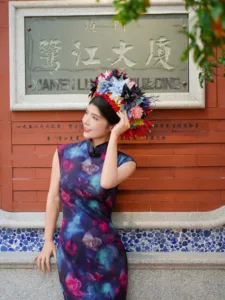
Xiamen Lujiang Harbourview Hotel — a 1958 hotel on Xiamen’s waterfront, the last major project of philanthropist Tang Kah-ke, built in his signature “Kah-ke” style with views of Gulanyu Island.
Three years before his death, one of the most influential philanthropists in the Chinese diaspora of the 20th century built a hotel on Xiamen’s waterfront, which was then the tallest building in the city. Xiamen Lujiang Harbourview Hotel is not just a hotel with views of Gulanyou Island, but the last major project of Tang Kak Kee, a man nicknamed “Henry Ford of Malaya.”
“Henry Ford of Malaya,” Who Invested in Education
Tang Kak Kee was born in 1874 in Fujian province and at the age of 16 moved to Singapore to join his father. Starting with pineapple preserves after the collapse of his father’s rice business, he eventually built a conglomerate based on rubber – plantations, processing, shipping, export trade and real estate throughout East and Southeast Asia, employing more than 10,000 people by the 1920s. He earned the nickname “Henry Ford of Malaya” precisely for the scale and industrial approach to business. But Tang Kak Kee entered Chinese history primarily not as a businessman, but as a philanthropist: in 1919 he founded Xiamen University at his own expense – one of the first modern universities in China, and in 1937 he organized a homeland relief fund during the war with Japan, which collected about 10 million Singapore dollars.
The Last Project and Signature Architectural Style
Lujiang Hotel — one of the last major projects by Tan Kah Kee, completed in 1958, just three years before his death. The building on the Amoy-Bund waterfront is constructed in what’s known as the “Kah Kee style” (嘉庚风格) – a recognizable architectural signature where traditional Chinese decorative elements are layered onto a Western structural framework; a characteristic feature of the facade is the stone balconies that extend directly over the strait and Gulangyu Island. The same style distinguishes the first buildings of the Xiamen University he founded, as well as the 1963 Singapore Chinese Chamber of Commerce building – Tan Kah Kee’s architectural signature literally crossed the ocean along with his capital.
From Monument of an Era to a Hotel with Protected Status
At the time of its construction in 1958, the hotel was the tallest building in Xiamen — a notable detail for a city where Tan Kah Kee was simultaneously erecting the university campus. Later, during the new era of Deng Xiaoping’s reforms, Lujiang Hotel became one of the first three hotels opened in Xiamen to receive guests. In 2013, the building was granted protected architectural monument status, and restoration work was carried out strictly according to principles of preserving its historical appearance — including the characteristic floral-patterned tiles in the interiors, typical of “Nanyang” (Southeast Asian) style buildings of the Chinese diaspora.
What Guests Say
The main thing that guests consistently note is the view of Gulangyu directly from the windows and balconies of the historic rooms: Shuzhuang Garden and Ziguan Mountain Rock are visible as if in the palm of your hand, and the car-free island reserve itself remains one of Xiamen’s most atmospheric corners. The hotel is valued precisely for this rare combination — not a museum reconstruction, but a functioning hotel almost seventy years old right on the waterfront.
What’s Next
Another hotel in China whose architecture tells the story of changing eras in the country is Jin Jiang Hotel in Shanghai, where the Sino-British Joint Communiqué was signed.
Prices, room availability and service composition may change – please check for current information before your trip.