Comparing Thailand's amusement parks: Dream World and Safari World in Bangkok, the Ramayana and Cartoon Network Amazone water parks in Pattaya, Vana Nava in Hua Hin and the Phuket FantaSea cultural show — what to choose and when to go.
Thailand has no Disneyland of its own — instead the country has bet on a different format: large water parks with record-setting wave pools, safari parks with animal shows and the “Thai Disneyland”, Dream World, whose nickname says more about ambition than about real scale. For a family trip around Bangkok, Pattaya or Phuket, amusement parks here are more one day among many than a purpose of the trip in themselves, but it is still worth choosing the right format for your children’s age and the weather in advance, especially given that most of the large venues are outside the city and need a separate day in the programme rather than a spontaneous stop on the way.
Dream World: the “Thai Disneyland” in Bangkok
Dream World in the north of Bangkok is the country’s largest classic amusement park, although the nickname “Thai Disneyland” reflects positioning rather than real similarity: it is a park with more than 30 rides divided into themed zones, including Snow Town — an indoor snow zone with artificial snow where you can slide down a hill on tubes, which for a tropical country remains an unusual and memorable experience for children who have never seen snow.
A basic ticket starts at around 590 baht, while a full adult entrance ticket with access to all zones costs 1,080 baht, and the Super Visa package with additional access to Snow Town, karting and other premium zones costs from 900 to 2,100 baht depending on whether a buffet and transfer are included. Children up to 91 cm tall enter free. The park holds animal shows and a Hollywood laser show daily, which makes it a convenient option for a whole day, not just a few hours of riding.
Besides Snow Town, the grounds are divided into several themed zones — Adventure Land with more active mechanical rides for older children and teenagers, Dream Garden with gentle carousels for the smallest, and a separate zone with a Ferris wheel from which, in clear weather, there is a view of the northern outskirts of Bangkok. The park is located in the Thanyaburi area in the north of the city, roughly an hour from the centre depending on traffic — most visitors get there by taxi, a hired transfer or an organised tour, since there is no direct convenient public transport connection from Bangkok’s central districts.
Safari World: a safari and marine animal shows
Safari World in Bangkok combines a drive-through safari zone, where you can drive in your own car or park transport among freely roaming lions, giraffes, zebras and other animals, with a separate Marine Park that hosts dolphin and sea lion shows. The park advertises six different performances during the day — from dolphin shows to performances featuring orangutans and sea lions — which makes it a convenient option for a family that wants to spend the whole day on site rather than a couple of hours. Tickets cost from 1,500 baht per person, and additional activities include hand-feeding giraffes, a contact zone with kangaroos and a photo session with tiger cubs.
It is worth knowing in advance: as with many safari parks in the region, Safari World has been criticised by animal-welfare organisations over the conditions in which animals are kept and the format of shows involving them. This does not mean the park operates illegally or conceals its activities — it remains one of Bangkok’s most popular family destinations — but if the ethics of such entertainment matter to your family, it is worth studying current independent reviews and the park’s position on the issue in advance, rather than relying solely on its own marketing materials.
Siam Amazing Park: a wave pool and slides in one complex
Siam Amazing Park (formerly known as Siam Park City) combines a classic amusement park with a large water park, including one of the largest artificial wave pools in Asia — the park’s marketing claims a Guinness World Record in this category, although no independent up-to-date confirmation of this particular record could be found, and such claims should be treated with a degree of scepticism. Rides for children include the Jurassic Adventure zone with life-size dinosaurs and Small World with gentler carousels for the smallest, and for thrill-seekers several classic roller coasters and free-fall towers in the dry part of the grounds.
The park’s “two-in-one” format — dry rides plus a full water park on one site — makes Siam Amazing Park a convenient choice for a group mixed in age and interests: part of the day can be spent on the slides, part in the water, without moving between different locations in the city.
Pattaya’s water parks: Ramayana and Cartoon Network Amazone
Pattaya offers two large competing water parks. Ramayana Water Park claims about 50 slides and attractions, including a small lagoon with water toys for the smallest and several extreme slides for a more grown-up audience — the park’s themed design refers to characters of the Thai epic Ramakien, the local version of the Indian Ramayana, which adds a cultural layer to the grounds on top of the usual set of water slides. Tickets start at around 28 dollars per adult on popular booking platforms.
Cartoon Network Amazone in Jomtien is aimed at families with young and middle-aged children thanks to the recognisable characters of the TV channel of the same name — Ben 10, Gumball and other heroes greet guests throughout the grounds. Thirty water slides and attractions, including the large Mega Wave zone and Surfarena for simulating surfing on an artificial wave — a format rare for the region’s water parks and interesting not only to children but also to adults who want to try surfing without travelling to the ocean.
Both parks are in the Jomtien area, not far from each other, which makes them a convenient alternative to one another depending on what matters more to a particular family — the recognisable cartoon characters of Cartoon Network or slightly more slides at Ramayana. Most hotels in Pattaya and Jomtien offer a transfer to both parks for an extra fee or include it in tour packages, which removes the need to work out local transport to a specific address on your own.
Vana Nava Water Jungle: the country’s first “water jungle” park
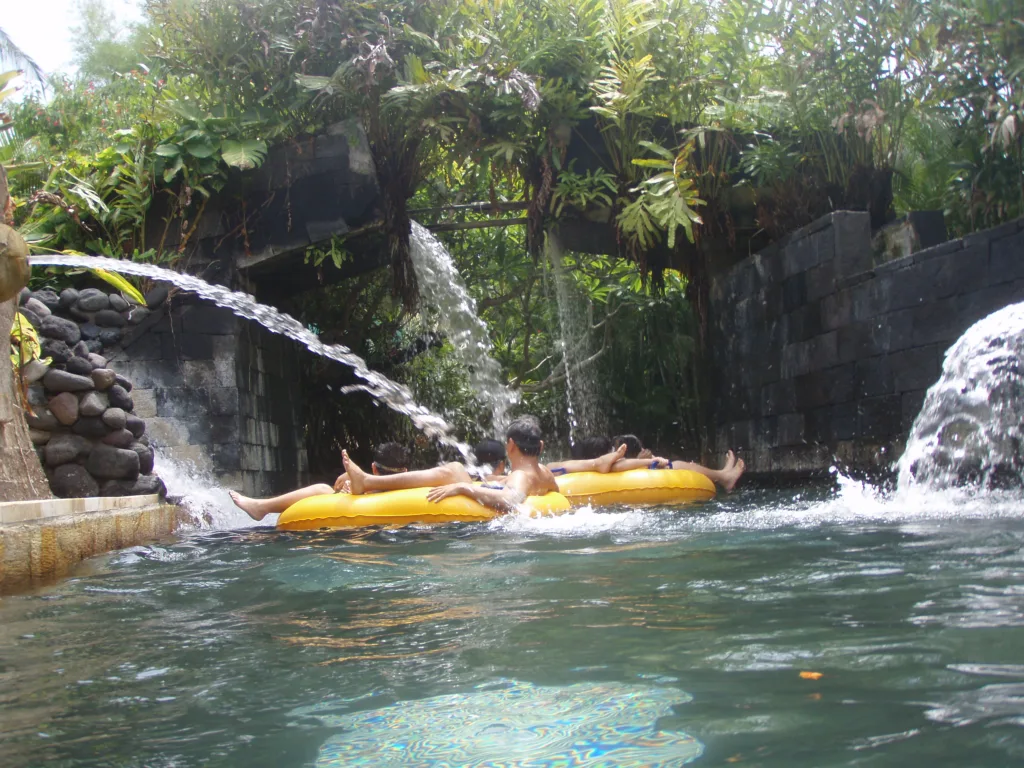
Vana Nava Water Jungle in Hua Hin is billed as the country’s first water park in the “water jungle” format — tropical vegetation is built into the very architecture of the slides and pools rather than just decorating the perimeter of the grounds, and the pavilion decor is styled as a temple complex lost in the jungle. Tickets cost around 37–41 dollars per adult depending on the package (including a towel and a locker in the price changes the cost). Rides include several fast slides for teenagers and adults, a calmer zone with a river for floating on rings and a separate shallow pool with water toys for the youngest guests.
The park’s format makes it an especially good choice for families holidaying in Hua Hin, a resort town that people from Phuket or Pattaya less often travel to specifically for a water park, but where Vana Nava becomes a logical addition to a beach holiday on the spot rather than a separate trip for a single venue. Hua Hin is also noticeably closer to Bangkok than Phuket or Pattaya — about three hours by car — which makes the combination of “beach holiday plus water park” realistic even as a one-day excursion from the capital.
Phuket FantaSea: a cultural show, not an amusement park
Phuket FantaSea is a fundamentally different format of entertainment: not an amusement park but a large-scale cultural show, “Fantasy of a Kingdom”, lasting about 70 minutes, combining Thai folklore, traditional dances, pyrotechnics and live elephants — 44 elephants are involved in the cast, some of which perform directly on stage while others take part in processions around the park grounds before the performance begins. The park runs its own elephant care programme.
The park operates every evening except Thursday (if a Thursday falls on a public holiday, the park may operate as usual that day), from 17:30 to 23:30 — an evening rather than daytime format of entertainment, which is convenient to combine with dinner on site before the performance itself: before the show guests are usually offered a buffet with Thai and international cuisine in the park’s own restaurant complex. For families looking specifically for a cultural experience rather than the adrenaline of slides, Phuket FantaSea remains a format unique to the island, with no direct analogues among the country’s other parks — tickets should be booked in advance, especially for popular evening slots in the high season, when seats on a particular date can run out within a few days.
Other water parks worth knowing
In Phuket, besides the FantaSea cultural show, there are several smaller water parks, including Splash Jungle in the north of the island — a more modest option for families staying in that area who don’t want to travel far for water slides. In general Phuket has no large water park on the level of Ramayana or Vana Nava, which is worth taking into account when planning: if water slides are the priority of the trip, it is more logical to choose Pattaya or Hua Hin than to count on a large-scale water park specifically in Phuket.
On Samui and the other islands of the Andaman and Gulf of Thailand there are in principle no large amusement parks or water parks — the resort infrastructure of these destinations is built around beaches, diving and hotel pools rather than separate park venues. Families for whom a water park is an essential part of the holiday should factor this into the choice of destination in advance rather than hope to find something similar on the spot after arrival.
SEA LIFE Bangkok Ocean World and KidZania: entertainment in the city centre
Not all of Bangkok’s family entertainment requires leaving town. Right in the basement of the Siam Paragon shopping mall, in the very centre of the capital, is SEA LIFE Bangkok Ocean World — a large aquarium with an acrylic tunnel, sharks, rays and seahorses; tickets cost from around 1,000 baht per adult, cheaper if bought online in advance. Next door, in the same mall, is KidZania Bangkok — an interactive miniature “city” where children play adult professions: from firefighter to airline pilot, earning play currency for completed tasks.
Both formats are convenient precisely because they don’t require a separate trip outside the city centre and work indoors — a reliable fallback for a rainy day or for families without a rental car, limited to public transport and taxis within the city. Combined tickets that bundle the aquarium with KidZania and the neighbouring Madame Tussauds wax museum often cost less than buying entry to each venue separately.
How to choose: Bangkok, Pattaya, Phuket or Hua Hin
If your base is Bangkok, Dream World or Safari World are the logical choice: both are within reasonable reach of the city centre and suit a day trip without an overnight stay outside the city. For families based in Pattaya the natural choice is Ramayana Water Park or Cartoon Network Amazone, both in the Jomtien area. Holidaymakers in Hua Hin should consider Vana Nava as a logical addition to the beach programme on the spot rather than a separate trip. In Phuket the main family event, besides the beaches, is more likely to be the evening Phuket FantaSea show than a full water park — keep this format in mind when planning the island’s evening programme.
By children’s age: Snow Town at Dream World and the water lagoons with toys at Ramayana and Cartoon Network Amazone suit the smallest best, while the more intense slides of the same parks and the drive-through safari at Safari World are more interesting for school-age children and teenagers. Phuket FantaSea suits practically any age thanks to the format of a spectacular show rather than physical activity.
By budget, Thailand’s parks are in general noticeably cheaper than their counterparts in Japan or China: most tickets fall within the range of 900–1,500 baht (roughly 25–45 dollars) per adult, and combined packages with transfer and meals rarely exceed 2,000–2,500 baht. This makes the country a convenient destination for families planning to visit several different parks in one trip without going beyond a modest additional budget on top of the main holiday costs.
The format of the group should also be taken into account: for a couple without children most of the listed parks are of little interest — they are designed primarily for a family audience — and a more logical choice for an adult group without children would be the nightlife of Bangkok or Pattaya, diving on the islands or a cultural programme such as temples and markets, rather than amusement parks.
Season and weather
The rainy season in central and southern Thailand falls roughly between May and October, with peak rainfall in September–October; during this period the open rides of parks like Dream World and Siam Amazing Park may temporarily suspend operation during a downpour, although they usually resume right after it ends thanks to the short tropical rains, which rarely last longer than an hour or two at a time. For water parks rain is not critical — swimming under a warm tropical downpour is even regarded by some local guests as additional entertainment — but note that visibility and the general enjoyment of the evening FantaSea show noticeably decrease in heavy rain.
The high tourist season (November–March, dry and cool weather) is the time of maximum crowds at all the country’s large parks, especially during the Christmas and New Year holidays and during the Thai New Year, Songkran, in mid-April, when local families go on holiday inside the country en masse. Weekdays outside this period are the best time to visit without long queues, and the morning hours right after opening are traditionally the least crowded at all the country’s large parks.
The temperature factor should be considered separately from rain: March–May in central Thailand is the period of the strongest heat, when the daytime temperature in the open grounds of parks like Dream World or Safari World can feel especially hard on small children — water parks in this sense tolerate the hot season more comfortably than dry rides thanks to constant access to water. In the hottest months it makes sense to plan the visit for the morning hours right after opening, and to spend the hottest part of the day, from noon until three or four, in the shade or in the park’s indoor areas.
Tickets and practical tips
Most of Thailand’s large parks sell tickets cheaper through aggregators like Klook or GetYourGuide than at the box office on the spot — the price difference often reaches 20–40%, especially with advance online booking. Combined packages with a transfer from Bangkok or Pattaya are convenient for those who don’t rent a car and don’t want to deal with public transport to a park located outside the city centre.
When visiting safari parks and animal shows, factor the specific start times of performances into your schedule — most shows run on a fixed timetable several times a day, and being late for a particular session may mean a long wait for the next one.
Food, sun protection and what to take with you
Inside most of Thailand’s amusement parks and water parks there are their own cafés and food courts, but the choice and quality are noticeably inferior to city restaurants, and prices are higher — many travellers prefer to bring a snack if the rules of the specific park allow it (at water parks like Ramayana or Vana Nava you usually can’t bring your own food and drinks for reasons of cleanliness, while at dry parks like Dream World this is more often permitted).
Sunscreen, preferably a reef-safe format that is harmless to the marine ecosystem, is a must for any of the country’s water parks: the tropical sun in Thailand burns quickly even in cloudy weather, and most of the water parks’ grounds are open, without continuous shade. For safari parks and dry rides, add a hat and comfortable closed shoes, especially if the programme includes walking around the grounds between pavilions in the hot midday hours.
Visa and how to get to the parks
Russians do not need a visa to enter Thailand for up to 30 days — this time is more than enough to visit one or several amusement parks as part of a broader trip around the country. Transport between cities within Thailand is well developed: regular buses and minivans run between Bangkok, Pattaya and Hua Hin, and to Phuket it is most convenient to fly a domestic flight if the trip is not limited to one region of the country.
Within Bangkok itself most of the large parks — Dream World, Safari World, Siam Amazing Park — are outside the coverage of the BTS and MRT rapid transit, so it is more convenient to get to them by taxi via the Grab app, an organised transfer or a rental car rather than by public transport. In Pattaya and Hua Hin the water parks most often include a hotel transfer in the price of a combined ticket, which removes the logistics question completely — when buying a ticket, check separately whether the transfer is included in the specific package, since the same park often sells several ticket options at once with a different set of included services.
Frequently asked questions
Is it true that Dream World is the Thai equivalent of Disneyland? The nickname reflects the park’s ambition, not a real similarity in scale or quality — it is a large but fundamentally more modest amusement park with its own zones like Snow Town.
Is Siam Amazing Park’s wave pool size record confirmed? No independent up-to-date confirmation of this particular claim could be found — treat such marketing wording with caution.
Should I worry about the ethics of animal shows in Thai parks? A number of the region’s safari parks, including Safari World, have been criticised by animal-welfare organisations over the conditions in which animals are kept — if this is fundamentally important, it is worth studying current independent reviews of the specific park in advance.
Does Phuket FantaSea operate every day? No, the park is closed on Thursdays, except when a Thursday falls on a public holiday — then the park may operate as usual.
Is there a large water park in Phuket on the level of Ramayana or Vana Nava? No, the island only has water parks that are more modest in scale, like Splash Jungle — for a full-scale large water park it is more logical to go to Pattaya or Hua Hin.
Where is it cheaper to buy tickets to Thai amusement parks? As a rule, through online aggregators like Klook or GetYourGuide — the price there is often 20–40% lower than directly at the park’s box office.
Do I need a visa for Thailand for a trip that includes an amusement park? No, Russian citizens have visa-free entry for up to 30 days — enough to visit one or several parks as part of a broader trip around the country.
Are there large water parks on Samui or other islands of the Gulf of Thailand? No, the infrastructure of island resorts is built around beaches and hotel pools rather than separate large water parks — for a full water park it is worth going to Pattaya, Hua Hin or Bangkok.
How do I get to the parks in Bangkok if they are not covered by the metro? Most conveniently by taxi via the Grab app, with an organised transfer or in a rental car — most of the city’s large parks are outside the BTS and MRT lines.
Is it worth going to an amusement park as a couple without children? As a rule, no — most of the listed parks are designed for a family audience with children; a couple without children should logically choose other formats of holiday like diving, nightlife or a cultural programme.
Can I bring my own food into a water park? Usually not — at most large water parks like Ramayana or Vana Nava there is a ban on your own food and drinks on site, while at dry parks like Dream World the rules are more often softer.
Are there entertainment options in Bangkok for a rainy day? Yes, SEA LIFE Bangkok Ocean World and KidZania in the Siam Paragon shopping mall — both are indoors and remain a working option even in pouring rain, unlike most of the parks outside the city.
See also: which island of Thailand to choose, the season in Thailand, which area of Pattaya to choose a hotel in.