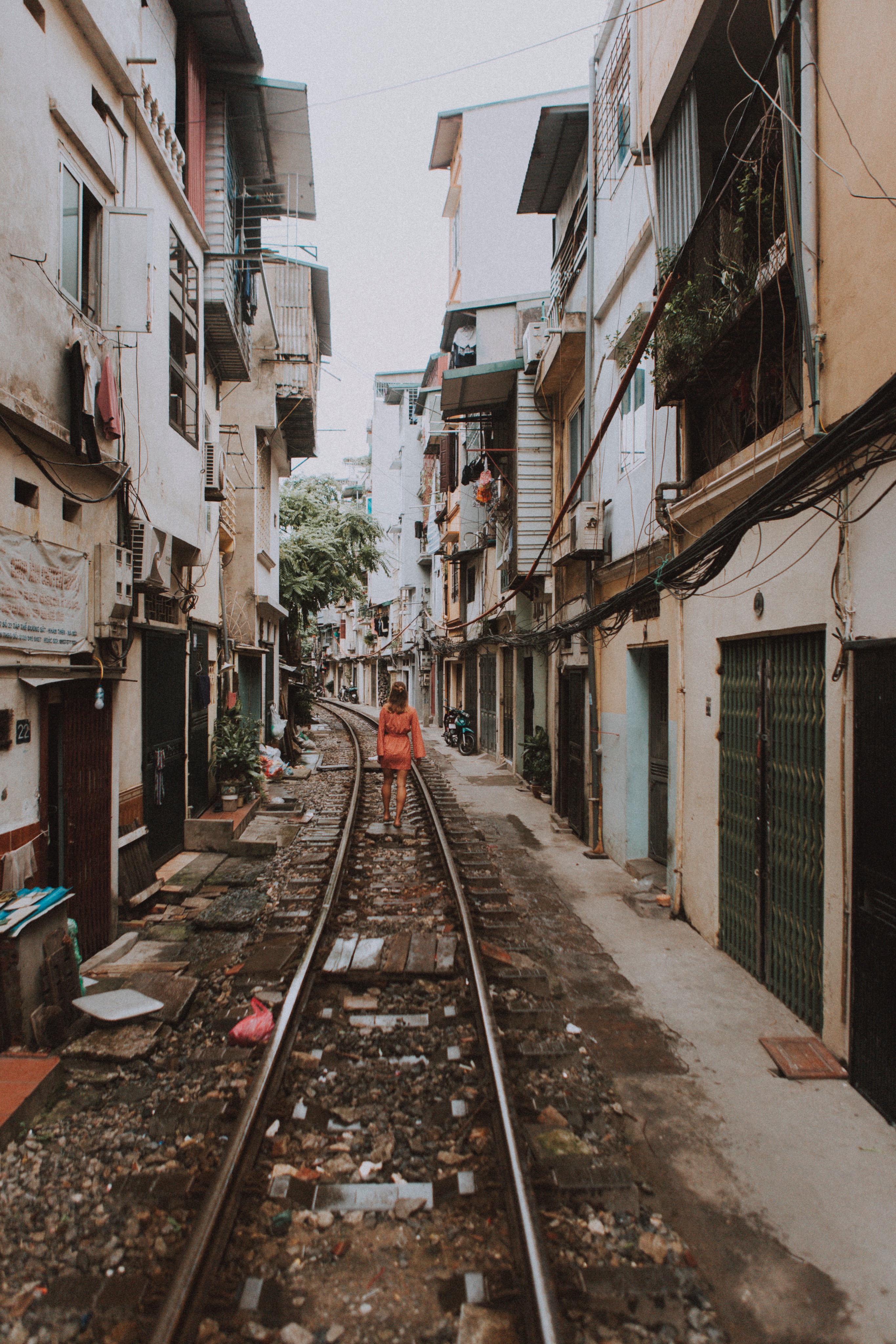
Train Street in Hanoi: a narrow residential alley where a train passes half a metre from café tables. The story of accidental viral fame, the 2019 closure and how to get there today.
A café table stands literally half a metre from the rails, the waiter puts a cup of egg coffee in front of you — and a minute later a horn sounds, a light tremor runs under your feet, and a real train slowly passes within centimetres of your elbow, while from both sides of the narrow passage residents look out of open second-floor windows, for whom this is just a Tuesday. The street the whole world knows as Train Street is one of the strangest examples of how an ordinary residential neighbourhood became a global tourist attraction almost by accident.
A century-old line that became an accidental sensation
The railway itself is not a tourist fabrication but an active line, built by the French colonial administration in 1902 and still used to connect Hanoi with the northern cities — Hai Phong, Lao Cai (from where people get to Sapa) and Vinh. For decades the residents of the narrow corridor along the tracks simply lived their ordinary lives a couple of metres from the rails — drying laundry, cooking food, trading right by the track. There was nothing specifically touristy about it until 2019, when photos and videos of a locomotive passing literally flush with café tables spread across social media — and turned a modest residential alley into one of Hanoi’s most recognisable spots, on a par with the Old Quarter and Hoan Kiem.
Closed — but not quite
The sudden fame had a flip side. The influx of tourists, ready to literally stand on the rails for the perfect shot and not move even as the train approached, forced drivers to make emergency stops several times. In October 2019 the Hanoi authorities ordered the cafés along the tracks closed and set up barriers with police posts restricting tourists’ access to the most dangerous part of the street. Since then Train Street has existed in a permanent “sometimes open, sometimes closed” mode: formally tourist access has been restricted since 2019, but in practice the cafés continue to receive guests, surveillance cameras monitor the entrances and the police patrol the area — a settled, though informal, compromise between the ban and real tourist demand.
How to get in today
Direct access “from the street” is restricted by checkpoints at most entrances — you can get through if you are let in as a guest of a specific café. Most establishments ask you to message in advance on WhatsApp or a messenger, after which a staff member meets you at the entrance and personally takes you inside, bypassing security. More than thirty coffee shops operate along the street — among the best known are Coffee 74, Railway Cafe, Hanoi 1990s and 30 Train Coffee — so the choice is more about the atmosphere of a particular place than about the fact of access. Trains pass 5–8 times a day, mainly in the afternoon and evening — the exact schedule should be checked with the café before the visit, since it changes.
How to behave when a train is coming
This is not a staged attraction but an active railway in a residential neighbourhood — the safety rules here are not a formality. Standing on the rails for a photo is officially forbidden and extremely unwise unofficially; when café staff or locals signal an approaching train, you must immediately step back to the wall of the building and stay there until the train has completely passed. It was precisely tourists’ violation of this simple rule in 2019 that caused the street’s initial closure — repeating others’ mistakes for the same shot as thousands of other tourists is clearly not worth it.
FAQ
Is Train Street open in 2026? Yes, the cafés along the tracks are open and receive guests, although the formal status of access remains restricted — check the current situation with the specific establishment before the visit, since the rules change periodically.
Do I need to book in advance? In practice — yes, at most cafés, especially at peak hours: contact the establishment through a messenger so that a staff member meets you at the checkpoint and takes you inside.
Is it safe to be there while a train is passing? Yes, if you follow the staff’s instructions and stay by the building wall rather than on the tracks — the distance is calculated precisely for the safe passage of the train provided this simple rule is observed.
Why was the street closed at all? Because of tourists who, for the sake of a photo, refused to step away from the rails as a train approached, which several times forced drivers to brake sharply — the authorities responded by restricting access in 2019.
Is it worth going specifically for this place? If an unusual urban attraction and unique atmosphere interest you — yes, but assess the format realistically: it is a modest residential street with several cafés, not a large-scale attraction, and the main impression lasts exactly the few minutes while the train passes.
Train schedules and access rules may change — check the current information with the café before the visit.