Ninh Binh is "Ha Long Bay on land" two hours from Hanoi: boats through Trang An and Tam Coc, 486 steps up to the Mua Cave, ticket prices, the best time to go and how to see it all in a day.
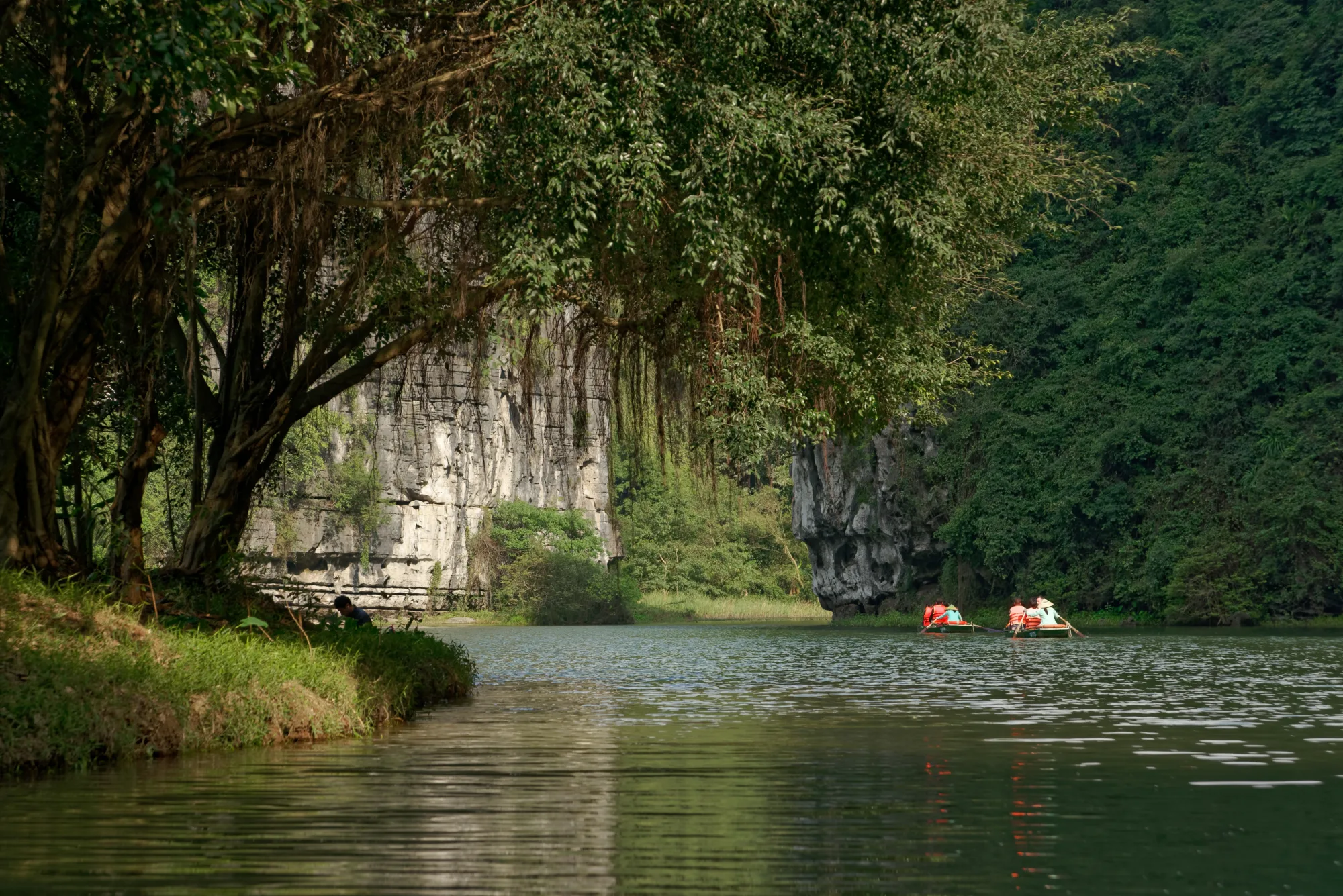
The boat glides soundlessly over mirror-like water, around you are sheer limestone towers overgrown with jungle, ahead the arch of a cave darkens, under which you must duck your head, and the oars of the rower, who works with her feet, splash barely audibly in the silence. Ninh Binh is called “Ha Long Bay on land”: the same karst rocks that rise from the water in the famous bay, only instead of the sea there are rice fields, rivers and caves through which you travel by boat. And you can get here in two hours from Hanoi.
Trang An: UNESCO mixed heritage
The Trang An complex spreads across a flooded karst basin: more than two hundred limestone mountains rise from river valleys that have been partly flooded since the end of the last ice age. The landscape received UNESCO status in 2014 as a mixed site — not only for its natural beauty but also for archaeological evidence: traces of continuous human habitation over thirty thousand years are preserved here, and nearby lies Hoa Lu, Vietnam’s first independent medieval capital of the 10th century. Boats depart from Van Lam village and follow a route through rice fields, karst towers, caves and small temples on the banks.
Tam Coc: the same landscape, a different character
Tam Coc — “three caves” — is a more intimate and accessible option: the boat goes along the Ngo Dong River between rice fields and through three low caves. The ticket costs about 250 thousand dong, and it should be bought at the box office at Dinh Cac pier, not from hotel agents and street sellers. The rowers here are known for rowing with their feet — and won’t refuse to show this trick for a small tip. The season is especially beautiful in May–June, when the fields turn golden before harvest and the green mountains contrast with the yellow terraces.
Mua Cave: 486 steps for the view
If Trang An and Tam Coc give a view from the water, the viewpoint at the Mua Cave opens Ninh Binh from above. The climb up the stone staircase on Ngoa Long Mountain (“the lying dragon”) is 486 steps, and on a hot day it is quite seriously exhausting. The reward is a panorama of the bends of the Tam Coc River, rice fields and the teeth of limestone. Entry costs about 150 thousand dong, and it is better to climb early in the morning or closer to sunset: at midday the staircase is hot and crowded.
Bai Dinh and Hoa Lu
The Bai Dinh pagoda complex is one of the most extensive Buddhist temple ensembles in the country; you can get around the grounds by electric car for 150 thousand dong. Hoa Lu is an ancient capital of which memorial temples to the kings of the Dinh and Le dynasties remain: a quiet place, and striking against the backdrop of karst mountains. Together with Trang An, Tam Coc and Mua, these points make up a full one-day route that many Hanoi hostels sell as a combined tour for roughly 35 dollars with lunch and transport.
How to get there and where to stay
From Hanoi to Ninh Binh is about 90 kilometres; a train, bus or hired car with a driver gets there in two to two and a half hours. Many come for a day, but it is better to stay at least one or two nights: the morning mist over the fields and the sunset over the rocks are worth it. You can stay in small guesthouses and bungalows right among the rice fields in the Tam Coc area — this is one of the main reasons to spend the night here rather than return to Hanoi.
Practical tips
Go out on the boats early — by ten in the morning the piers are packed with organised groups. Take sunscreen, a hat and water: there is almost no shade on the water. Tickets at Trang An work at a fixed price, include the boat, the rower and entry to the temples on the route — there is no need to bargain, but it is worth politely declining the rower’s “additional” services. Comfortable shoes are needed for the staircase at the Mua Cave, and a raincoat if you travel in the rainy season, when boats are often stopped because of the water level.
FAQ
How much does a trip to Ninh Binh cost? A boat through Trang An is about 300 thousand dong, through Tam Coc 250 thousand, the Mua Cave 150 thousand; a combined tour from Hanoi costs roughly 35 dollars with lunch.
When is it best to go? In May–June, when the rice fields are golden, but it is beautiful in autumn too, when the heat subsides.
What should I choose — Trang An or Tam Coc? Trang An is larger-scale and better organised, with temples along the route and UNESCO status; Tam Coc is shorter and more intimate but no less picturesque.
How many steps are there at the Mua Cave? About 486 — the climb takes 20–30 minutes, but the views from the top repay the effort.
Is one day enough? Yes, for the main points, but a night among the fields and the morning mist add a separate pleasure to the trip.
Ticket prices and opening schedules may change — check the current information before your trip.