Hue, Vietnam, in 2–3 days: the Imperial Citadel, the tombs of Khai Dinh and Minh Mang, Thien Mu Pagoda, royal cuisine, the best time to go and ready-made itineraries.
Hue is the Vietnam that slows down. There is neither the chaos of Hanoi, nor the skyscrapers of Ho Chi Minh City, nor the beach bustle of Nha Trang: boats creep along the Perfume River, bicycles whisper along the streets, women in white ao dai return from school, and the walls of the old imperial citadel rise above the city. For more than a hundred and forty years — from 1802 to 1945 — Hue was the capital of the Nguyen dynasty, the last Vietnamese imperial dynasty, and it has preserved the palaces, tombs, pagodas and cuisine that Vietnamese consider the most refined in the country. The historic part of the city and the monuments connected with it are on the UNESCO World Heritage list. For many travellers Hue is an “intermediate stop” between Hanoi and Hoi An where a few hours are enough. But those who stay for two or three days call it the best discovery of the trip. In this guide: what to see, how to build a route, what to try, when to go and how to avoid the mistakes that make a trip to Hue disappointing.
- History: the capital of the Nguyen dynasty from 1802 to 1945; the Imperial Citadel and the complex of monuments are on the UNESCO list.
- The main sights: the Dai Noi Imperial Citadel, the tombs of the emperors Minh Mang, Khai Dinh and Tu Duc, Thien Mu Pagoda on the bank of the Perfume River.
- Food: bun bo Hue soup, rice cakes and “royal” cuisine.
- Best time: roughly January to April; September to November brings rain, storms and possible floods.
- Tickets: entry to each monument is paid, and combined tickets exist; prices change, check before buying.
- Main tip: set aside at least two days for Hue and visit the tombs in the morning, before the heat.
A city of two eras: understanding Hue in ten minutes
The history of Hue is the history of the last dynasty of Vietnamese emperors. In 1802 Gia Long unified the country and chose Hue as the capital, and the following emperors built a citadel here on the model of Beijing, but with Vietnamese details. Around the citadel grew a whole ensemble of tombs, pagodas and gardens on the banks of the Perfume River. In 1945 the last emperor Bao Dai abdicated, and the empire itself disappeared. Another drama came in 1968: during the Tet Offensive Hue went through heavy fighting, and a significant part of the citadel was destroyed. Today many buildings have been restored, but in places traces of destruction remain, and some structures are under restoration.
The practical conclusion: Hue is not a museum under glass but a living city where cafés stand next to palaces and families stroll the embankment in the evening. Come with an interest in history, but without the expectation of a perfect “postcard”: many buildings have faded and some are being restored, and that is normal.
The Dai Noi Imperial Citadel
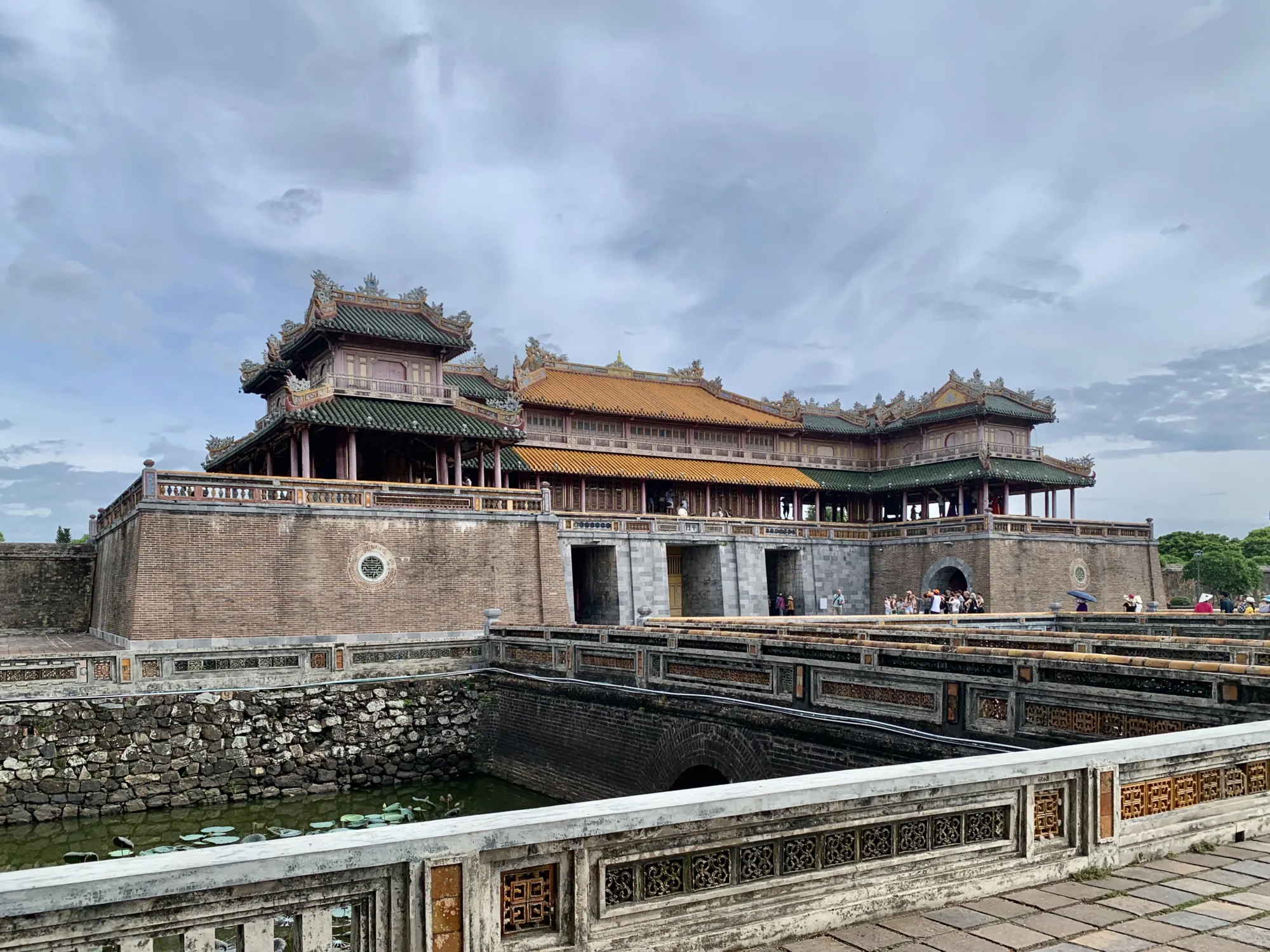
The Imperial Citadel is the heart of Hue. It is a huge complex on the northern bank of the Perfume River, surrounded by walls and a moat. The entrance is through Ngo Mon, the monumental “Noon Gate”, above which rises a two-tiered pavilion. Behind it are a square, the main Thai Hoa Palace where ceremonies were held, and a whole city in the inner space with pavilions, galleries and gardens. The main idea of the layout is symbolic: each courtyard and gate is connected with rituals and hierarchy. You can easily spend three or four hours here, or more if you love details. Come for the opening, while it is cool and there are few tourists: in the daytime the open squares are hot with little shade. If you want to understand what you are seeing, hire a guide or download an audio guide: without explanations many pavilions look alike.
A separate experience are the evening programmes: on some days night tours with illumination and performances are held in the citadel. The schedule and prices depend on the season, so check with your hotel or at the entrance.
The royal tombs: three different characters
Outside the city, along the banks of the Perfume River, the emperors’ tombs are scattered. They were built during the rulers’ lifetimes as country residences: with ponds, pavilions and parks, and the body was later moved to a secret place. Each tomb reflects the character of its owner.
The tomb of Khai Dinh. The most striking and unusual. Built at the end of the dynasty’s rule, it combines Vietnamese architecture with European motifs: grey concrete, stone staircases and inside a luxurious mosaic of porcelain and glass fragments. Small in size, but very expressive.
The tomb of Minh Mang. A classic of Vietnamese imperial architecture: symmetry, ponds, pavilions and avenues. It is the most harmonious and “correct” tomb, a calm place for a walk.
The tomb of Tu Duc. More like a park or country estate: a lake, gazebos, pathways. Tu Duc was a poet, and his tomb was created as a place for reflection and rest.
The tombs are convenient to visit by taxi, on a rented bike or as part of a boat excursion on the river. For some, one or two tombs are enough: if you have to choose, take Khai Dinh and Minh Mang — they are the most different. Dress modestly, since these are places of memory.
Thien Mu Pagoda and the Perfume River
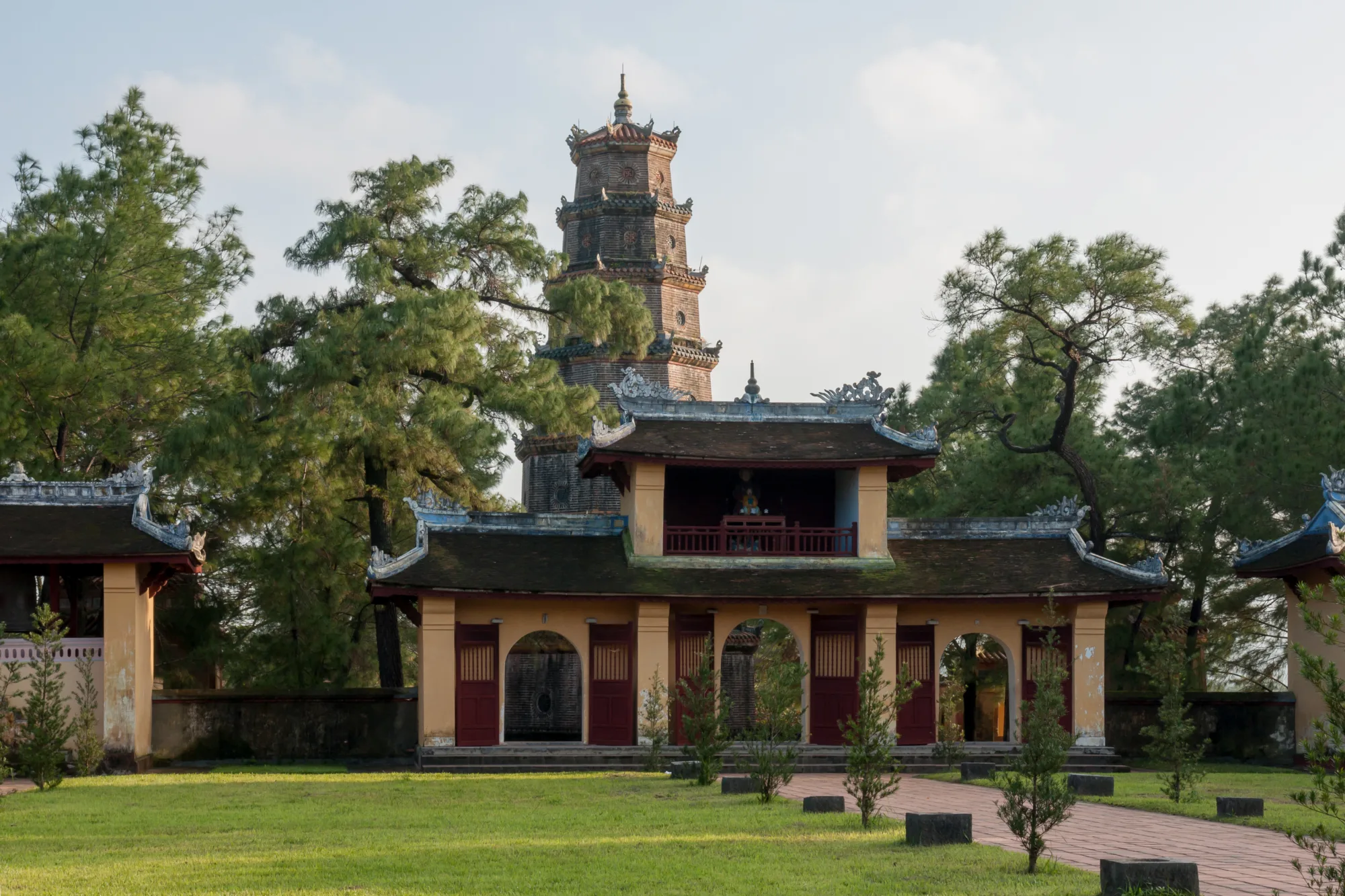
One of the most recognisable sights of Hue is Thien Mu Pagoda, the “Pagoda of the Celestial Lady”. It stands on a high bank of the Perfume River, and its seven-tiered tower is a symbol of the city. The pagoda was founded in the early 17th century, and the tower was added later. It is a working monastery, and its grounds are a calm place for a walk. From here there is a view of the river and boats. It is better to come in the morning or towards sunset, when the light is soft and there are fewer people. A “dragon boat” excursion on the river lets you see the pagoda and tombs from the water; discuss the price in advance and take life jackets.
What to try: royal cuisine and street food
Hue is famous for a cuisine the Vietnamese consider the most refined: the imperial court demanded many small, exquisite dishes. The main symbol is “bun bo Hue”: a spicy soup with rice noodles, beef and lemongrass. Try “banh beo” — small rice cakes with shrimp, “banh khoai” — crispy pancakes, “com hen” — rice with clams and herbs, and “nem lui” — grilled sausages. Many restaurants offer “royal” dinners with many small dishes; it is beautiful and tasty, but more expensive than street food. Don’t be afraid of spice: chilli is used generously in Hue, so ask for “not spicy” in advance if you don’t like it. One more feature is the vegetarian cuisine at pagodas: it is varied and very tasty.
Emperor after emperor: a short cheat sheet
So as not to get tangled in the names of tombs and pavilions, it is useful to know a few names. Gia Long — the founder of the dynasty, who unified the country in 1802 and made Hue the capital. Minh Mang, his son, built the citadel in its present form and was the author of a strict Confucian system of government; his tomb is a model of the classical style. Tu Duc — a poet and a long-lived ruler of the throne, who owns the most “park-like” ensembles. Khai Dinh — an emperor of the French protectorate era who loved European luxury, which is reflected in his tomb. Bao Dai — the last emperor, with whom the dynasty ended in 1945. Knowing this chain turns the trip from a set of beautiful buildings into a coherent story.
Ao dai, silk and crafts
Hue is considered the birthplace of the classic Vietnamese dress, the ao dai — schoolgirls in the city still wear it, and tailor shops on the streets make outfits to order in a few days. If you want a souvenir that is truly connected with the place, order an ao dai or a silk scarf: workshops offer fabrics and styles to choose from. Other traditional crafts are conical “non la” hats, including special “poetry” hats through which verses and drawings can be seen against the light, as well as incense sticks and paper paintings. Before buying compare prices in several shops and don’t hesitate to bargain politely.
A trip to the former demilitarised zone
If you are interested in recent history, day trips are organised from Hue to the former demilitarised zone that divided Vietnam into north and south during the war: museums, bridges and underground tunnels are shown there. Such excursions are emotionally heavy but help to understand the country better. Choose trusted operators with clear programmes and limited groups, and before the trip read about safety and follow the guides’ instructions: you must not leave the marked routes. For the other side of Vietnam’s history read the article on the Cu Chi tunnels.
Hue with children and with parents
Hue is a calm city, but the days here are long and hot. With children plan short outings: the citadel in the morning, a boat on the river in the afternoon and an evening walk. For elderly parents think about transport and don’t try to see all the tombs in one day: two tombs and the citadel is already a full programme. Bring water, hats and sun umbrellas, take stops in the shade and drink enough fluids. Hotels with a pool help to recover in the middle of the day.
For photographers: light and angles
Hue is photogenic but needs light. The Ngo Mon gate and the citadel’s roofs look best in the morning, when the sun lights up the yellow tiles. Thien Mu Pagoda is beautiful at sunset, when the tower is reflected in the river. In the tomb of Khai Dinh the main thing is the details of the mosaic, so bring a lens that lets you shoot close up. Women in ao dai on bridges and embankments are a popular subject, but always ask permission to photograph. And don’t forget a rain cover for the camera: weather in Hue changes quickly.
When to go: the climate of Hue
Hue lies in the central part of Vietnam, where the seasons differ from the northern and southern ones. The best time is roughly January to April: cool, dry and not too hot. From May to August it can be very hot and humid, and sightseeing in the citadel becomes an ordeal. September to November is the season of rain and storms; at this time floods, closures of sights and transport delays are possible. If you come in autumn, watch the forecast and keep flexibility in your schedule. For the country’s seasons read the article on Vietnam’s seasons, and for the events of the year the overview of Vietnam events in 2027. If you land here at New Year, see our guide to Tet 2027: it is a good chance to see traditional rites, but many establishments close for several days.
Getting there
Hue is connected with Hanoi, Da Nang and Ho Chi Minh City by buses, trains and planes. From Da Nang over the famous Hai Van Pass the road takes about two to three hours by car or bus; the train runs along a scenic route by the coast. From Hoi An it is about three to four hours. In the city itself it is convenient to get around by taxi, via apps and by bicycle; for the tombs it is better to hire a car for half a day or join a small group. The historic part on the northern bank can be explored on foot, but you have to drive to the tombs. If you are coming from Hanoi, for flights read the article on Vietnam’s airports.
Where to stay
Hue is divided into two parts: the old city with the citadel on the northern bank and the new city with hotels, cafés and restaurants on the southern one. For a first trip the southern bank is more convenient: food streets, the embankment and bridges are nearby. If you want atmosphere, choose small family hotels and guesthouses where the hosts will tell you about the city and help to book excursions. Boutique hotels and resorts on the outskirts offer quiet and pools but require transport. Book in advance for the Tet period and summer holidays: then prices go up.
Practical tips
Bring water and a hat: the citadel is hot with little shade. Dress modestly when visiting tombs and pagodas: shoulders and knees covered. Come for the opening: the morning light is soft and the crowds are smaller. Carry cash: tickets and small purchases are often paid in cash. Don’t accept the first price from boatmen and rickshaw drivers and agree in advance. And watch the weather forecast: even in the “dry” season there is drizzle in Hue.
How much the trip costs and how to save
Hue is one of the most affordable cities of central Vietnam. The main expenses are entry tickets to the monuments, transport to the tombs, accommodation and food. To save, look for combined tickets for several sites, share taxis with fellow travellers, eat at local places rather than tourist restaurants, and book accommodation in advance with free cancellation. Don’t buy excursions from random touts in the street: it is better to book through your hotel or a trusted operator. Exact prices change, so check current information before the trip and keep a small reserve of cash for minor expenses.
Three ready-made itineraries
“Hue in a day”. Morning — the citadel, lunch with bun bo Hue, afternoon — Thien Mu Pagoda and an evening walk along the embankment.
“Imperial Hue” — 2 days. The first day — the citadel and the city, the second — the tombs of Minh Mang, Khai Dinh and Tu Duc, and in the evening a dinner of royal cuisine.
“Central Vietnam” — 5–7 days. Hue, the Hai Van Pass, Da Nang with Ba Na Hills and Hoi An with its lanterns.
Hotels in Hue
Below is a selection of hotels from our database in Hue and Da Nang. Look at the reviews and the “Hotel health” block, and check the distance to the citadel and whether a transfer is available.
FAQ
How many days are needed for Hue? At least two: a day for the citadel and the city, a day for the tombs.
What is the main thing in Hue? The Imperial Citadel, the tombs of Khai Dinh and Minh Mang, Thien Mu Pagoda and the cuisine.
When is the best time to go? January to April; September to November brings rain and floods.
Do I need a guide? Not mandatory, but a guide or audio guide helps to understand the citadel.
What should I try? Bun bo Hue, banh beo, banh khoai and com hen.
How do I get there from Da Nang? By car, bus or train in two to three hours over the Hai Van Pass.
Ticket prices, opening hours and transport schedules may change — check current information before the trip.