How much money you need to travel in Asia: an honest budget for Thailand, Vietnam, Cambodia, Bali, China and Japan — accommodation, food, transport, SIM cards and locals' hacks for saving money.
“Asia is expensive” is a myth that lives only among those who book everything through aggregators for tourists and have never asked the hostel reception for advice. The reality is different: thousands of backpackers live in Southeast Asia for months on 900–1,200 dollars, and some manage on 700. The secret is not in hardship but in knowing simple things that locals and experienced travellers use every day: where to ask the price in the local language, why a midnight bus is cheaper than a daytime one, which SIM card is really the best value and why you can have a perfectly good lunch at 7-Eleven. This article gives an honest budget for six countries (Thailand, Vietnam, Cambodia, Bali, China, Japan), broken down by accommodation, food, transport and connectivity, and specific hacks that usually don’t make it into guidebooks because only those who have already lived here for more than a week know them.
- Thailand: $25–40 a day — a hostel bunk $5–8, market food $3–5, city transport $1–2.
- Vietnam: $20–35 a day — one of the cheapest routes in the region; night buses save both money and a night in a hostel.
- Cambodia: $20–35 a day — a country effectively on dollars, guesthouses from $6–8.
- Bali: $25–45 a day — strongly depends on the area: Canggu is more expensive, Ubud and Lovina are cheaper.
- China: $30–50 a day — cheap food and metro, but without mobile payments it will be harder and more expensive.
- Japan: $60–90 a day — the most expensive country in the region, but even here there are capsule hotels and convenience-store hacks.
How a backpacker’s budget in Asia is built
A travel budget almost always consists of four items: accommodation, food, transport and connectivity, plus entertainment and a visa on top. In Southeast Asia these items are cheaper than anywhere else in the world at a comparable level of comfort, and the difference between an “expensive” and a “cheap” trip is usually not the country but habits. The same person can spend both 15 and 50 dollars a day in the same city — it’s just that in the second case they choose a taxi instead of a songthaew, dine at a café for tourists and don’t bargain at the market. Below, country by country: accommodation, food, transport, connectivity and one or two hacks that are known mostly to locals and those who have lived here for months.
Thailand: markets, songthaews and daily SIMs
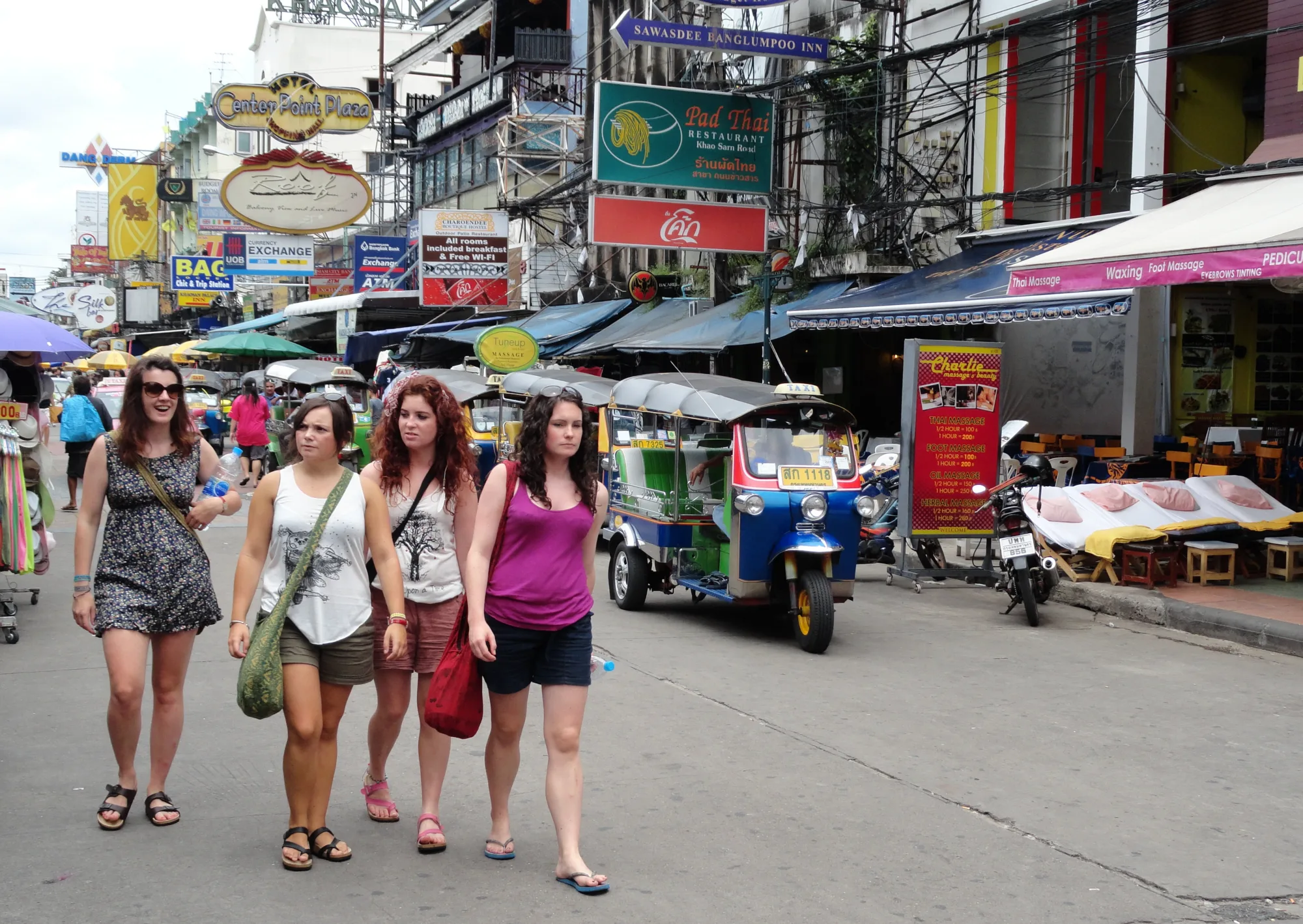
Accommodation. A hostel bunk in Bangkok or Chiang Mai is 5–8 dollars, a decent guesthouse with a private bathroom 12–18. In Bangkok, look for accommodation not on Khao San Road itself but a couple of blocks from it: the price falls, and everything is just as close.
Food. A full meal at a street market is 40–80 baht (1–2.5 dollars): pad thai, noodle soup, rice with grilled chicken. The locals’ secret is to eat where there is a queue of Thais, not where the sign has an English menu with photos: the price in the second case is usually one and a half to two times higher. At 7-Eleven there is hot food and ready-made lunches for 30–50 baht — this is not a “snack out of desperation” but a perfectly normal lunch that local office workers use too.
Transport. Songthaews (shared pickup-truck minibuses) in Chiang Mai and provincial towns cost 20–30 baht for a ride around town — many times cheaper than a taxi. In Bangkok the BTS skytrain and MRT metro are cheaper than a taxi and don’t sit in traffic. Between cities a night bus or train saves on both the ticket and the lodging: you sleep on the way and wake up in a new city without an extra night in a hostel.
Connectivity. A tourist SIM card at the airport costs more than the same card bought in a city mobile shop or at 7-Eleven. The difference can be 30–50%. If you are not coming for the first time or are planning a long trip, look at local monthly-payment plans — they come out cheaper than weekly tourist packages.
Vietnam: the sleeper bus and street food for pennies
Accommodation. A hostel bunk is 4–7 dollars, a guesthouse room for two 10–15. In Hoi An and Da Lat the competition between guesthouses is high, so prices are lower than in Hanoi and Ho Chi Minh City.
Food. A plate of pho or bun cha at a street kitchen is 20–40 thousand dong (less than a dollar). The locals’ secret is to eat where people sit on small plastic stools and there is no sign in English: such places rely on their regular customers rather than tourists, and the price is accordingly low.
Transport. The sleeper bus — a night bus with reclining berths — is the main hack of Vietnamese backpacking: a ticket Hanoi — Hue or Nha Trang — Da Lat costs 8–15 dollars and saves a night in a hostel. Within a city, Grab (the local taxi equivalent with a fixed price in the app) is cheapest — it spares you bargaining with motorbike drivers.
Connectivity. A local SIM with unlimited internet for a month costs about 5–8 dollars at an ordinary mobile shop — versus 15–20 at the airport counters. Ask your hostel reception where the nearest official Viettel or Mobifone shop is: they will help you get a card without overpaying.
Cambodia: a country on dollars and the day rate of a tuk-tuk
Accommodation. A guesthouse in Siem Reap or Phnom Penh is from 6–10 dollars a room, a hostel bunk 4–6. Cambodia officially uses the US dollar alongside the riel, so budget calculation is especially transparent.
Food. Local noodles or rice with meat at a market are 1.5–3 dollars. Amok and other street snacks are cents. As everywhere in the region, the closer an establishment is to the main tourist street, the higher the markup: move a couple of blocks away, and the price drops by half.
Transport. A tuk-tuk for the whole day to see the temples of Angkor usually costs 15–20 dollars — this is better value than paying for separate rides, and the driver waits for you at every temple. Agree on the daily price in advance, back at the hotel: the receptionist often knows the fair price and can recommend a trusted driver.
Connectivity. A local SIM with a week of internet is 3–5 dollars at any roadside shop, set up in five minutes with a passport. There is no point overpaying for it at the airport — the price there is usually twice as high.
Bali: warungs, scooters directly and local markets
Accommodation. A room in a guesthouse is 8–15 dollars, a hostel bunk in Canggu or Ubud 6–10. Canggu and Seminyak are noticeably more expensive than Ubud, Lovina and the east coast at comparable quality of accommodation.
Food. A warung — a small family café with Indonesian food — is 1.5–3 dollars for a full portion of nasi goreng or gado-gado. Cafés with smoothie bowls and vegan menus in tourist areas cost three to four times more: this doesn’t mean they should be avoided, but alternating warungs and cafés saves a lot of budget.
Transport. Renting a scooter directly from a local or from your guesthouse costs 40–60 thousand rupiah a day — cheaper than through tourist agencies with a markup. Agree on a week at once: the price per day falls. Grab and Gojek in the app are cheaper than the private drivers who offer their services on the street.
Connectivity. A local SIM with a big internet package for a month is 5–10 dollars at a mobile shop, not at a kiosk at the airport, where the price can be two to three times higher for the same amount of traffic.
China: cheap metro and mobile payments as savings
Accommodation. A hostel bunk in a big city is 8–15 dollars, which is more than the region’s neighbours, but the metro and food make up the difference.
Food. A portion of noodles or rice at a local canteen is 15–25 yuan (2–3.5 dollars), and street food is cheaper still. The difference between a canteen for locals and a restaurant for foreigners can be five times.
Transport. The metro in Chinese megacities is one of the cheapest and most efficient in the world: a ride costs 2–8 yuan. High-speed trains in second class give almost the same speed as first class but are noticeably cheaper.
Connectivity and payments. The main local hack is to master Alipay or WeChat Pay with a foreign card linked before the trip: many sellers and taxi drivers in China physically do not accept cash or cards, and without mobile payments you overpay for everything through intermediaries and taxis for foreigners. Details in our article on payments in China.
Japan: an expensive country with budget loopholes
Accommodation. A capsule hotel is 25–40 dollars a night, noticeably cheaper than an ordinary hotel in the same area. A manga café, where you can spend the night in an open booth with a sofa and a shower, is cheaper still — about 15–20 dollars a night, and this is an official, legal option common among local young people when they miss the last train.
Food. Ready-made food from konbini (Seven-Eleven, Lawson, FamilyMart) — onigiri, bento, noodles — is from 150 to 500 yen (1–3.5 dollars) and in quality is quite comparable to a cheap café. Local students and office workers lunch there constantly, and it is not a sign of thrift but a normal part of city life.
Transport. The JR Pass is not worth it for everyone: if your route doesn’t involve several long Shinkansen journeys, ordinary tickets and regional passes will cost less. Before buying, calculate the cost of individual tickets for your route — a detailed breakdown in the article on the JR Pass mistake.
Connectivity. A local SIM or pocket Wi-Fi router booked online in advance and collected at the airport is usually cheaper than buying on the spot on arrival.
Five universal hacks that work in any country of the region
Eat where there is a queue of locals. This is the most reliable indicator of food that is both tasty and fairly priced in any Asian country — from Bangkok to Osaka.
Ask the price in the local language or through a translator on your phone. At markets and with tuk-tuk and motorbike drivers the price for a person who is clearly not local is often one and a half to two times higher; a phrase in the local language or text shown in an app reduces the markup.
Buy a SIM card in the city, not at the airport. The price difference for the same amount of traffic is from 30 to 200% in almost all countries of the region.
Travel between cities at night. A night bus or train saves both the ticket money and a whole night of lodging — this is classic backpacker logistics, not hardship.
Bargain calmly and with a smile. At markets without price tags (unlike supermarkets and chain stores, where bargaining is out of place) the seller usually builds in room for haggling: knocking the price down by 15–30% is normal practice, not rudeness, if done in a friendly way.
Long-term living: where digital nomads live
If you are planning not a short trip but a month or more, the economics change completely: a long-term rental of a room or studio is almost always cheaper per night than even the cheapest hostel. Chiang Mai, Da Nang, Hoi An, Ubud and Canggu have long become long-stay centres for those who combine travel with remote work: a room or a small studio for a month costs 200–400 dollars depending on the city and area, and coworking spaces and cafés with fast internet are almost everywhere. Look for details on specific cities in our articles on long-term rental and monthly budgets — for example, renting a villa in Bali for a month and a month’s budget in Chiang Mai.
What guidebooks don’t mention: non-obvious expenses
Even experienced backpackers sometimes forget to include a few items in the budget. First, insurance — it is not part of the “daily budget”, but its absence can result in costs incomparable with the whole trip. Second, ATM fees: withdrawing cash abroad often incurs a double fee — from your bank and from the local ATM, so withdraw larger sums less often rather than a little every day. Third, visa fees and fines for overstaying a visa: the rules change, and what was true six months ago may not be relevant today — always check the current conditions for your citizenship. Fourth, deposits for renting scooters and equipment: they are sometimes not returned in full for the slightest scratch, so photograph the equipment before and after the rental.
Ready-made monthly budget guidelines
To plan a trip roughly, here are averaged guidelines for a month of modest but comfortable backpacker travel in one country, excluding flights between countries and visa fees: Vietnam and Cambodia — 600–1,000 dollars; Thailand — 750–1,200; Bali — 750–1,300; China — 900–1,500; Japan — 1,800–2,700. The spread within each figure depends on how often you choose a hostel over a guesthouse, street food over a café and a night bus over a plane.
FAQ
How much money do I need for a month of travelling in Southeast Asia? On average 600–1,300 dollars per person depending on the country and travel style, excluding flights between countries.
Which country in the region is the cheapest? Vietnam and Cambodia usually turn out to be the most affordable at a comparable level of comfort.
Is it worth buying a SIM card at the airport? As a rule, no: the same card at a city mobile shop or from a local seller costs 30–100% less.
Is it true that you have to bargain everywhere? No: prices are fixed in supermarkets and chain stores; bargaining is appropriate only at markets, with tuk-tuks and in small shops without price tags.
Can I travel around Asia with no money at all? Completely free — no, but workaway, couchsurfing and volunteering in hostels can sharply reduce costs for accommodation and food.
What is the most expensive country in the region? Japan — but even there capsule hotels and convenience-store food make budget travel realistic.
Prices are given as guidelines at the time of writing and may change depending on the season, exchange rate and region — check the current figures on the spot.