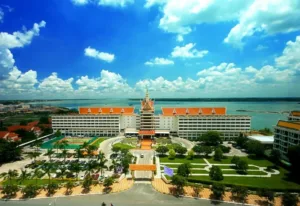
Hotel Cambodiana in Phnom Penh is a hotel dating back to the 1960s, built in the style of "New Khmer Architecture" and commissioned by King Sihanouk. It later served as barracks for Lon Nol and was abandoned during the time of the Khmer Rouge. It was renovated in 1990.
The stilted building overlooking the reclaimed bank of the Mekong was conceived by King Sihanouk himself — and it took Lon Nol, the Khmer Rouge, and refugees to complete it and survive within its walls before it finally became what it was intended to be. Hotel Cambodiana in Phnom Penh is a rare example of “New Khmer Architecture” from the 1960s, a hotel whose history itself is a synopsis of Cambodia’s recent history.
The King’s Commission and “New Khmer Architecture”
In the early 1960s, King Norodom Sihanouk, actively promoting the modernization of independent Cambodia’s appearance, commissioned construction of a representative hotel on the banks of the Mekong from Lu Ban Hap — one of the leading architects of the movement now known as “New Khmer Architecture”: a trend of the 1950–1970s that consciously combined modernist forms spreading around the world with traditional Khmer motifs and climatic solutions adapted to Cambodia’s tropical climate. This movement gave Phnom Penh a number of iconic buildings from that era, and Hotel Cambodiana was conceived as one of its representative showcases.
Construction began in 1963 on literally reclaimed land — the plot on the banks of the Mekong River was artificially expanded for development, and the building itself was erected on stilts, which was both a climatic and an engineering solution for the unstable riverbank. Work was completed only in 1969— at the very end of a relatively peaceful period in Cambodian history, just a year before the coup that would forever change the fate of both the country and the building itself.
Barracks, Ruins, Refugee Shelter
In 1970, shortly after the coup that brought General Lon Nol to power and ousted Sihanouk, the newly completed hotel was taken over for military barracks — instead of guests, the luxurious building on the Mekong River housed soldiers. With the rise of the “Khmer Rouge” in 1975 and the subsequent mass evacuation of cities across the country, the building, like almost all of Phnom Penh’s infrastructure, was abandoned for years. In the period that followed, after the fall of the Khmer Rouge regime, the dilapidated building was temporarily used as housing for refugees and displaced persons — a fate shared by many large buildings in the Cambodian capital during those decades.
A Return in 1990
A new chapter began when a Singaporean company secured a 70-year lease on the building and undertook its complete restoration. The hotel reopened in July 1990 — a moment coinciding with the dawn of a new era in Cambodian history: just one year later, in 1991, the Paris Peace Accords would be signed, formally ending the civil war, and the country would begin a long road to recovery, symbolically marked by the revival of a building once intended as a showcase for an independent, peaceful Cambodia.
The Hotel Today: 239 Rooms on the Riverside
Today, Hotel Cambodiana is a four-star hotel with 239 rooms, located on Preah Sisowath Quay, a five-minute walk from the Mekong River and the Royal Palace, near the Independence Monument and the National Museum of Cambodia. The property features an outdoor pool overlooking the river, tennis courts, two restaurants (Mekong Restaurant and Riverside), a spa, and a fitness center, and for families — babysitting services at an additional charge.
What Guests Say
- “Location, service, atmosphere, and cleanliness are all excellent. The equipment is somewhat outdated; the bathrooms only have old fixed showerheads, which is slightly inconvenient. Apart from the equipment, everything else is great. Very good value for money!”
- “This is a good hotel. I chose a room with a river view. The hotel is clean, rooms are spacious, and staff are friendly.”
- “Excellent hotel. The renovation is a little dated, but overall excellent location, nice rooms. The staff are great!”
- Some rooms have noisy air conditioners and the room equipment is a little dated. Overall, it’s relatively quiet here and the staff are friendly. There’s an outdoor pool and tennis court by the river with pleasant views.
- This is an old, run-down hotel; the beds are old, making for an uncomfortable sleep. Positives include its riverside location and the ability to walk to the nearby Royal Palace and museum.
What’s Next
Here are two more examples of 20th-century Phnom Penh architecture from our section — the renovated French colonial building Plantation Urban Resort and the skyscraper Rosewood Phnom Penh, occupying the tallest building in the country.
Prices, room availability, and service inclusions are subject to change – please check for updated information before your trip.