Bian lian is the technique of instant mask changing in Sichuan opera, the secret of which was kept for centuries inside families of masters. How it works, what the colors mean and where to watch it in Chengdu.
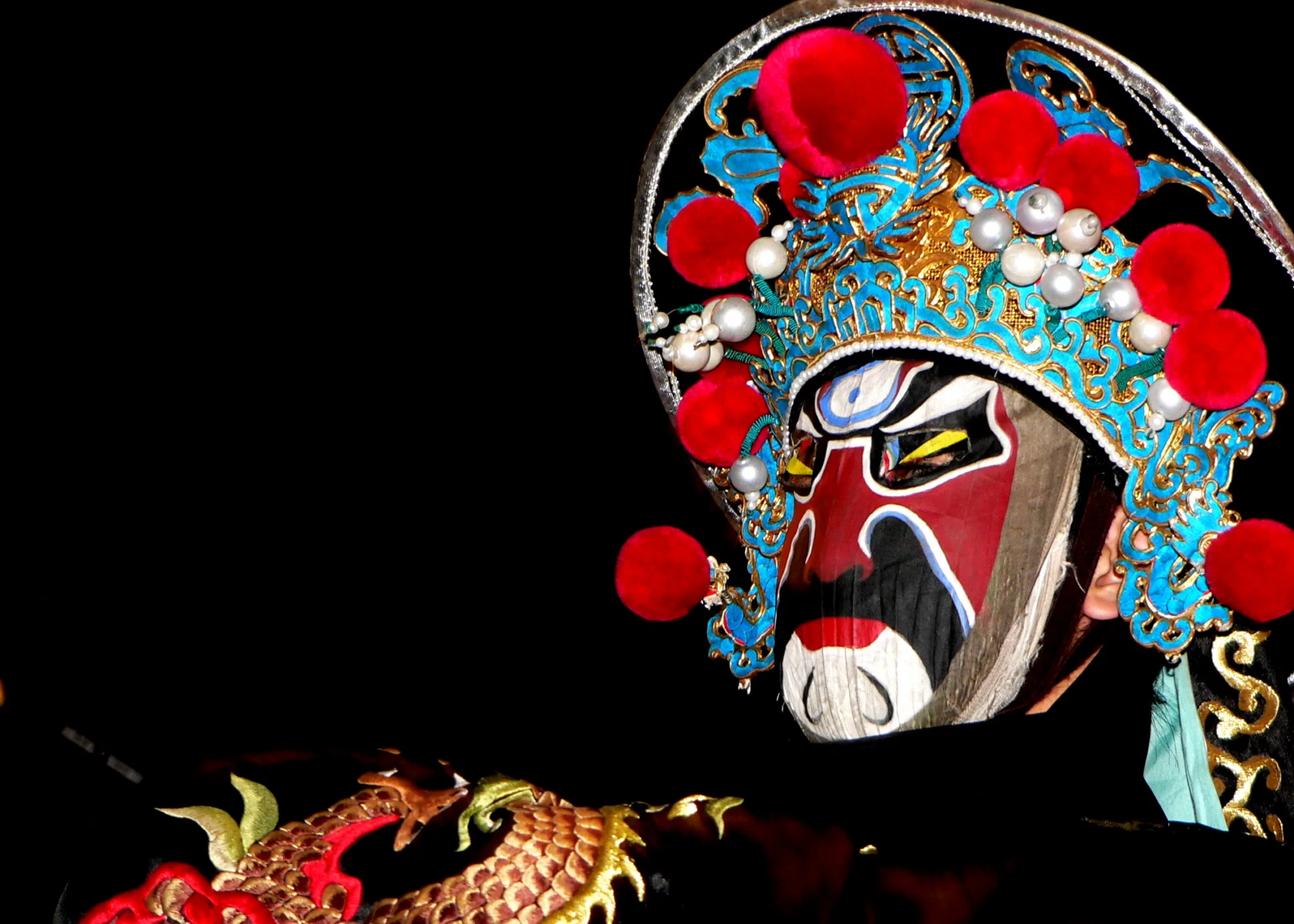
A performer in a bright embroidered robe makes a sharp sweep of a fan in front of the face — and where a moment ago there was the scarlet face of a demon, there is now the blue mask of a spirit, then a black one, then a golden one, and so seven times in a minute, with not a single visible hand movement toward the face and without a pause in the dance. Spectators in the front row of a Sichuan tea theater instinctively lean forward, trying to catch the moment of the switch — and almost never manage. Bian lian, “face changing”, is one of the most mysterious stage tricks that have come down to us from imperial China, and the secret of its mechanism was guarded by families of masters for centuries as carefully as the recipe for a real secret sauce.
Three hundred years of a family secret
The technique of instant mask changing was born inside Sichuan opera — one of China’s oldest theatrical traditions — around the middle of the 18th century, in the era of the Qing dynasty’s Qianlong Emperor. Originally the device was used to show visually a sharp change in a character’s mood or nature on stage — fear, rage, transformation into a spirit — without interrupting the action to change backstage. The secret of the technique was passed down for centuries exclusively within the master’s family, and traditionally only along the male line: it was believed that a daughter, once married, would carry the secret to another family, and therefore only sons were taught. Such secrecy was preserved right up to the 20th century, and only relatively recently has the technique begun to be officially taught in theater schools — today women can also master bian lian, although most of the leading performers still trained within closed theater troupes.
How it actually works
Performers are forbidden by the guild’s official code to reveal the secret of bian lian, but the general principle is known and described in detail by researchers of Chinese theater. Modern masters use not the usual rigid masks but the thinnest painted silk sheets — sometimes more than twenty layers — each of which is attached to the face by a separate, practically invisible thread or fishing line hidden in the folds of the costume. A sharp turn of the head, a sweep of the fan, a jerk of the sleeve or a flick of the cloak serves at once as an effective stage gesture and as a mechanical release: one sheet is torn off, revealing the next, already applied beneath it. An older, less “high-tech” version of the trick is the so-called “pulling”: make-up hidden in the eyebrows or sideburns is smeared across the face with a sharp movement of the palm, instantly changing expression and color without any mechanism. Both techniques require years of practice in synchronizing movement and music — a mistake of a split second, and the spectator in the front row will see the secret of the performance.
What the mask colors mean
As in classical Chinese opera in general, the color of the mask in bian lian is not a random choice by the costume designer but part of a symbolic language understood by the local audience without translation. Red is traditionally linked with courage and loyalty, black with honesty and directness of character, gold and silver usually mean deities or supernatural beings, blue indicates a character’s stubbornness or arrogance, and white often signals treachery and cunning. An experienced spectator, even without understanding a word of Chinese, can read a plot turn from a single change of mask color — the hero gave in to anger, met an evil spirit or his true, less noble nature was finally revealed.
Where to watch in Chengdu
The capital of Sichuan province, Chengdu, is the undisputed center of the tradition, and it is here that it is easiest to see bian lian in an authentic setting rather than in a tourist production somewhere in another city. The best-known and most atmospheric option is the Shufeng Yayun tea theater on the grounds of the Cultural Park, by the walls of the ancient Taoist temple Qingyang Gong: the performance there runs in the classic tea house format, where spectators sip tea and crack sunflower seeds right during the show, as people here have done for generations. The evening’s program is usually not limited to mask changing: it also includes shadow theater, puppet numbers, Sichuan opera singing and the spectacular fire-breathing trick, so in one evening you manage to see several facets of the local stage tradition at once. There are usually two sessions an evening, at about six and eight o’clock, lasting about an hour and a half.
Tickets and what to pay attention to
Prices depend on proximity to the stage and the set of included options: basic seats cost noticeably less, and VIP tickets, besides the best view, often include one of the local “Sichuan” procedures before the show starts — ear cleaning with a special instrument, a short massage or the chance to try on an opera character’s costume for a photo. In most theaters the ticket price already includes tea and light snacks, which are brought around before the start and during the interval. A sensible tip for those who want to really see the moment of the mask change, and not just catch the general impression, is to take seats closer to the stage: from the back rows the trick is also effective, but the details of the movement are lost at a distance.
FAQ
Is it true that performers have no right to reveal the secret of the technique? Yes, traditionally revealing the mask-changing mechanism is considered a serious violation of guild ethics within the community of Sichuan opera performers, although the general principle of the technique has long been described in open sources and is no longer a complete secret.
How many masks can a performer change in one performance? Depending on the number — up to seven or eight changes in about a minute of continuous movement, each change synchronized with a particular musical accent and gesture.
Can I see bian lian outside Chengdu? Separate staged shows with elements of bian lian are sometimes shown in other large cities of China and even abroad, but the truly authentic context of Sichuan opera — with a tea house, music and a full program of numbers — is to be sought precisely in Chengdu.
Do I need to understand Chinese to enjoy the show? No — the mask changing itself, the music, the costumes and the color symbolism are perceived visually and without translation, and tourist-oriented theaters usually have short explanations in English.
Is it worth taking a VIP ticket? If you want not only the best view but also to try local entertainments like ear cleaning or a costume photo — yes, but for the purely spectator impression of the show a mid-level ticket with a seat closer to the stage is quite enough.
Ticket prices, session schedules and the program of performances may change — check the current information before your visit.