Zhangye Danxia rainbow mountains in Gansu province: how 24 million years of geology turned into a striped landscape. Tickets, the best time for the brightest colors and how to get there.
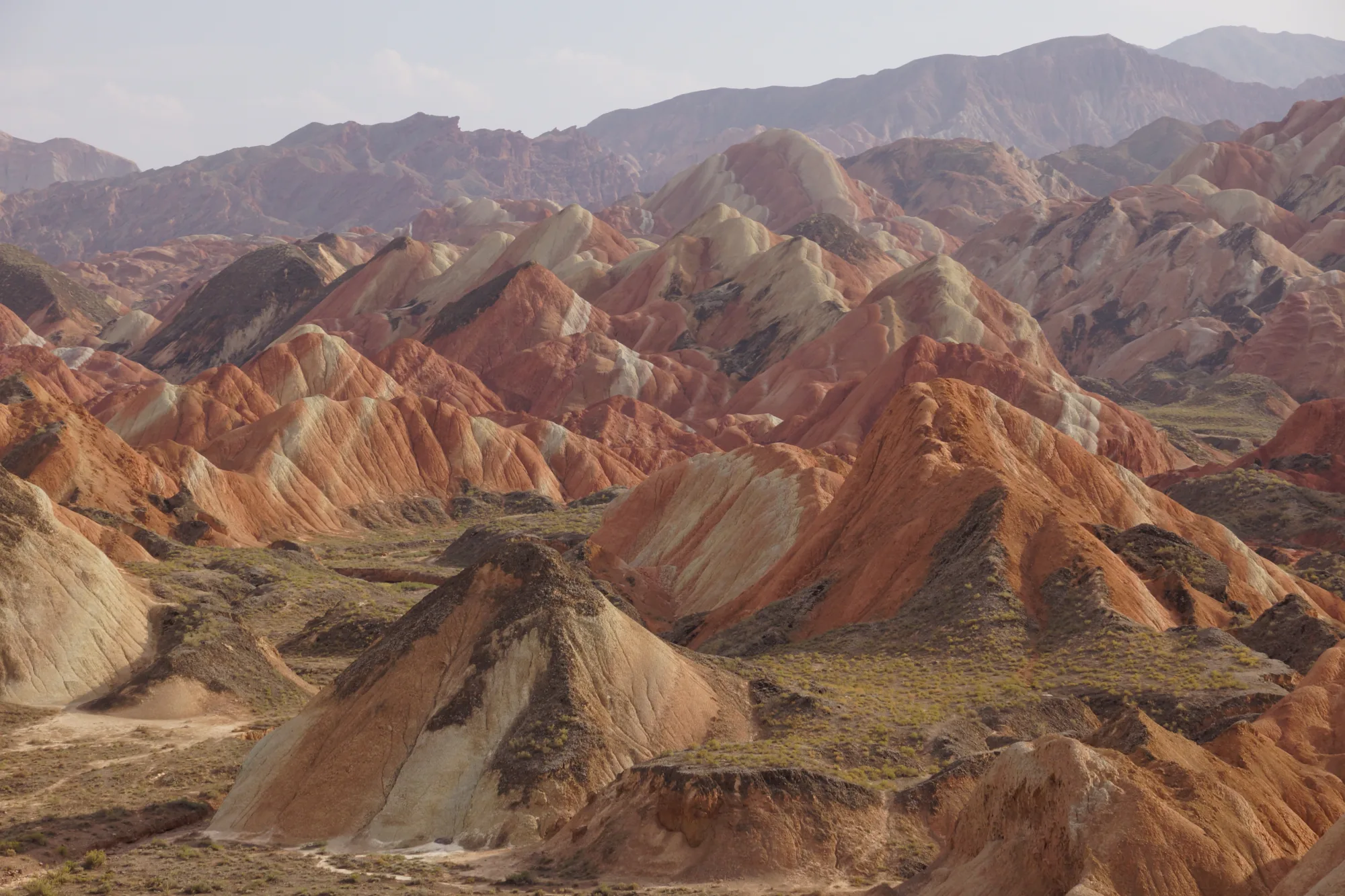
The first reaction at the sight of these mountains is almost always the same: “surely this isn’t tinted in an editor?” The layered slopes, as if cut by a giant knife into red, orange, yellow, green and bluish stripes, look so unreal that many tourists who see photos of Zhangye Danxia for the first time sincerely suspect Photoshop. But the mountains are real, the colors are real minerals, not a filter, and they are located in northwest China, in Gansu province, along the ancient Silk Road, where you least expect to meet one of the planet’s most psychedelic landscapes.
Twenty-four million years for a single photograph
What looks like a random whim of nature is in fact the result of a geological process tens of millions of years long. Millions of years ago the site of today’s mountains was the floor of an ancient sea — gradually, layer by layer, sandstone and other mineral sediments of different composition and different color were deposited here. When the tectonic plates that raised the Himalayas began to move, this layered “pie” was pushed upward and tilted at an angle — so the once horizontal strata became the very diagonal multicolored stripes that tourists see today. Then erosion took over: water and wind washed out the softer rocks for millions of years, exposing the relief and making the contrast between the layers even sharper. This type of landscape is called danxia in geology — after similar formations in China — and Zhangye is considered one of its brightest and best-preserved examples in the world, which became the basis for including the geopark in the UNESCO World Heritage list.
Where the colors come from
The secret of the rainbow palette is in the mineral composition of each individual layer of rock. Red and orange shades come from iron oxides — essentially ordinary rust formed in the rock during arid periods rich in oxygen, when the iron in the minerals oxidized. The yellow and greenish stripes are linked to other mineral inclusions and a different degree of oxidation, and the lighter, almost white interlayers to sandstone in which there was little iron at all. The result is not a static picture: depending on the time of day, the angle of the sun and the humidity of the surface after rain, the same slope can look now muted ochre, now almost neon bright — which is why photographers return to the same viewpoints at different times of day.
When to go: light decides everything
Zhangye Danxia is a rare case where the time of the visit literally determines what you will see. At midday, in direct overhead light, the colors noticeably fade and “flatten” — some tourists who came at noon later write disappointedly in reviews that the mountains are “not as bright as in the photos”. The explanation is simple: the shots with the most saturated colors were almost always taken in the first hour after sunrise or, even more spectacularly, in the last hour before sunset, when the low sun lights the layers from the side and strengthens the contrast of red and orange tones. A separate stroke of luck is to be in the park right after rain: the wet surface of the rock gives the deepest, most saturated shades, which dry out and fade again within half an hour. As for the season, it is most comfortable to go from June to September — at other times it may be either cold or windy in Gansu, and some viewing routes work on a reduced schedule.
How the park is arranged and what to see
The geopark is arranged so that tourists do not wander chaotically over the fragile landscape but move between sites on a special shuttle bus — walking on the slopes yourself is prohibited here, partly to preserve the relief, partly for safety reasons. The standard route includes four main viewing platforms from which the most recognizable and photogenic views of the striped slopes open — these are the points to plan for the sunset hours. For those who take photography more seriously, there is an in-depth route for an extra fee giving access to less crowded platforms closed to ordinary visitors — an option for photographers willing to pay for views without a crowd in the frame.
Tickets and how to get there
The combined ticket, which includes entry to the park and a ride on the internal shuttle between sites, costs about 93 yuan for adults, is valid for 48 hours and lets you pass the entrance twice by a facial recognition system — that is, you can come back for the next day’s sunset on the same ticket. There are discounted rates for students and for elderly people aged 60–69, and admission is free for visitors aged 70 and over. The in-depth photo route with access to additional platforms costs about 328 yuan. The easiest way to reach the park is through the city of Zhangye — a major hub along the ancient Silk Road with its own airport and railway station, from where it is about 40 minutes by taxi to the geopark. In peak season (April–October) the park works from 5:30 a.m. to 7 p.m., with the last entry at 6 p.m., so that guests can catch the sunset.
A practical tip for photographers and ordinary tourists
Even without a professional camera it is worth bringing at least a phone with a good sensor and not being too lazy to walk to the far sites of the route — the views most widely circulated on social media are often shot not from the first point closest to the entrance but from more distant platforms that fewer tourists reach. Sunglasses and a hat are mandatory: in the middle of the day, between the morning and evening “golden hour”, there is practically no shade in the park, and the direct sun in Gansu is quite intense. And most important — plan the visit not for one day but for an evening and the following morning: it is the change of lighting at dawn and sunset that turns Zhangye Danxia from a merely unusual landscape into one of the strongest visual impressions of a trip around China.
FAQ
Is it true that the colors in photographs are embellished? Partly yes — photographers boost contrast with processing and choose the best lighting, but the colors themselves are absolutely real: they are natural minerals in the sandstone layers, not decoration or tinting.
When is it better to come — in the morning or the evening? Both are good, but most of the most spectacular shots were made in the last hour before sunset, when the low sun gives the most expressive side light and deep shadows between the rock layers.
Can I walk the mountains on my own? No, moving around the park’s territory is possible only along the route on a special shuttle between the viewing platforms — this is done to protect the fragile relief and for safety reasons.
How much time does a visit take? At least two to three hours to tour the main sites, but for the best photographs it is more sensible to plan a sunset visit and return at dawn the next day on the same 48-hour ticket.
Is it worth going specially for this place? If you are interested in unusual natural landscapes and are ready to adjust your route to the time of day — absolutely yes, it is one of China’s most recognizable natural sites, quite unlike the country’s usual urban or mountain attractions.
Ticket prices, the park’s schedule and shuttle routes may change — check the current information before your trip.