A 1924 estate in the former French Concession of Shanghai: it’s where Chiang Kai-shek supposedly proposed to Soong Mei-ling, and after 1949, the estate became a state residence for Mao, Zhou Enlai, and foreign leaders.
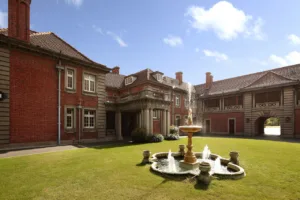
In the heart of Shanghai’s former French Concession, among old plane trees and Tudor-style mansions, stands a hotel—in whose garden a proposal of marriage was made that changed the course of Chinese history. InterContinental Shanghai Ruijin — this is how the former Juijin estate is known today, and until 1949 it was the private manor of a British magnate, which became the residence of one of the most influential politicians of the 20th century.
The Manor of a British Magnate
The estate was built in 1924 for Benjamin Morris — a British entrepreneur who made his fortune in Shanghai during the era of international concessions, when the city was one of Asia’s most cosmopolitan ports and foreign businessmen were building mansions here that were no less impressive than those in London or Paris. The architecture of the grounds is characteristic of the time—a mix of English country estates (Tudor half-timbered facades, an extensive park with old trees) surrounded by the rapidly expanding Shanghai metropolis.
The location proved strategically advantageous: the estate is located in the area of the former French Concession, one of the few parts of Shanghai where colonial construction from the 1920s has been preserved almost untouched—today it is one of the greenest and quietest historic districts of the city, built with similar old mansions and plane tree avenues.
A Proposal That Changed Chinese History
In 1927, the estate became linked to Chiang Kai-shek through an episode often recounted as part of the broader story of his relationship with Song Meiling—the youngest sister from a prominent Shanghai family. Their familial connections (including her older sister’s marriage to Sun Yat-sen) made the marriage not just personal, but a political alliance. According to a widespread version, Chiang Kai-shek proposed to Song Meiling in the garden of this estate—just months before they married in Shanghai in December 1927, and as Chiang Kai-shek himself became the de facto leader of the Republic of China for the next two decades.
Regardless of how literally historically accurate the legend about the specific location of the proposal is (such details are rarely documented protocolarly in private correspondence of that time), the estate itself has firmly entered the biographical canon of this couple—and therefore into the history of pre-war China’s political elite.
State Residence for World Leaders
After the founding of the People’s Republic of China in 1949, the estate, like many similar former private properties belonging to foreigners and Chinese elites, passed into state ownership and was used as a residence for receiving foreign delegations and high-ranking guests. Mao Zedong and Zhou Enlai are named among its guests at different times, as well as foreign leaders of the socialist bloc and the Non-Aligned Movement—Indonesian President Sukarno and North Korean leader Kim Il-sung, whose visits to Shanghai in the 1950s–60s were invariably accompanied by protocol receptions of precisely this level of exclusivity and representation.
The status as a state residence explains the complex’s appearance today: an extensive, well-maintained old park with centuries-old trees amidst dense urban development—a rarity for central Shanghai, where land has historically been too expensive to allow such luxury of space unless the estate had been under state protection precisely because of its protocol status.
The Hotel Today: Garden, Quiet and World-Class Service
Currently, the estate is managed by InterContinental Hotels Group, and its location—a short walk from South Shaanxi Road metro station and a couple of blocks from Huaihai commercial street—makes the hotel equally convenient for business trips and for those who want to stay in the historic part of the city, rather than in the new Pudong skyscrapers. Shanghai Railway Station is about 4 km away; Hongqiao Airport is approximately 13 km.
A recurring theme in reviews is that guests primarily praise not the rooms themselves (though they are spacious and elegant), but rather the garden—”serene,” according to one guest, with many old trees, which is lovely to stroll through in the evening when this part of the city becomes truly quiet. The front desk staff—specifically employees named Yves, Carrie, and Stanley—are mentioned by name in several independent reviews, which is uncommon for hotel reviews and usually indicates consistently high, rather than one-off, service levels.
What Guests Say
- “Staying at the hotel was excellent! I’d especially like to thank the front desk staff: Carrie, Claire, and Stanley. They were very professional and efficient, helped improve the room […] The hotel is wonderful, the service is top-notch.”
- “The external setting of the hotel impresses with its grandeur and tranquility, ideally suited for receiving state and foreign guests. The interior décor harmonizes perfectly with the exterior: rooms are spacious, quiet, graceful, and elegant.”
- “Ruijin Hotel is excellent, with a beautiful serene garden and clean, cozy rooms. The service is warm, attentive, and efficient […] There are many old trees in the garden, and it’s very quiet to walk around here in the evening.”
- “InterContinental Ruijin Shanghai is located very close to Ruijin Hospital, which was very convenient. We were very pleased with our stay! We especially want to mention the front desk staff Yves, Carrie, and Claire.”
What’s Next
Ruijin stands alongside other Shanghai hotels in historic buildings—for example, Capella Shanghai, the only hotel in the city built from actual old shikumen houses. And if you’re arriving via Pudong, you’ll find our breakdown of how to get from the airport to the city center faster and cheaper useful.
Prices, room availability, and service composition may change—check for current information before your trip.