The 10th Echigo-Tsumari Art Triennale runs from 17 July to 7 November 2027 in Niigata. What is confirmed about dates, venues, tickets and access, and what is still unannounced.
A narrow road climbs along terraces where the rice stands thick and green in July. Gravel crunches under the wheels of a rental car, and ahead is an old school whose classrooms now hold other people’s thoughts turned into installations. Further up the slope stands a house where you can spend the night in a room flooded with an artist’s light. And in a village with only a few dozen residents, a house on the edge of the settlement suddenly turns out to hold a work that was worth leaving the highway for. This is Echigo-Tsumari, the world’s largest open-air contemporary art triennale. In 2027 it takes place for the tenth time, from 17 July to 7 November.
We have gathered verified information about the 2027 triennale, noted what is known for certain and what the organisers have not yet announced, and prepared a practical plan for a trip from Tokyo. The data is current as of 24 November 2026.
- Dates: from 17 July (Saturday) to 7 November (Sunday) 2027, 85 days, the tenth edition.
- Where: the cities of Tokamachi and Tsunan in Niigata Prefecture, about 760 square kilometres and around 200 artworks.
- Director: Fram Kitagawa, who has led the triennale from the start.
- 2027 tickets: separate triennale prices have not been announced yet; a winter bundle with snow fireworks and a 2027 voucher is already on sale.
- Getting there: by rail to Tokamachi station, then local trains and a car; you need an international licence to drive.
What Echigo-Tsumari is and why go
The triennale has been held every three years since 2000; the 2027 edition will be the tenth. The idea, as the organiser puts it, is simple and unusual: “human beings are part of nature”. Instead of museum halls the exhibition uses rice terraces, roads, abandoned schools, houses and tunnels in the mountainous Echigo-Tsumari region. According to the official site the territory covers about 760 square kilometres divided into six areas. Around 200 works remain here permanently, and new ones are created for each triennale.
The official site also mentions that some works can be seen year-round, while temporary works and programmes are added for the triennale. The list of works that will appear in 2027 had not been published when this article was prepared: we found only a link to the artwork calendar on the organisers’ site. So do not expect descriptions of “the main novelties” from us: they are not yet in the public domain.
Who is behind the triennale: Fram Kitagawa
The project’s general director, Fram Kitagawa, was born in 1946 in Niigata and leads not only Echigo-Tsumari but other major art festivals in Japan too. These include the Setouchi Triennale, the Northern Alps Art Festival and the Oku-Noto Triennale. This matters for planning: if you have been to Setouchi, much will feel familiar in spirit, but the scale and wildness of the landscape here are different: you travel not across islands but through mountain villages.
2027 dates and when to go
The triennale dates for 2027 are 17 July to 7 November. These dates are published on the tickets page of the official site. Which time within the range suits you depends on your taste.
- Late July and August: rice at its greenest, hot days and a dense programme.
- September: the rice turns yellow and the weather is milder; for walking between villages this is perhaps the most comfortable time.
- October and early November: cooler and quieter; near closing, check the opening hours of individual works.
A third-party events listing says that sites are generally closed on Tuesdays and Wednesdays, except 10 August, 11 August and 3 November. We did not find this schedule for the triennale on the official site, so confirm before travelling. For winter programmes the official site states the same principle: closed on Tuesdays and Wednesdays except holidays.
2027 tickets: what is known
At present no separate ticket price for the 2027 triennale has been published. What the official site does have:
- Winter bundle with the 2027 snow fireworks: it includes entry to the fireworks, a “passport” voucher for the 2027 triennale and a ticket to the winter programme. The adult version costs 8,000 yen, a high school student 6,000 yen, a middle or elementary school pupil 3,000 yen; there are discounts for residents of Tokamachi and Tsunan. Sales run from 20 September 2026 to 26 February 2027 or until sold out. The fireworks are planned for 27 February 2027.
- Winter programme: Art Field Winter 2027 runs from 30 January to 7 March 2027.
For orientation: a Japanese travel portal lists, for the 2026 event in the region, a price of 2,500 yen for adults and 1,000 yen for elementary and middle school pupils. That is not the 2027 price; treat it as a lower bound and check the official site when sales open.
Venues to keep in mind
The triennale has several anchor sites that help plan a route. Details from the official site:
- MonET (Museum on Echigo-Tsumari): a building designed by Hiroshi Hara with 15 permanent works; about a ten-minute walk from Tokamachi station.
- Matsudai NOHBUTAI: a structure by MVRDV with about 40 works nearby in a “field museum”; directly connected to Matsudai station.
- Kyororo (Matsunoyama Museum): about 40 works.
- Tunnel of Light in Kiyotsu Gorge: a tunnel 750 metres long.
- James Turrell’s House of Light: the only Turrell work where a visitor can stay overnight.
The organisers have not yet published a list of venues for 2027, so use these places as the basis of a plan, not as a final list.
How to get from Tokyo to Tokamachi
The official site describes the route like this: to Tokamachi station by rail, on the Hokuhoku Line and JR, from Tokyo or Nagoya by bullet train, or by air from Niigata Airport. A Japanese travel portal adds that from Tokyo the area can be reached via the Joetsu Shinkansen with a change to a local train. We did not find travel times or fares in these sources, so we do not give them.
Practical details from the official site:
- Tokamachi and Matsudai stations are close: about ten minutes apart on the Hokuhoku Line, with trains roughly once an hour;
- by car from the Muikamachi or Shiozawa-Ishiuchi exits of the Kan-Etsu Expressway it takes from about 20 minutes to an hour; an international driving licence is needed to rent;
- near Tokamachi station there are car rental offices and taxis.
The area is large, so without a car or an organised tour you will see far less. If you do not drive, consider a tour or a day taxi and check train timetables in advance. Links to the Hokuhoku Line timetable are on the organisers’ site.
Where to stay
The official site mentions several unusual places to spend the night. In Turrell’s House of Light you can stay overnight. In Akiyamago there is Katakuri House, a hot-spring inn in a former school, and in Matsunoyama there is Sansho House, also in a former school. For winter tours the hotels Route-Inn Tokamachi and New Tokamachi are used. The page has no booking recommendations for the triennale period, so do not delay: in spring it is usually already visible which rooms are taken.
A three-day plan
If you have three days, the structure could be as follows.
- Day one: arrive in Tokamachi, MonET, a walk around the centre, dinner in town. Go to bed early: in the morning you start by car or on a tour.
- Day two: Matsudai and Matsudai NOHBUTAI, then the surrounding villages with works in old houses and schools. Stop at the Tunnel of Light in Kiyotsu Gorge in the later part of the day.
- Day three: Kyororo and the Matsunoyama area, then back to the station.
Do not try to see everything. The area is about 760 square kilometres, and some works are closed on certain days. The best way to feel the place is to choose two or three districts, give yourself time to sit by the terraces and listen to the village.
Winter works too: snow fireworks and Art Field Winter
If waiting until July seems too long, you can get to know the region in winter. The official site lists two winter events. The Art Field Winter 2027 programme runs from 30 January to 7 March 2027. The snow fireworks, timed for the tenth anniversary, are planned for 27 February 2027, and the ticket for them, as we wrote above, includes a voucher for the triennale. It is a good idea for those who want to see the area ahead of time and come back in summer prepared: in winter you will understand how far apart the villages lie and that without transport it is not easy.
Questions and answers
Can I manage without a car? The official site describes Tokamachi and Matsudai stations as convenient anchor points, and MonET is a ten-minute walk from Tokamachi. But the territory covers about 760 square kilometres, and without a car or a tour you will see only a small part.
Do I need an international licence? Yes; for renting a car the organisers specify an international driving licence.
Are there works that can be seen outside the triennale? Yes. According to the official site, about 200 works remain in the region permanently, so the area is interesting outside the triennale too, and in a triennale year new ones are added.
When do tickets go on sale? We did not find the start of sales for separate 2027 triennale tickets on the site. The winter bundle is on sale now.
How to prepare in advance
Make a short list of three areas that really interest you and choose accommodation around them. Download an offline map: connectivity in mountain villages can be unstable. Allow extra time on the road, because the routes between works run on mountain roads. Choose comfortable closed shoes: some works are on slopes and by fields. And above all leave empty windows in the schedule: Echigo-Tsumari works best when you are not in a hurry.
What we do not know today
As of 24 November 2026 the organisers have not published the list of new works for 2027, separate triennale ticket prices or detailed public transport routes. We also found no confirmed data on journey times from Tokyo. As soon as the information appears on the official site, we will supplement the article.
Sources
- Official triennale site: echigo-tsumari.jp (About, Visit and Access pages).
- Event listing on iwafu: iwafu.com.
- Article about the region on Japan Travel: japantravel.com.
More about travelling in Japan in 2027 in the Japan events calendar and the Gion Matsuri guide.
Information is current as of 24 November 2026. Dates and prices may change; check the official site before travelling.
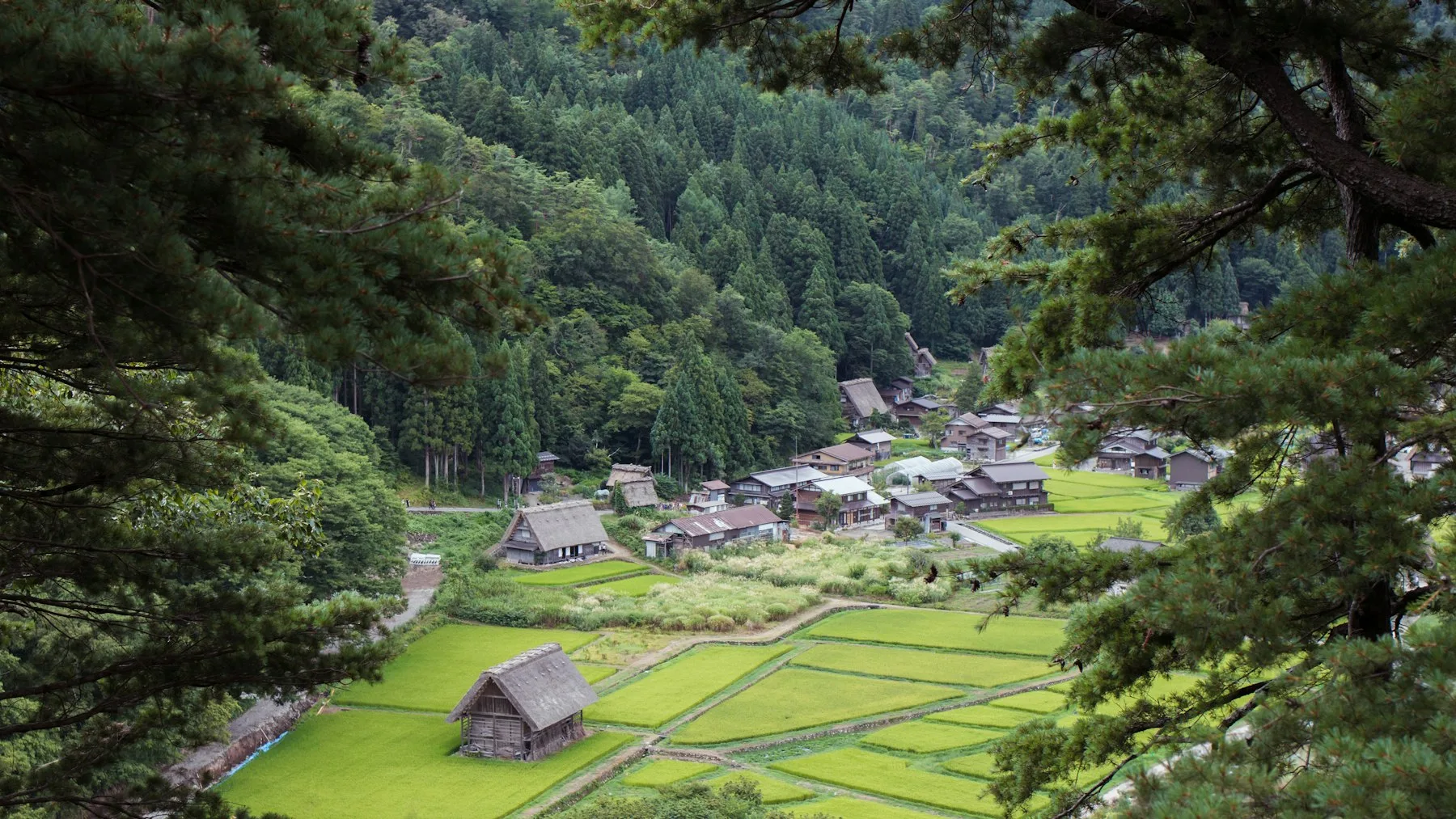
Cover photo: Unsplash (illustration: a Japanese mountain village among rice fields).