Japan 2027: the main events of the year — the Sapporo Snow Festival, cherry blossoms, GREEN×EXPO in Yokohama, Kanda Matsuri, Gion in Kyoto, Tenjin in Osaka, Nebuta and Awa Odori. Dates, prices, routes and booking tips.
Imagine a street where it has gotten dark but the lights have not been turned off: a huge paper warrior the height of a two-story house floats along it, thousands of bulbs burning inside, thousands of people in white yukata and flower-decked hats leap around, shouting in chorus “Rasserah!”, drums beat, and you realize you have been standing at the roadside for half an hour and haven’t noticed the time pass. This is what Nebuta in Aomori looks like — and it is only one evening from a long list of events that will make 2027 special in Japan. Several rare coincidences come together this year: an odd year, when the main, “big” Kanda Matsuri takes place in Tokyo; an international horticultural exhibition in Yokohama for six months; the unchanging but each time new cherry blossom season; and, of course, the country’s three main summer festivals, which for the first time in a long while are conveniently combined into one route.
- February 4–11 — the Snow Festival in Sapporo (free admission).
- March 19 – September 26 — the international horticultural exhibition GREEN×EXPO 2027 in Yokohama.
- Approximately March 23 – April 5 — the best window for cherry blossoms in Tokyo, Kyoto and Osaka (the exact forecast comes out only in December–January).
- Early to mid-May — Kanda Matsuri in Tokyo (held in odd years; exact dates to be announced later).
- July 1–31 — Gion Matsuri in Kyoto; the main float processions are on July 17 and 24.
- July 24–25 — Tenjin Matsuri in Osaka with a river procession and fireworks.
- August 2–7 — Nebuta in Aomori.
- August 11–15 — the Awa Odori dance festival in Tokushima.
How to read this calendar and why you need to book right now
The main rule of Japanese festivals is that they do not adapt to travelers. Hotels in Kyoto for Gion and in Aomori for Nebuta are snapped up half a year ahead and earlier, tickets for paid seats along the route are sold in waves, and prices on these days rise several times over. So it is better not to “choose where to go” but first to choose one or two dates that truly fire you up and build the trip around them. Below are the festivals in calendar order, with what is the main thing in them, where to watch and what mistakes beginners make most often.
The dates below are according to tourist services and organizers at the time of preparing this piece. For a number of events (Kanda Matsuri, the cherry blossom forecast, individual programs of Awa Odori) the final schedules will be announced closer to the season, so before buying tickets check the official websites.
February: Sapporo, a city where palaces are built from snow
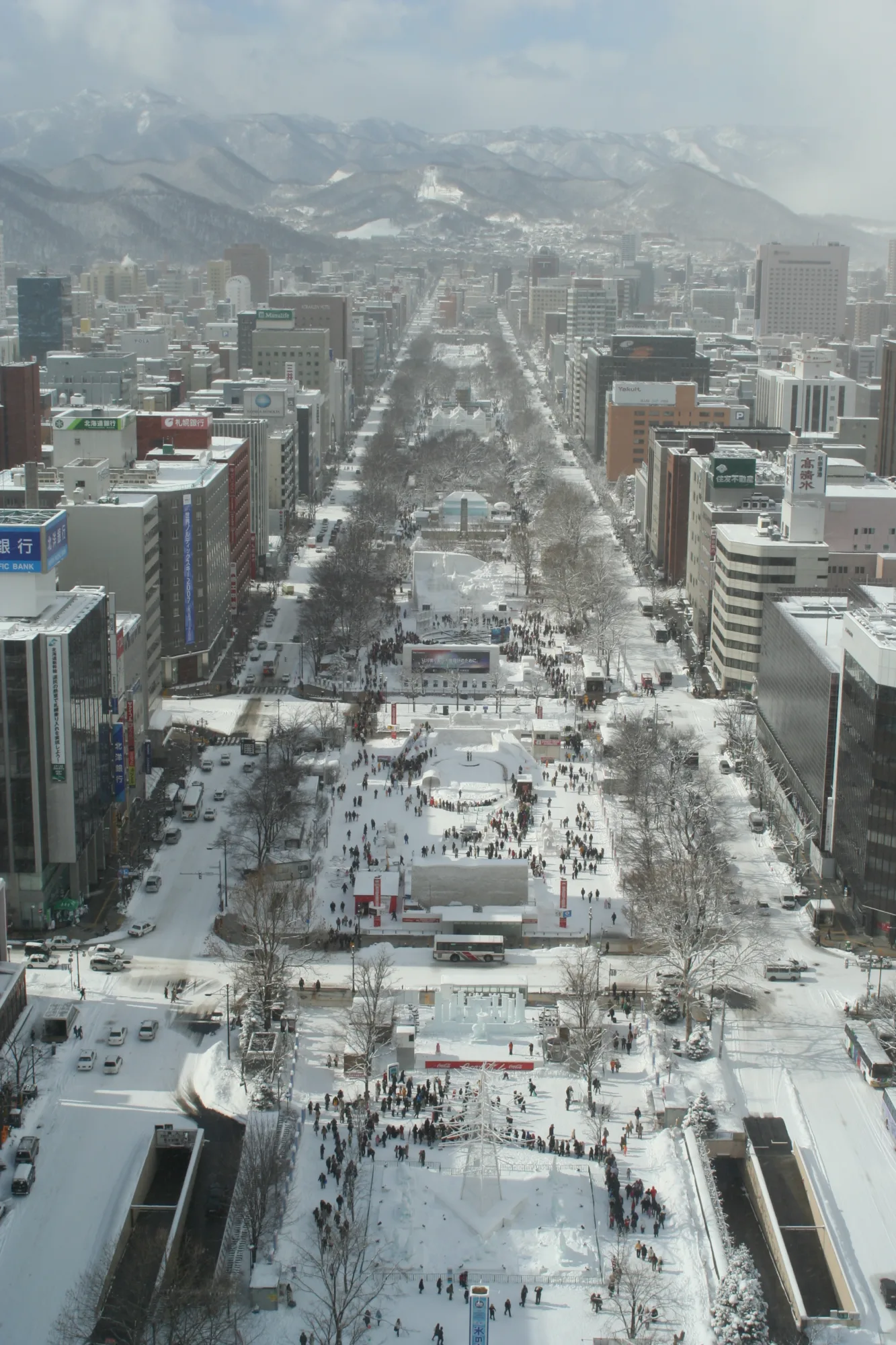
The year in Japan begins with frost. From February 4 to 11, 2027, the Snow Festival takes place in the north, in Sapporo — and you will be surprised at how childishly sincerely this large-scale festival works. It all began in 1950, when six schoolchildren made six snow figures in Odori Park; today in the same park there are a kilometer and a half of sculptures, some taller than fifteen meters, and next to it two more sites: the ice sculptures of Susukino (to the south, in the nightlife district) and the family-oriented Tsudome with snow slides and a maze. Admission to all three sites is free, you pay only for food, souvenirs and rides. The best time for Odori Park is the first days of the festival, while the sculptures are fresh, and twice: by day — to look at the details, in the evening — when the lighting is turned on. A detailed guide with prices, sites and clothing tips is in our piece on the Snow Festival in Sapporo.
March — April: cherry blossoms and a double plot with the Expo
Cherry blossoms are the only event on this list that is not marked on a calendar and is not sold by ticket, and it is exactly what drives planners crazy every year. The guideline for 2027 is the window from March 23 to April 5 for Tokyo, Kyoto and Osaka: in Tokyo the peak of blossoming usually falls around the end of March, in Kyoto in the first days of April, and in the north, in Tohoku and Hokkaido, the cherries bloom in mid-to-late April. Each tree blooms for about ten to fourteen days, and the very peak is only five to seven, so one wrong day can turn a “pink cloud” into a rain of petals. The Japan Meteorological Corporation publishes official forecasts only in December–January, but hotels in big cities are booked six to twelve months ahead, so you can’t wait for the forecast. A practical tip: take a week and move from south to north following the blossoms — for example Kyoto and Nara, then Tokyo — and keep flexible dates in reserve.
The year 2027 adds one more reason to come in spring besides the cherry blossoms. From March 19 to September 26 the international horticultural exhibition GREEN×EXPO 2027 takes place in Yokohama — on the territory of the former American Kamiseya Communication Facility in the Seya and Asahi wards. Of the 242 hectares of land returned to the Japanese, about a hundred are allotted to the exhibition, and ten million flowers are promised, with organizers expecting around fifteen million visitors. The theme is “Scenery of the Future for Happiness”, and the idea itself is simple: to show how greenery, gardens and biodiversity change urban life. Entry is by ticket only with a prebooked date; discounted tickets can be bought in advance until March 18, 2027, and during the operating days at the regular price. Shuttle buses run from Seya station on the Sotetsu line. If you are going to Japan for blooming gardens, the Expo is a rare chance to see blossoms not for one week but for six months in a row: tulips, summer flower beds, autumn compositions.
May: Kanda Matsuri, the most “Tokyo” festival
Tokyo is rarely associated with folk processions, but once every two years the city is transformed. Kanda Matsuri is held in odd years — which means 2027 is exactly the “big” one — and stretches for about a week in early to mid-May, although the center of the festival is the weekend. It is one of the oldest and most revered street events in the capital: more than two hundred neighborhood mikoshi — portable shrines carried by local residents and trade associations — converge at Kanda Myojin shrine to receive a blessing, while floats, musicians, dancers and people in Heian-era costumes parade through the streets. To go to such a procession is to see Tokyo as the Tokyoites themselves know it: without shop windows and without neon, but with the endless thunder of drums and the cries of the bearers. The organizers will announce the dates of Kanda Matsuri in 2027 later: approximately it will be the weekend closest to mid-May, but it is better to check the exact date with the shrine’s website.
July: Gion — the month when Kyoto turns into a theater
If you choose one festival for all of Japan, many would choose Gion Matsuri. It runs all of July — from the 1st to the 31st — and traces its count to 869, when, according to tradition, the people of Kyoto prayed for deliverance from an epidemic. Today it is Kyoto’s largest festival and one of the greatest in the world, and its heart is Yamaboko Junko, the procession of huge floats. There are two types: twenty-four “yama” (smaller, carried by hand) and ten “hoko” (tall, on wheels): some reach twenty-five meters in height and weigh up to twelve tons. They are pulled by hundreds of people, and at the turns comes the famous “tsuji-mawashi”: bamboo is placed under the wheels and the multi-ton float is turned on the spot while spectators hold their breath.
In 2027 the main processions are on July 17 (roughly 9:00 to 13:00) and July 24 (9:30 to 11:50), along a route about three kilometers long through Shijo, Kawaramachi and Oike streets. On the eve, on the yoiyama evenings — July 14–16 and 21–23 from six in the evening to eleven — the central blocks of Kyoto are closed to cars and turned into a fair: the evening floats glow with paper lanterns, vendors sell snacks, and people stroll the narrow streets in yukata. On the evenings of July 17 and 24 the mikoshi togyo also takes place — a procession of portable shrines from Yasaka Shrine. A practical tip: paid seats along the route are sold in advance, but you can also take a place for free on the sidewalk from the morning — come out no later than seven. If you want to combine Gion with a walk around Kyoto and an overnight stay nearby, take a look at Fushimi Inari — an ideal morning stop before the heat.
July 24 and 25: two festivals in two days
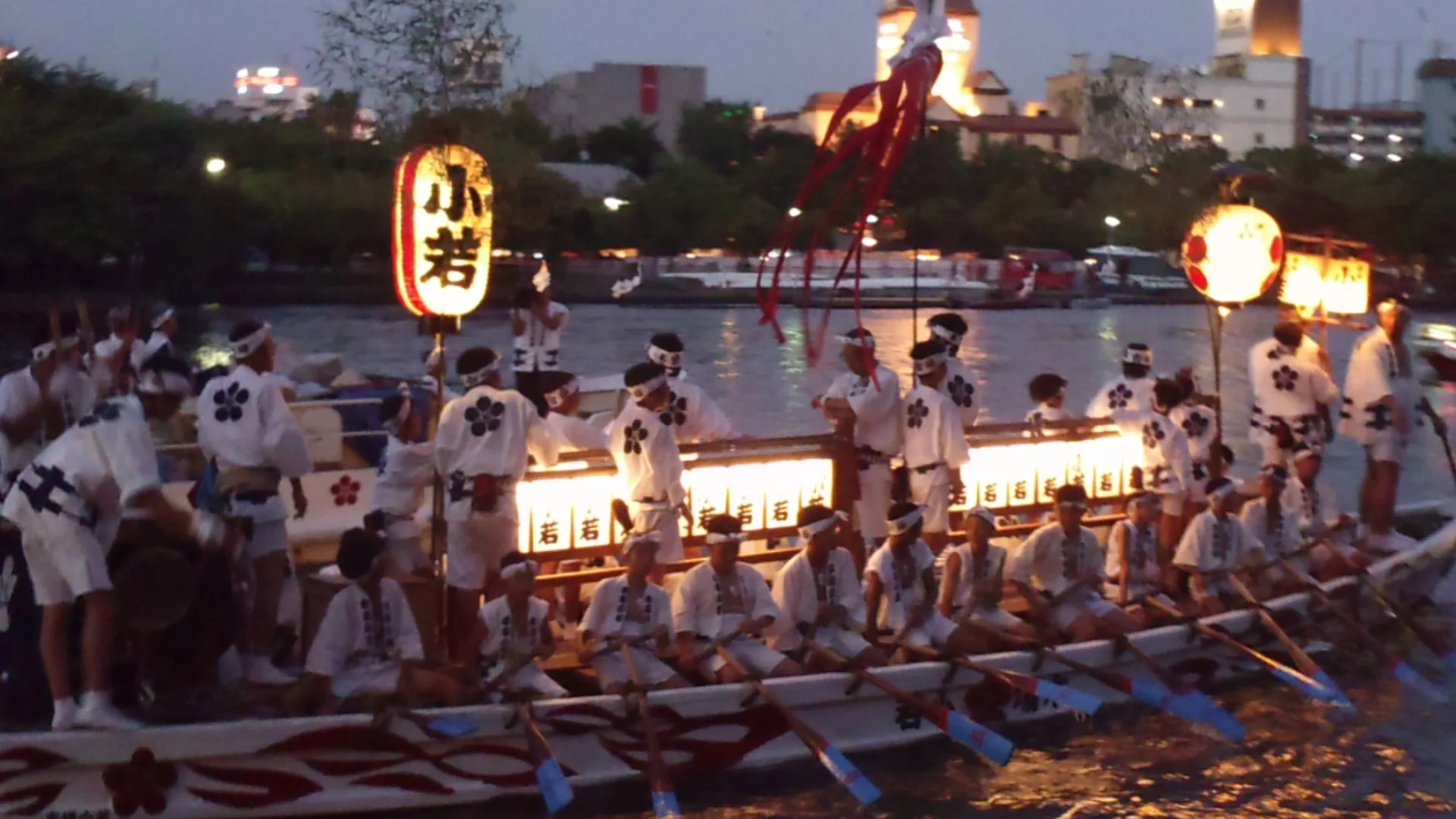
The calendar plays along with festival lovers: on the second float day of Gion, July 24, Osaka’s Tenjin Matsuri also begins, lasting July 24–25. Kyoto and Osaka are separated by half an hour to an hour by train, and this is a rare chance to see a morning in Kyoto and an evening in Osaka. Tenjin Matsuri is one of Japan’s three great festivals, and its history is more than a thousand years long: the first record dates to 951, when a spear was thrown into the Dojima River to choose the site of a shrine. The main day is July 25: by day a land procession goes through the streets, and from six in the evening the funatogyo — the river one — begins. About a hundred boats with ten thousand participants glide along the Okawa River, boats with lanterns and paper decorations sail up and down the current in ritual formation, noh and bunraku are performed on “stage” boats, and “dondoko” boats are driven briskly up and down by young rowers. From half past seven in the evening fireworks begin over the river — about three thousand shells for nearly ninety minutes; it is considered one of the best in Japan.
August: Nebuta — fiery warriors and “rasserah”
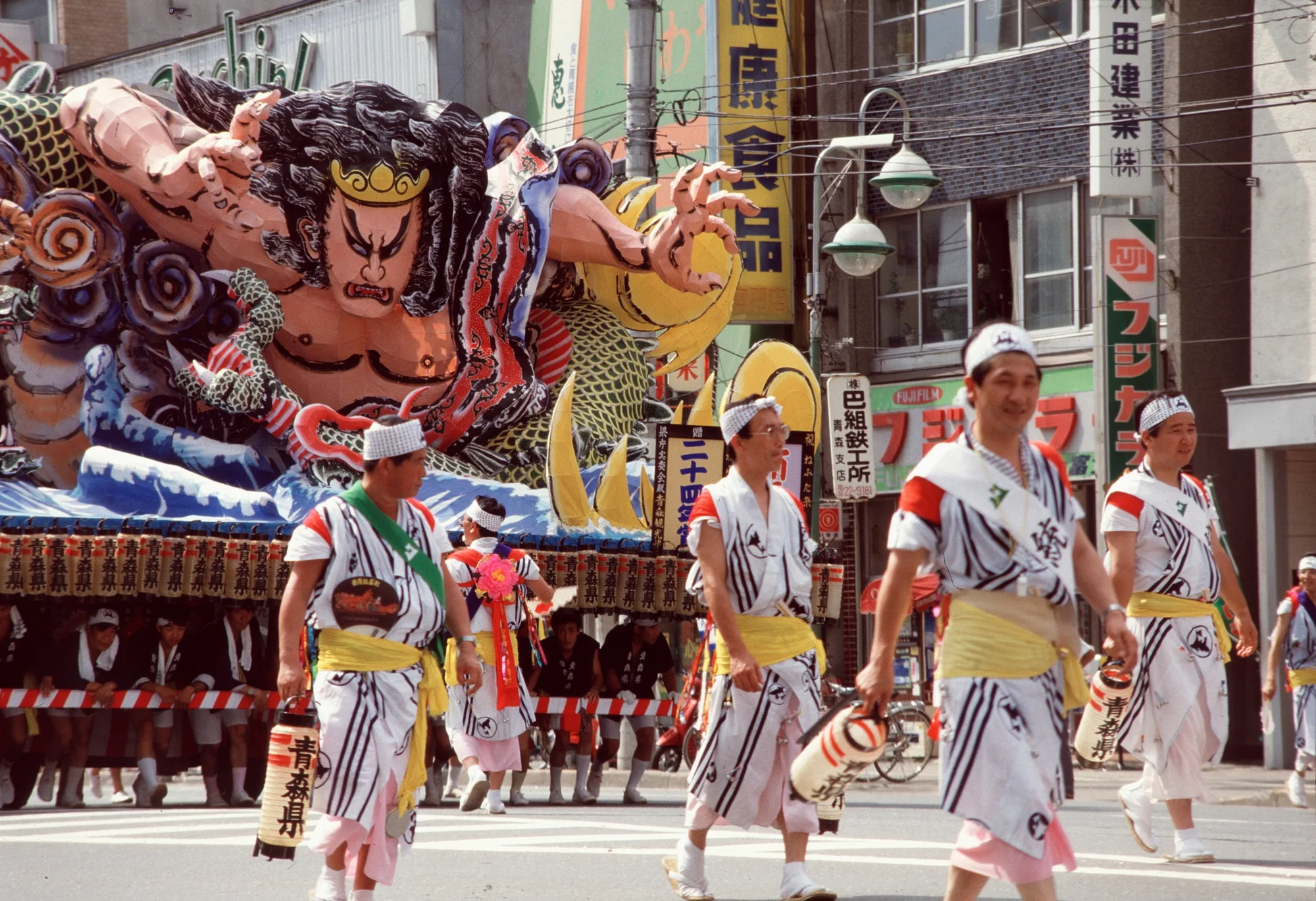
Aomori — a city at the very north of Honshu island, calm during the rest of the year — turns into a stage from August 2 to 7. Nebuta is the largest summer festival of the Tohoku region, attended by more than two and a half million people. The main heroes are the giant “nebuta” figures: frames carved from bamboo and covered in paper, up to nine meters wide and five meters tall, painted in the colors of Chinese mythological heroes, kabuki theater heroes and historical personalities. They are lit from within by up to a thousand lamps (today more often LEDs), and around each figure from five hundred to a thousand, and sometimes up to two thousand, haneto dancers in yukata and flower-decorated hats jump.
The most valuable thing is that anyone can take part. A haneto costume can be rented in the city’s department stores for about four thousand yen (buying costs about ten thousand), you only need to join the formation in front of a figure thirty minutes before the start of the procession and jump to the shout “Rasserah, rasserah!”. Along the route there are free places on the sidewalk, paid ones from four thousand yen per procession, and on the evening of August 7 the program ends: the figures are loaded onto barges and carried across Aomori Bay, with fireworks launched above them (fireworks seats from four and a half thousand yen). A tip: plan at least two nights, look for accommodation in Aomori or Hirosaki half a year ahead and clarify the program by day in advance.
August: Awa Odori — “fools dance and fools watch”
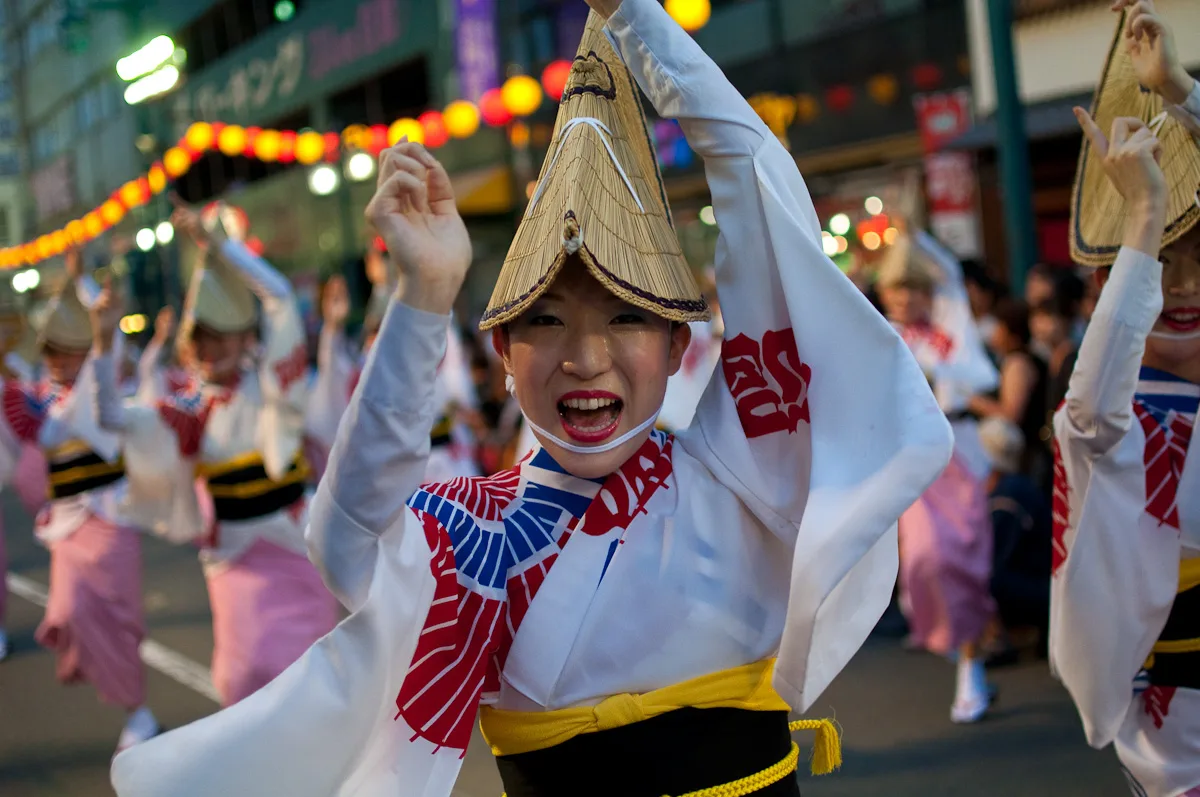
A few days after Nebuta comes Awa Odori, Japan’s most famous dance festival. It takes place in Tokushima on Shikoku island on August 11–15 (the main evenings are the 12th to the 15th), on the days of the Obon holiday, when, according to belief, the souls of ancestors return home. It is believed to have arisen in 1586, when the daimyo Hachisuka Iemasa organized a celebration in honor of the opening of Tokushima Castle, but the roots are most likely even deeper. More than a million spectators come here, and for four evenings the city turns into one long dance floor: “ren” groups — up to several dozen people in identical outfits — march through the streets, women in tall straw hats and wooden sandals glide in graceful steps, men dance with bent knees, and over it all rings the refrain: “Fools dance and fools watch — if we’re all fools, we may as well dance!”. It’s no joke: everyone is invited to join the dance, and at the end of the evening many spectators really do end up in the street. To catch the main evenings, come on the 12th, and if you manage — after Nebuta get to Shikoku within a day or two: there is a connection, but the schedule is worth checking in advance.
The Fuji season, autumn and everything near the festivals
From July 1 the Mount Fuji climbing season opens — but the 2027 dates have not yet been announced, and since 2026 a paid entrance and online booking have been in effect, so follow the official website; a full breakdown is in our guide to climbing Fuji. In autumn, in November, red maples replace cherry blossoms in the role of the main color event, and between festivals and parks it is worth leaving a day for something quiet: for example a morning in Nara among the deer (guide to Nara) or an evening in a hot spring — if you are a beginner, start with the onsen rules so as not to be embarrassed.
Three routes for the 2027 festivals
“Spring”: cherry blossoms + Yokohama (10–12 days). Kyoto and Nara in the first week of April, then Tokyo and Yokohama with a day at GREEN×EXPO. The difficulty: the peak of blossoming is unpredictable, so allow a spare day and choose flexible fares.
“Summer festival”: Kyoto — Osaka (5–7 days). The yoiyama evenings and the procession on July 17 in Kyoto, the second procession on the morning of July 24 and the evening Tenjin Matsuri in Osaka. One of the most compact and brightest routes: the two main points are less than an hour apart.
“Northern August”: Aomori and Tokushima (8–10 days). Nebuta from August 2 to 7, then a flight or trip to Shikoku for Awa Odori on August 12–15. The liveliest but also the most demanding option in planning: accommodation must be booked in advance and the heat taken into account.
Practical tips
Dress lightly for summer festivals: in July–August it is hot and humid in Japan, and you will spend several hours in the street, so bring water, a hat and a towel. Cash will come in handy for street food and costume rental: small towns do not accept cards everywhere. Don’t try to take a place by the road at the last moment: on the days of the main processions the sidewalks fill up from the morning. And leave a margin for the return: the last trains on festival days are overcrowded and taxis are snapped up instantly.
FAQ
Which festival of 2027 is the most important? Formally Gion Matsuri in Kyoto, but emotionally many choose Nebuta in Aomori and Awa Odori in Tokushima — there you can not just watch but take part.
When do the cherry blossoms bloom in 2027? The window for Tokyo, Kyoto and Osaka is roughly March 23 to April 5; the exact forecast comes out in December–January, so book accommodation with flexible cancellation.
What is GREEN×EXPO 2027 and is it worth going? It is an international horticultural exhibition in Yokohama from March 19 to September 26, 2027: about a hundred hectares, ten million flowers and an expected fifteen million guests; entry by ticket with a date booking.
Can I take part in Nebuta rather than only watch? Yes: a haneto costume can be rented in the city for about four thousand yen, and you need to join the formation half an hour before the start of the procession.
How can I combine Gion and Tenjin Matsuri? On the morning of July 24 watch the float procession in Kyoto, and on the evening of the 25th the river procession and fireworks in Osaka; the cities are less than an hour apart.
When should I book accommodation? For the cherry blossoms, Gion and Nebuta — six to twelve months ahead, for the rest two to three.
The dates, schedules and prices of festivals may change, and part of the programs for 2027 have not yet been announced — check the organizers’ official websites.