Son Doong is the world's largest cave: its own clouds, the underground "Garden of Eden" jungle, a chamber that could hold a Boeing 747. The history of its discovery, prices and why tours are booked years ahead.
In 1990 a forester named Ho Khanh came upon a crack in a rock in the jungle, from which clouds of mist were pouring, while from inside came the roar of an underground river and a strong wind noticeably blew. He did not climb down — and then for twenty years could not find the place again. When in 2008 Ho Khanh did come across the same entrance a second time, he did not suspect that he had found the largest cave by volume on the planet — with its own clouds, a river and a real jungle deep underground.
A cave that was lost twice
The story of the discovery reads like an adventure novel. In 1990 Ho Khanh, a local hunter sheltering from bad weather in the jungle, came upon a crevice in a rock — thick mist poured from it, the noise of an underground river could be heard, and wind noticeably blew from the opening. He did not climb inside — a tropical downpour and elementary caution proved stronger than curiosity — but he told of the find to the British amateur cavers Howard and Deb Limbert, who had been exploring the region’s caves for years. The problem was that Ho Khanh himself did not remember the exact place in the jungle and for almost the next two decades could not find it again. Only in 2008, again finding himself in the same places on a hunt, did he happen upon the familiar crevice — and this time carefully memorized the way so as to lead an expedition there.
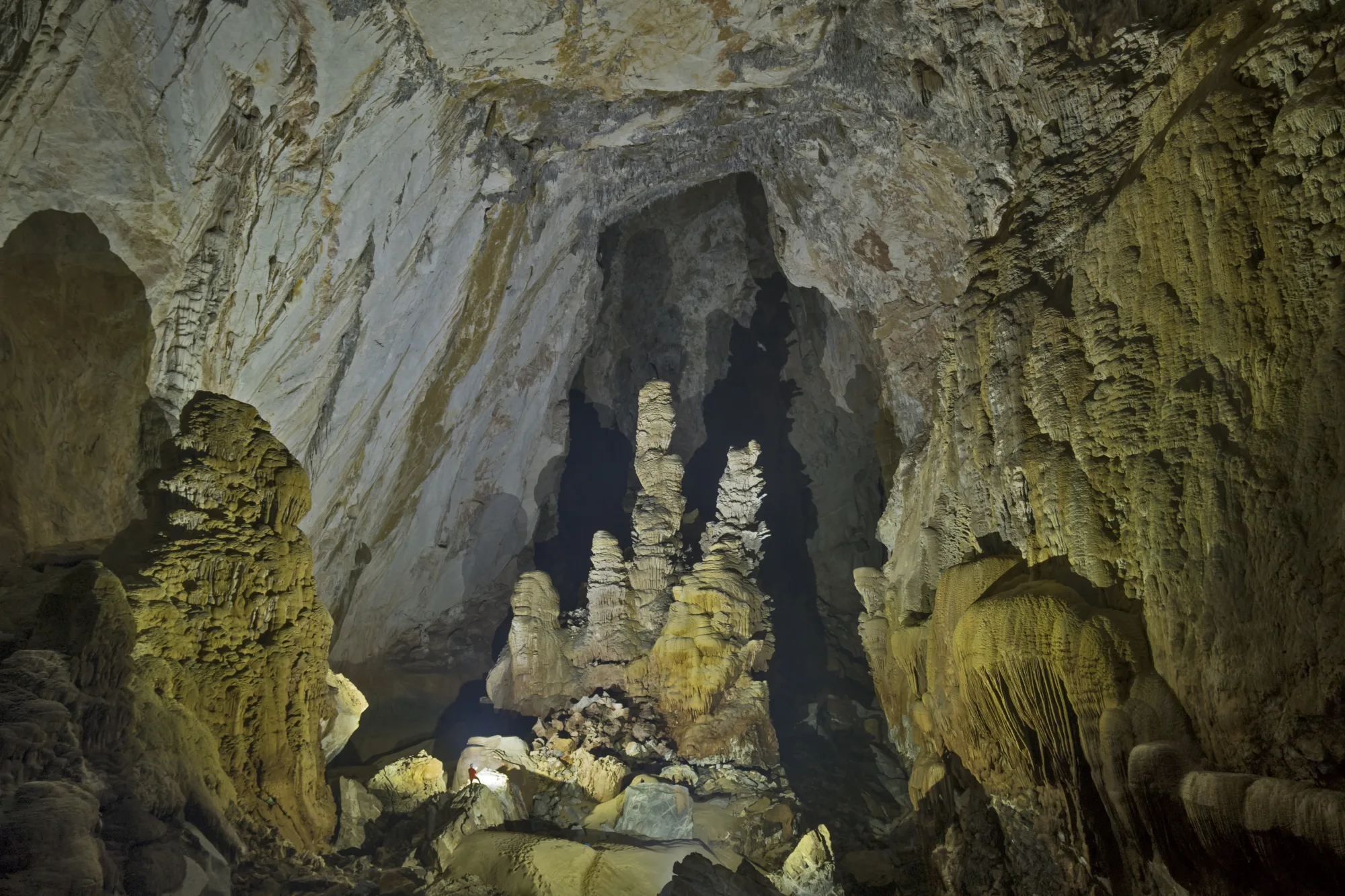
The official survey took place in 2009 by the British Vietnam Caving Expedition Team, which declared Son Doong the largest known cave on the planet by volume — 38.5 million m³, five times the Deer Cave in Malaysia, which had held first place before. Some sections reach almost 200 meters in height and 150 meters in width — a scale at which one of the cave’s most famous chambers, “Hope and Vision”, could hold a whole Boeing 747 in flight.
A cave with its own weather
The most amazing thing in Son Doong is not the size itself but what happens inside. In several places the cave’s roof collapsed many thousands of years ago, forming so-called dolines — giant sinkholes through which sunlight enters the underground chambers. Where streams of warm, humid air from outside and cold air inside the cave meet, real mist condenses and clouds form, drifting under the vault as in the open sky — hence the clouds of steam that Ho Khanh noticed at the entrance twenty years ago. And where light penetrates deep enough, over millennia a real jungle has grown — an area that the first explorers jokingly christened the “Garden of Eden”: trees several stories tall growing at a depth of 200 meters underground, in their own underground ecosystem with birds and monkeys that happened to be trapped in paradise in the middle of the cave.
A ticket sold out years in advance
You cannot get into Son Doong on your own — since the opening to tourism the only licensed expedition operator has been the Vietnamese company Oxalis. The basic format is a 4-day 3-night trek with overnight stays right inside the cave in a tent camp; the extended version stretches to 6 days 5 nights, although travelers spend only part of this time directly in the cave and on the approaches to it. The cost is about 75 million dong (roughly $3,000) per person, in a group of 6 to 10 participants; the price includes permits, guides, porters, caving equipment and full supply of the trek. To preserve the unique ecosystem the authorities strictly limit the flow — no more than 1,000 visitors a year, and tours for the coming seasons are usually sold out many months, and sometimes a couple of years, ahead: you need to book in advance, and counting on a spontaneous trip is not an option.
Who this expedition suits
This is not a leisurely weekend excursion but a full multi-day trek with elements of mountaineering — river crossings on foot, rope descents, overnight stays in tents without electricity and connection, physical effort in the jungle in tropical humidity. The organizers warn directly: basic physical fitness is needed and readiness for several days without the usual comfort. In return you get what cannot be seen anywhere else on the planet: an underground forest lit by the sun breaking through the vault, and clouds drifting under a stone ceiling many meters high.
FAQ
Can I see Son Doong without a multi-day trek? No, access to the cave itself is possible only as part of a full Oxalis expedition lasting from 4 days — there are no shorter or lighter tours to the main cave.
How far ahead do I need to book a tour? At least 6–12 months — the quota of 1,000 people a year and the strict limit of groups of 10 participants mean tours are sold out several seasons ahead.
Is special preparation needed? Special caving experience is not required, but good general physical fitness is needed — the trek includes many-hour walks through the jungle, river crossings and rope-technique elements under the guides’ direction.
How does Son Doong differ from the more accessible caves of Phong Nha-Ke Bang? The same national park has caves for day and even half-day excursions without special preparation — but it is precisely the scale, the underground jungle and the status of the world’s largest cave that make Son Doong unique as a multi-day expedition and not an ordinary attraction.
Is it true that clouds form inside the cave? Yes, it is a documented phenomenon — in places where the roof has collapsed (the dolines), warm humid air from outside meets the cold air of the cave and condenses into mist and clouds right under the stone ceiling.
Prices, tour availability and booking conditions may change — check the current information with the operator before your trip.