Bali 2027: the main events of the year — Nyepi on March 8 and the ogoh-ogoh parade, the double Galungan (January 13 and August 11), the Bali Arts Festival, the kite festival in Sanur and literary Ubud. Dates, rules and routes.
At six in the morning on March 8, 2027, the island on which hundreds of planes land every day will fall silent. Not just quiet down but fall silent — truly: at Ngurah Rai airport not a single flight will land, in the streets not a single car will pass, in not a single window will a light come on. Only guards in black-and-white checkered sarongs will walk the roads, and hotels will turn into quiet refuges where guests do not step beyond the gates. Nyepi, the Day of Silence, is the strangest and most beautiful festival that exists at all: Bali shuts down the whole island for a day to deceive evil spirits, who will decide that no one lives here. But Bali in 2027 is not only silence. The calendar holds a double Galungan with bamboo penjor along the roads, the night of the ogoh-ogoh demons, July skies full of kites and a month-long arts festival in Denpasar. We go through it all in order.
- January 13 — Galungan, January 23 — Kuningan.
- Early to mid-March — Saraswati, Pagerwesi and the Melasti rites.
- March 7 — the ogoh-ogoh parade on the eve of Nyepi.
- March 8 — Nyepi: a day of silence from 6:00 on March 8 to 6:00 on March 9, the airport is closed.
- Mid-June to mid-July — the Bali Arts Festival in Denpasar.
- July to October — the Kite Festival in Sanur (dates to be confirmed).
- August 11 — Galungan, August 21 — Kuningan (the second time in the year).
- October — the writers and readers festival in Ubud (in 2026 it is October 21–25; the 2027 dates will be announced later).
How Bali’s calendar works and why Galungan happens twice
To understand Balinese festivals you have to get used to the island having two calendars. One is the lunar-solar Saka calendar: Nyepi lives by it, and it defines the “New Year”. The other is the pawukon, a calendar of two hundred and ten days that is not tied to the Moon or the Sun at all: it consists of thirty weeks of seven days, and temple days, sacred dates and Galungan with Kuningan are counted by it. Since the pawukon is shorter than the Gregorian year, some festivals in it occur twice a year: in 2027 Galungan falls on January 13 and August 11, and Kuningan on January 23 and August 21. So the most suitable tactic is to plan the trip around the festival that suits you better, rather than looking for “the one and only”.
The pawukon dates may shift slightly, and some programs of Nyepi, Melasti and Pagerwesi are clarified on the spot by the organizers, so in this article the dates of Saraswati and Pagerwesi are marked as approximate: in 2027 they fall in early to mid-March, before Nyepi. It is better to check exact dates with your hotel or a local guide closer to the trip.
January 13 and 23: Galungan and Kuningan — the festival when ancestors come home
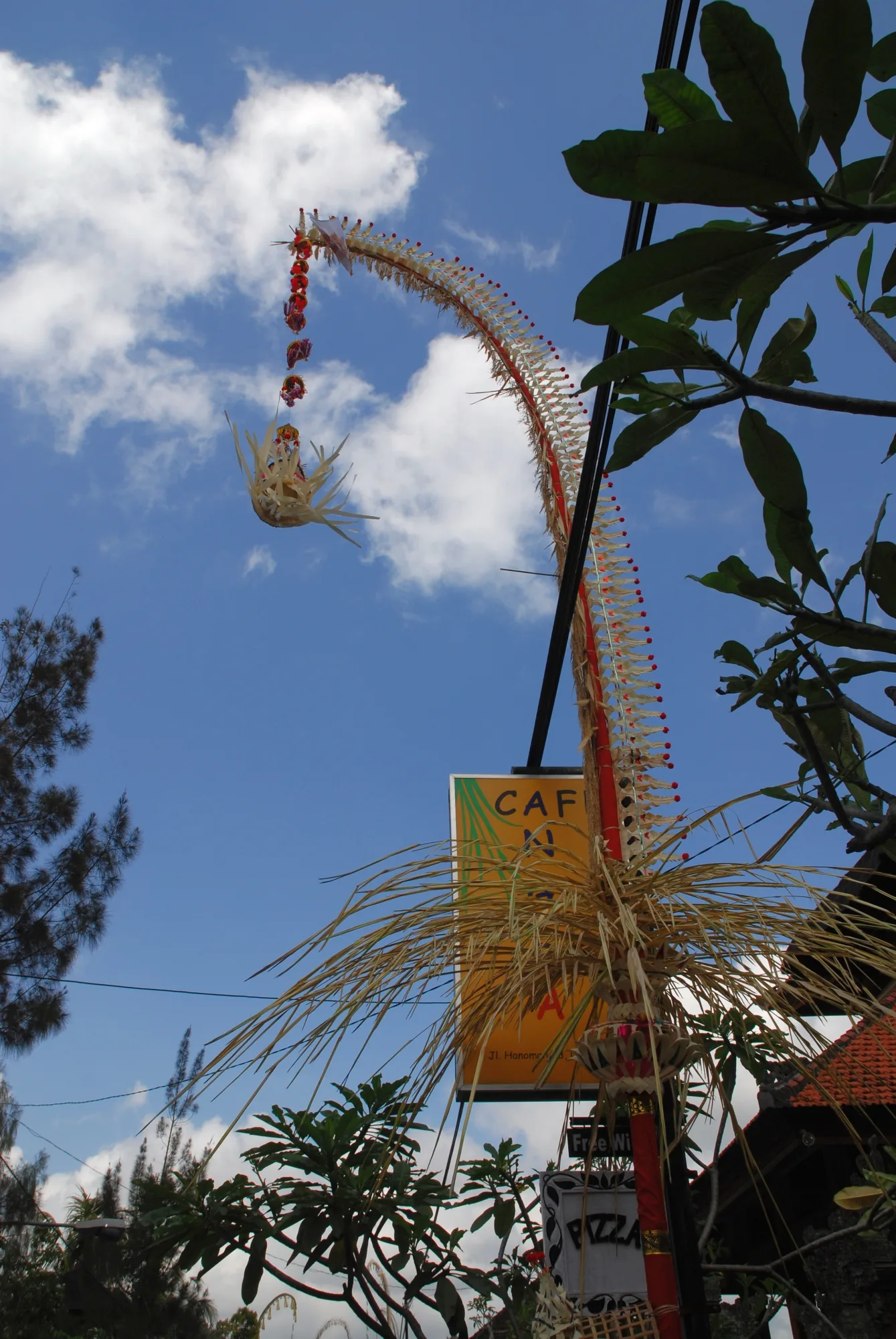
If you find yourself in Bali on the days of Galungan, you will understand at once: something is happening. Along the roads, at the entrances of courtyards and above temple gates there rise penjor — tall curved bamboo poles decorated with woven palm leaves, flowers and offerings; they bend over the road like giant fishing rods and for several kilometers create the sense that the island has been decorated for a parade. Galungan marks the victory of dharma over adharma — good over evil — and at the same time the time when, according to belief, the spirits of ancestors descend to earth to visit their homes. Families prepare offerings, pray in family temples and lay tables, and ten days later, at Kuningan, the ancestors return — they are seen off with yellow rice and symbolic offerings. On the festival days there is a lot of live music, processions and family feasts in Bali, and tourists who behave respectfully are gladly invited to visit.
Practical tips: on the days of Galungan and Kuningan many local establishments are closed, and on village roads there are jams because of processions, so allow extra time. Clothing should be modest: shoulders and knees covered; a sarong and sash are needed to enter a temple — they are usually issued at the entrance. Photograph the penjor and processions, but do not come right up to the worshippers and do not stand higher than priests.
March 7 and 8: ogoh-ogoh and Nyepi — the night of demons and the day of silence
Nyepi is Bali’s main festival, the New Year in the Saka calendar, and it is built on an amazing scenario: first noise, then absolute silence. A few days before Nyepi the Melasti rites of purification take place, when residents carry their sacred objects to the sea and rivers to wash them and themselves. In 2027 they are joined by Saraswati — the day of knowledge, dedicated to the goddess of wisdom — and Pagerwesi — the day of the “iron fence”, the protection of the soul — both in early to mid-March.
On the evening of March 7, the eve of Nyepi, comes the time of the ogoh-ogoh parade — giant demonic effigies that youth groups in the villages make all winter: horned monsters of bamboo, paper and papier-mâché several meters tall, with fangs, claws and glowing eyes. They are carried through the streets on shoulders to the crash of the gamelan, singing and torchlight, and at the end ritually burned or destroyed to drive out evil spirits and cleanse the island before the new year. The night turns out eerie, beautiful and very loud — and that is exactly why the morning after it seems so deafeningly quiet.
Nyepi itself in 2027 is Monday, March 8. From 6:00 a.m. to 6:00 the next day four traditional prohibitions apply to the whole island: you may not light a fire or turn on bright light, you may not work, you may not go out into the street and you may not have fun. The prohibitions apply to tourists too: no one, including guests, leaves the hotel grounds. Ngurah Rai airport closes for a day — the only airport in the world that stops every year for a religious festival — and not a single flight takes off or lands. Mobile and internet connections may be limited in some areas, the lights in hotels are dimmed, and only the pecalang guards walk the streets, monitoring compliance with the rules.
What to do on such a day? Plan in advance. Hotels prepare food, films and sometimes special programs for guests; many hold quiet retreats on the grounds with yoga and meditation, and after sunset stargazing: without a single lamp the sky over the island fills with such thick blackness and stars as you will not see in Bali all year. Bring books, a supply of water and board games, arrange meals with your hotel in advance, and book flights so as not to depart or arrive on March 8 — and better add a spare day on both sides. For details of the rules, read our guide to Nyepi and the piece on mentality and etiquette in Bali.
June — July: the Bali Arts Festival
Every summer, from mid-June to mid-July, a month-long celebration of art runs on the island — Pesta Kesenian Bali, or the Bali Arts Festival. It takes place at the Taman Werdhi Budaya cultural center in Denpasar: traditional dances, gamelan orchestras, theater, crafts and painting exhibitions are shown here, and the days begin with a large-scale parade in which delegations from all over the island take part. It is a rare chance to see what Balinese culture looks like when it is shown by the residents themselves: without lighting for tourists and without cuts. Entry to the venues is usually inexpensive, and the schedule is drawn up by day, so it is worth choosing a program in advance.
July — October: a sky full of kites
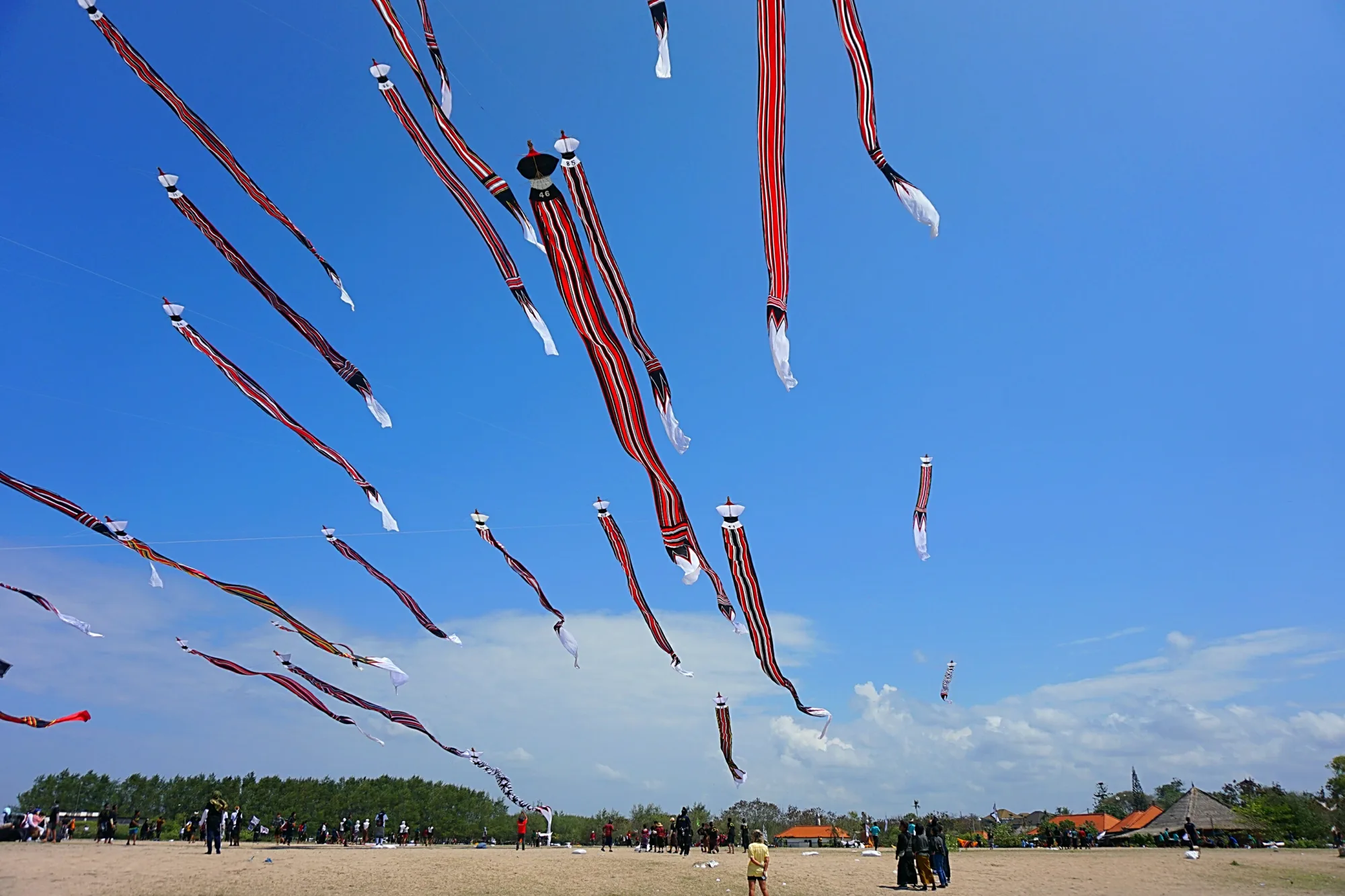
During the dry season, when a steady wind blows over the coast, the Kite Festival is held on the beaches of Sanur, especially around Padang Galak and Mertasari. Traditional kites here are not toys: teams from the villages of Denpasar launch giant sheets — about four meters wide and almost ten long — and compete in beauty and height of flight. The festival also has a religious meaning: the kites are launched to convey gratitude to the gods and to ask for a good harvest. The exact dates for 2027 have not yet been announced — the festival is tied to the weather and usually takes place in July–October — but if you find yourself in Sanur in those months, go: the beach turns into a giant colorful gallery.
August and October: the second Galungan and literary Ubud
The second wave of Galungan is August 11, Kuningan August 21: the same rhythm, the same penjor, only now against the background of the dry season and high stars. For many travelers this is the best option: the weather is excellent, and the festival is in all its glory. October belongs to Ubud: the annual Ubud Writers & Readers Festival is four days of meetings, discussions, readings and evening programs, to which writers, publishers and readers from all over the world gather. In 2026 it will take place on October 21–25, and the 2027 dates will be announced later. If you love books, the October plan is evenings in Ubud’s best cafés, morning lectures and walks through the rice terraces between sessions; read about the terraces themselves in our guide to Bali’s rice terraces.
Where to spend Nyepi: which hotel to choose
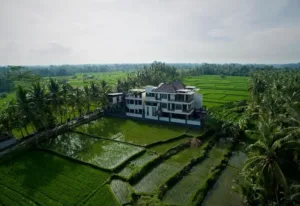
The choice of place for Nyepi is more important than it seems. You will have to spend a day on the hotel grounds, so look not only at the room but at everything around it: is there a garden or pool where you can sit outdoors, will the restaurant work and what is included in the “Nyepi package”. Resorts in the Ubud area and in the north of the island, among rice fields and jungle, give a feeling of real seclusion; in Sanur and the south guests are more often gathered in a common courtyard and offered programs. Yoga and meditation retreats at Nyepi are a separate category: there the silence becomes part of the practice. If you are traveling with children, choose a hotel with a spacious courtyard and find out in advance what you will do all day.
Don’t forget about logistics in the days around Nyepi. On the evening before, on the day of the ogoh-ogoh, the streets are closed for processions, so a transfer from the airport to Ubud or Canggu can take two to three times longer than usual; it is better to arrive the day before, on March 6, and settle in without haste. On the morning of March 9, when the prohibitions are lifted, “Ngembak Geni” begins — a day when locals visit one another, make up with those who offended them and exchange greetings: it is the warmest and most peaceful day of the festival, and many travelers consider it the best. The airport reopens, but in the first hours delays are possible, so it is not worth flying out the same morning.
What is edible on festival days? For Galungan and Kuningan every home cooks lawar — a dish of chopped meat, coconut and spices — roast pork and yellow rice; at Nyepi the food in hotels is more often modest and vegetarian, and after the prohibitions are lifted, a feast of flavors begins again in markets and warungs. During the festival days don’t be surprised if your favorite restaurant is closed: local cooks celebrate too and go to the temple with their whole family.
The standing program: what to see in Bali in any month
Besides the big dates, the island has a rhythm that does not depend on the calendar: almost every evening somewhere temple ceremonies are held, dance performances in Ubud, barong and legong theater, the famous kecak dance at sunset at Uluwatu temple. If you manage to attend a local ngaben cremation, remember: it is a sacred ceremony, not a spectacle, so do not approach without an invitation, dress modestly and never photograph a family in grief. It is also useful to know that Bali’s temples may be closed to visitors on the days of their festivals, and entry is often open only to worshippers. It is worth counting on the local rhythm rather than forcing the island to adapt to yours.
Three routes for the 2027 festivals
“Nyepi and March Bali” (7–10 days). Arrive by March 4–5, see Melasti on the coast, the ogoh-ogoh parade on March 7 in Ubud or Denpasar, spend the day of silence in a hotel among rice fields and fly out no earlier than March 10. The most atmospheric option of the year.
“Galungan in the heat of August” (7–9 days). Arrive by August 8, see the penjor and processions, spend Kuningan on August 21 with your hosts’ family, and dive into the ocean between times. The dry season means excellent weather.
“Summer of arts” (7–8 days). The Bali Arts Festival in Denpasar, evenings in Ubud and, if you’re lucky, kites in Sanur. A good route for those who love culture rather than the beach.
Practical tips
Book accommodation for Nyepi and Galungan in advance and ask the hotel how it will operate on these days: some establishments close, some offer special programs. Dress modestly, take a sarong to temples, keep money in cash: villages do not accept cards everywhere. Remember that Bali is an island where faith is part of everyday life and tourists are guests, so whoever behaves more quietly and attentively wins. And leave a day in your route “just in case”: festivals in Bali easily turn a planned trip into an adventure.
FAQ
When is Nyepi in 2027? Monday, March 8: the silence lasts from 6:00 on March 8 to 6:00 on March 9, the airport is closed, and the ogoh-ogoh parade takes place on the evening of March 7.
Can I leave the hotel at Nyepi? No, the prohibition applies to everyone, including tourists: you may not leave the hotel grounds.
When is Galungan in 2027? January 13 and August 11; Kuningan — January 23 and August 21.
What is a penjor? A tall curved bamboo pole with decorations and offerings, set up by homes at Galungan and Kuningan.
When is the Bali Arts Festival? Usually from mid-June to mid-July; the 2027 schedule will be announced later.
When is it best to go to Bali for the festivals? March for Nyepi, August for Galungan and dry weather.
The dates of Balinese festivals are determined by the pawukon and Saka calendars and may be clarified — check the official Bali tourism websites and your hotel.