Offerings on the sidewalks, the dress code in temples and the Day of Silence, when the whole island falls still.
In Bali it is easy to go wrong where elsewhere you would get away with it: stepping on a small basket of flowers, sitting on the steps of a shrine for a photo, or going out on the day when the whole island is silent. The island is governed not only by the administration but also by the religious calendar: about nine out of ten residents practice Balinese Hinduism, and temples, ceremonies and offerings are woven into an ordinary day as tightly as shops and minibuses are with us. Hence the main rule of etiquette in Bali: you are a guest in someone else’s home, where every object on the ground may be part of a rite. Below is everything a tourist really needs to know: what to wear to a temple, how to behave around offerings and processions, how to spend Nyepi, which gestures are considered rude, and what foreigners on the island are fined or deported for.
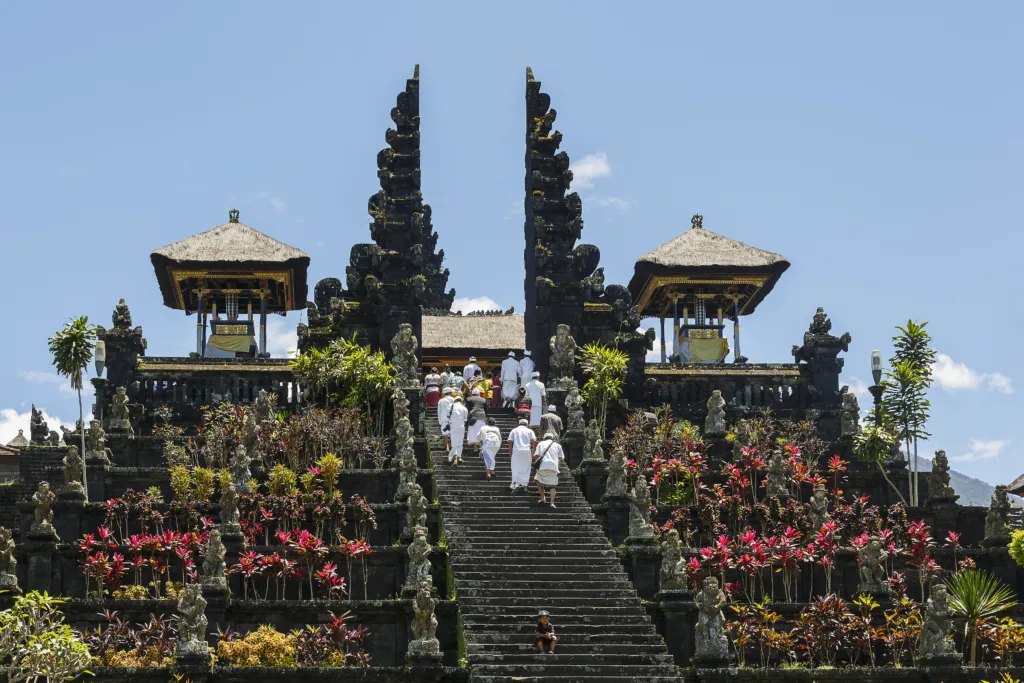
- Temple: a sarong and sash are mandatory for everyone, shoulders covered, shoes removed where customary; tourists are usually not allowed into the inner courtyard of an active temple.
- Offerings: canang sari on the ground are not trampled or kicked; walk around them carefully.
- Ceremonies: give way to processions, never stand higher than a priest, do not photograph worshippers at point-blank range.
- Nyepi: in 2027 it falls on March 8, a day of silence, the airport is closed, you do not leave your hotel.
- Body and gestures: do not touch heads, use the right hand to pass things, pointing with a finger is impolite.
- Clothing in town: a swimsuit and going topless are acceptable on the beach, but not in a shop, a temple or a village.
Current as of October 2026. Local rules for tourists are updated, and different temples have their own requirements, so on the spot go by the signs and the words of the attendant.
Hinduism in Bali: why etiquette is taken seriously
In most regions of Indonesia Islam predominates, while Bali remains a Hindu island. Balinese Hinduism took shape from a mixture of Indian teaching, Buddhism and local beliefs, and at its center stands the principle of Tri Hita Karana: the harmony of a person with God, with other people and with nature. From this idea follows almost everything you see on the streets: daily offerings, a temple at every house and village, festivals on a special 210-day calendar and endless processions with a gamelan orchestra.
For a visitor this means a simple thing: there is no “just a road” or “just a beach” on the island. Any stone stele with an umbrella may be a shrine, any path at sunset may turn out to be a procession route, and a large tree with black-and-white checkered cloth on its trunk is considered sacred. Knowing this logic spares you most awkward situations. The history of the island itself and of its hotels, which grew up around palaces and temple lands, can be read through the example of the royal palace Puri Saren Agung in Ubud.
Canang sari and offerings: what not to step on
Every morning Balinese place small baskets of palm leaves with flowers, rice, biscuits and a stick of incense by the doors of houses and shops, on sidewalks, by cars and motorbikes. These are canang sari, an expression of gratitude to the gods. Baskets on the ground are meant for lower spirits, and those placed higher (on altars and in shrines) for the gods. Dogs and bikes inevitably brush them, but a person is expected to treat them with respect.
- Try not to step on the baskets. If an offering lies on a narrow path, step over it or go around; if you step on one by accident, do not panic or apologize theatrically, just walk on more carefully.
- Do not touch or throw away offerings, do not take treats or money from them, do not move them for a shot.
- Do not photograph in a way that puts a basket “in the center of the composition” right up against the lens. Wide shots are fine.
- Do not put out the incense from an offering, and do not wave the smoke away with your hand in front of the host’s face.
An offering is often placed in your villa or hotel too. If you are living in a rental rather than a hotel, it is better to ask the owner who renews them and what to do with them; more on the nuances of long-term rental in the breakdown of villa prices and conditions.
Dress code in a temple: sarong, sash and covered shoulders
An active temple admits you if you follow simple rules that are the same for men and women, tourists and locals:
- A sarong covering the legs below the knees. It is issued or rented at the entrance of most tourist temples (Tanah Lot, Uluwatu, Besakih and others); sometimes it is included in the ticket price, sometimes it is lent for a small fee.
- A sash (selendang) tied over the sarong. It symbolically separates the “upper” part of the body from the “lower”. It is usually also issued at the entrance.
- Covered shoulders. A T-shirt or shirt instead of a tank top or crop top.
- Modest footwear. In temple courtyards shoes are often removed; follow what the locals do and the signs.
For a ceremony where you are not just a tourist but a guest, Balinese dress up: women in a kebaya, men in a white shirt, a sarong and an udeng headscarf. Coming dressed like that is not required, but if you have been invited (to a wedding, a village festival, a cremation), it is worth following the hosts’ example.
Temples with additional restrictions
In many active temples the area is divided into an outer, a middle and an inner courtyard. Tourists can usually enter the outer and sometimes the middle courtyard; the inner one, where prayers take place, admits only worshippers. This is not discrimination but the layout of the shrine. Do not peer past the gate and do not look for a “way around” for a shot.
The Balinese have the concept of cuntaka, ritual “impurity” (it relates to menstruation, recent childbirth, open wounds, mourning). During such periods Hindus themselves do not enter a temple. At the entrance of a number of tourist temples there are signs asking women not to enter during menstruation. How to apply this request to yourself is for you to decide, and how it is checked varies by place; take it as part of a religious tradition, not as an insult. For the island’s other risks, from bikes to “Bali belly”, read the article on safety in Bali.
Behavior at ceremonies and in processions
A Balinese ceremony, whether a temple festival, a wedding or a cremation, is a public event, and you can watch it, but with conditions:
- Give way. A column of women with towers of fruit and offerings on their heads, an orchestra, palanquins with the gods take priority over bikes and pedestrians. Stop and wait.
- Do not stand higher than a priest (pemangku) and do not walk between the worshippers and the altar. Do not sit on raised platforms that may be part of a shrine.
- Do not photograph worshippers’ faces at point-blank range, do not use a flash, do not push into a procession with a drone or selfie stick.
- Do not push into the center to touch things. If you want to take a photo, it is better to stand to the side and, if possible, ask permission.
- Do not laugh or talk loudly, even if the ceremony seems noisy and cheerful to you.
If you want to see living culture rather than catch processions by chance, the island’s calendar has notable dates. Which festivals fall in 2027 you can see in the piece on Bali events 2027.
Nyepi: the Day of Silence and what a tourist should do
Once a year Nyepi comes to Bali, the Balinese New Year in the Saka calendar and at the same time a day of complete silence. In 2027 Nyepi falls on March 8, and on the evening before, March 7, Ogoh-ogoh processions with giant demon figures pass through the streets. Sources sometimes differ by a day on the dates, so before booking tickets check with the airline and the hotel.
The rules of Nyepi apply to the island’s guests too. From about 6 a.m. to 6 a.m. the next day:
- Ngurah Rai international airport is closed, flights are neither received nor sent;
- you may not leave the hotel or villa grounds, patrols of the village guard pecalang are on duty in the streets;
- you may not make noise, turn on bright light or hold parties, curtains on windows are drawn;
- restaurants and shops are closed, and hotel meals are usually prepared in advance for this day.
Choose in advance a hotel or villa where you will be comfortable sitting for a day, and buy water and food. Detailed rules and tips are collected separately: Nyepi in Bali, when the whole island closes and the guide to Nyepi 2027.
Gestures, the body and communication
| Situation | How it is done in Bali |
|---|---|
| The head | Considered the “cleanest” part of the body. Do not pat anyone on the head, even children. |
| Legs and feet | The “lowest” part. Do not show the soles to your interlocutor and do not point at people or objects with your foot. |
| Left and right hand | The left is considered “unclean”. Pass money, food and business cards with the right or with both hands. |
| Pointing with a finger | Impolite. Indicate with the whole palm or with the thumb. |
| Emotions | A raised voice and open conflict are seen as a loss of face. It is better to argue calmly and with a smile. |
| Greeting | A light nod and a smile; the handshake is soft, without force. “Selamat pagi” means “good morning”. |
Clothing and behavior in town, on the beach and in a village
Bali is considered a free-spirited resort, but the freedom ends beyond the beach. A swimsuit, trunks and shorts are appropriate on the shore and by the pool, while in a shop, café, bank and especially in a village you should dress: a T-shirt, light trousers or a dress. Walking the streets of Ubud or Canggu shirtless, or women in a bikini top, looks provocative in the eyes of locals, even if there is a crowd of equally dressed tourists around. Going topless on Bali’s beaches is prohibited, swimming naked is not allowed, and nude photos near temples and sacred trees have repeatedly ended in deportation.
Take care on the roads: besides traffic rules there are local expectations. Overtaking a procession, riding a bike in flip-flops and without a helmet, noise at night in residential neighborhoods cause irritation and fines. What you need to know about licenses and fines is in the piece on bikes, and how to get around without a bike in the article on transport in Bali.
Sacred places that tourists often visit
- Tanah Lot and Uluwatu: cliff temples, the inner courtyards are open to worshippers, the outer part is accessible to tourists; at Uluwatu monkeys steal glasses, hats and phones, do not wear jewelry in plain sight and do not feed the animals.
- Lempuyang (“Gates of Heaven”): an active temple with a long photo queue, where it is important to observe the dress code and the queue. Details in the piece on Lempuyang.
- Sacred trees and springs: at Tirta Empul and similar temples purification is done by the rules, not bathing as in a pool.
- Mount Batur: the volcano is considered sacred, before the ascent politely follow the guide’s instructions; more on the sunrise on Batur.
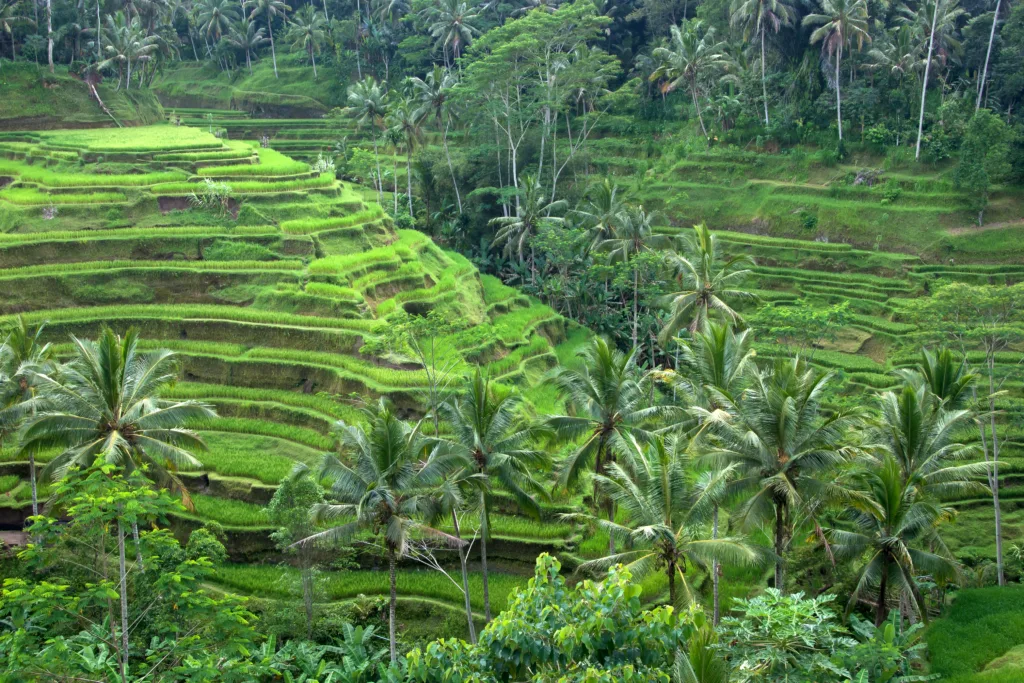
- Rice terraces: these are fields with temples of the subak water system, do not walk on them for a photo. See Tegalalang and Jatiluwih.
Money, haggling and tipping
At markets and in souvenir shops people haggle, but calmly and with a smile: the first price is usually inflated, and the result is on average a third to a half lower. In shops with price tags, cafés and restaurants there is no haggling. Tips are not required, but 5–10% or rounding up the bill is welcome, especially if the service charge is not included. How much money to take to the island and how to pay is in the articles on the trip budget and currency. The hacks the Balinese themselves use to save are collected in a separate piece.
An unusual fact: four names for everyone
The Balinese are traditionally named by birth order, and only four names are used for this: the first child receives the name Wayan (also Putu or Gede), the second Made (Kadek), the third Nyoman (Komang), the fourth Ketut. The fifth is called Wayan again. So by the name you almost cannot tell whether you are dealing with a man or a woman, and to tell people apart a second, personal name is added: Wayan Aryana, Ketut Sari. If you make a mistake and call your interlocutor by the wrong order name, there will be no offense, but asking “which one are you in the order?” is received warmly and shows an interest in the culture.
What not to do in Bali
- Climb temple walls, shrines, statues and sacred trees for a photo.
- Step on offerings or move them.
- Enter a temple’s inner courtyard uninvited and walk between the worshippers and the altar.
- Pose naked or in a bikini by temples, trees, waterfalls.
- Go out in the street during Nyepi and try to fly out that day.
- Touch children on the head, show the soles of your feet, point with a finger and raise your voice.
- Feed monkeys by hand and wear items they can grab.
For couples who come without a stamp in the passport, a separate piece will help: why there are no love hotels in Bali. The remaining organizational questions are covered by the articles on the visa and the island levy, on traveling independently and on choosing an area.
Frequently asked questions
Which rules of behavior in Bali does a tourist need to know?
The main ones: dress modestly away from the beach, do not step on offerings, wear a sarong and sash in temples, do not stand higher than a priest and do not interfere with processions, do not touch people on the head and pass things with the right hand. It is also important to know the date of Nyepi, when you may not go out and the airport is closed.
What is not allowed in Bali?
You may not climb sacred structures and trees, be photographed naked, swim without clothes, step on offerings, enter the inner courtyards of temples uninvited, feed monkeys by hand, or leave the hotel during Nyepi. For serious violations foreigners face fines and deportation.
What should I wear to a temple in Bali?
A sarong to the knees or lower, a sash over it and a T-shirt or shirt covering the shoulders. The sarong and sash are issued or rented at the entrance of most tourist temples. You can also bring your own, which is more convenient and more hygienic.
What is canang sari and can I step on it?
It is a small basket of palm leaves with flowers, rice and incense that Balinese place daily as an offering to the gods. You must not step on it deliberately; walk around or step over it. If you brush against one by accident, do not be frightened, just walk on more carefully.
When is Nyepi in 2027 and what is forbidden that day?
Nyepi in 2027 falls on March 8, and the Ogoh-ogoh procession takes place the evening before. For about a day you may not leave the hotel grounds, make noise, turn on bright light or hold parties. The international airport is closed and there are no flights. Check with your airline before buying tickets.
Can women enter a temple during their period?
Balinese Hinduism has the concept of cuntaka, a period of ritual impurity when one does not enter a temple. At the entrance of a number of temples there are signs asking not to enter on such days. The requirement is based on faith, not on checks; the decision remains yours, but it is more respectful to take it into account.
Can I walk down the street in Bali in a swimsuit?
Bikinis and trunks are worn on the beach and by the pool. In town, in shops, cafés and villages they are considered inappropriate: throw on a T-shirt and shorts. Going topless on Bali’s beaches is prohibited.
How do I greet and address the Balinese properly?
A smile, a light nod and the words “Selamat pagi” (good morning) or “Terima kasih” (thank you) are enough. Many names repeat because they are given by birth order: Wayan, Made, Nyoman, Ketut. So a second name is usually added or the forms of address “bapak” (sir) and “ibu” (madam) are used.
Do I need to tip and haggle?
At markets people haggle with a smile, in shops with price tags and in restaurants they do not. Tips are optional, but 5–10% or rounding up the bill is considered a nice gesture.
Can I photograph ceremonies and people?
Wide shots of processions and festivals are usually acceptable, but do not photograph worshippers at point-blank range, with a flash or a drone. It is better to take portraits of people with permission. In temples follow the signs: photography is restricted in a number of inner areas.
Current as of October 2026. Check festival dates and local rules with official sources and your hotel before the trip.