Rupiah, licensed money changers and the classic short-counting scheme. What currency to bring to Bali, where to exchange safely and which fees to remember.
In Bali it is easy to lose money before your first cocktail: at a street exchange booth with the “best” rate, at an ATM with extra conversion, or just by getting lost in the zeros. The rupiah is counted in millions, a Russian card barely helps, and besides the visa you will be charged a separate tourist levy. What currency to bring to Bali, in what form, how much, and where to exchange so as not to overpay — we go through it step by step. Which cards work and how QR payments will go we put in a separate article about cards in Bali, and here we deal with the money itself.
- Local currency: the Indonesian rupiah (IDR). Everyday payments are made only in it.
- What to bring from home: US dollars in cash (euros are exchanged too). Rubles are not accepted everywhere and at a poor rate.
- Where to exchange: only at licensed money changers (Authorised Money Changer) and banks, not “at the entrance” and not in a nook without a sign.
- Fixed payments: the visa on arrival is 500,000 IDR (about 35 dollars) and the tourist levy is 150,000 IDR per person.
- We do not fix the rate: check it for the day of your trip at a bank or on the Bank Indonesia website.
Current as of October 2026. Fee amounts and rules change, so check the official portals before you fly.
What currency is used in Bali: the rupiah and how to count it
The Indonesian rupiah (IDR) is a currency with a lot of zeros. Lunch at a café can cost a hundred thousand, dinner three hundred, a night in a decent villa a million or more. In the first days the numbers are confusing. A simple trick: mentally drop three zeros and divide by roughly 15. A hundred thousand rupiah becomes “a hundred”, which is on the order of six or seven dollars. Check the exact rate for the day of your trip separately, but you will quickly get a feel for the order of magnitude.
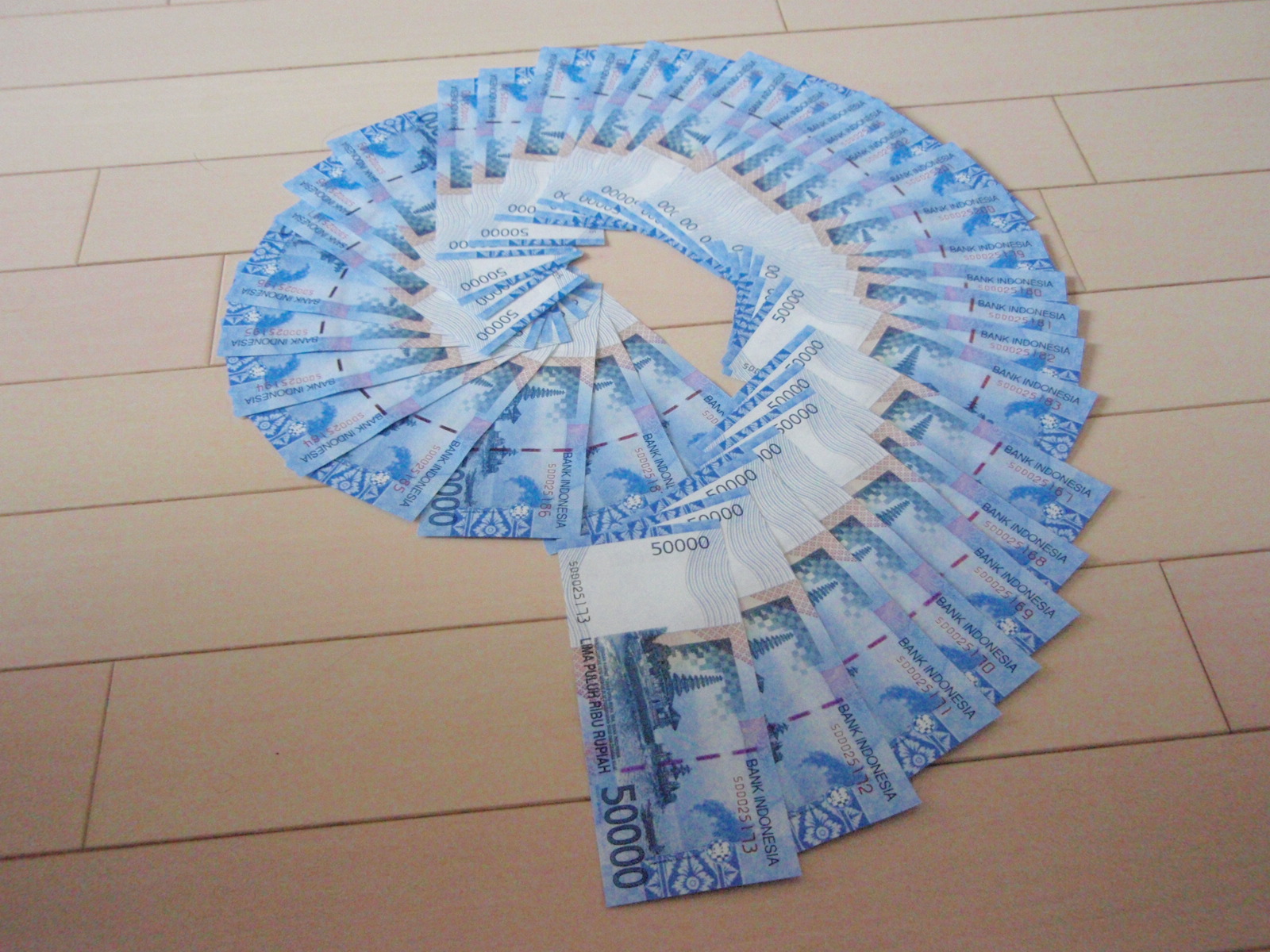
Large-denomination banknotes (50,000 and 100,000) are convenient for exchange and hotels, but at a market or a warung there is often no change. Keep a stack of small notes: 2,000, 5,000, 10,000 and 20,000 rupiah. There are coins but they are little used.
What currency to bring to Bali: dollars, euros or rubles
| What to bring | Accepted for exchange? | Comment |
|---|---|---|
| US dollars | Yes, everywhere | The best option: the most widely used rate; notes should be new, without tears or marks |
| Euros | Yes | The rate is usually slightly worse than the dollar’s |
| Rubles | Not everywhere | The rate is noticeably worse and some changers do not take them at all |
| Rupiah from home | Usually no | It is hard to buy rupiah in Russia, so don’t plan on it |
| Yuan | Rarely | Not the best idea for the island |
The scheme that works for most Russians: exchange rubles for dollars at home (buying cash currency at a bank or exchange point — check the current restrictions in advance), and in Bali exchange the dollars for rupiah in small portions. Foreign cash from the equivalent of 100 million rupiah must be declared, and for bringing in the equivalent of 1 billion rupiah or more a permit from Bank Indonesia is required, according to a review on travelto.ru. For an ordinary tourist these sums are out of reach, but it is useful to know the threshold.
How much money to take to Bali
There is no universal amount: it depends on the style of the trip, the area and whether you have a foreign card. For the calculation it is worth splitting expenses into three parts.
- Mandatory payments on entry: the visa of 500,000 IDR (about 35 dollars) and the levy of 150,000 IDR (about 10 dollars) per person. Allow at least 45–50 dollars per person.
- The first days: the transfer, lunch, hotel payment if cash is required, a SIM or eSIM. A few million rupiah in equivalent will be enough.
- Daily spending: food, transport, entrance tickets. A detailed breakdown by day and category is given in the piece about the trip budget, and a month of living is analyzed in the calculation for a freelancer.
If you have no foreign card, the whole trip budget will have to be brought in cash. Split the money between different places (bag, hotel, belt) and don’t carry it all with you. If you do have a card, you need less cash, but a reserve for warungs and unplanned days is still needed.
Where to exchange money and how not to fall for a scam
The main risk in Bali is money changers that short-count. The scheme is classic: you are shown a rate noticeably above the market, a stack of rupiah is counted out, you recount it and everything adds up. Then the cashier “straightens” the stack, palms a couple of notes with a deft move and hands it back. At home or in the hotel you discover the shortfall. Even experienced travelers get caught.
- Only licensed money changers. There should be an Authorised Money Changer sign, a permit on the wall, a receipt and a Bank Indonesia QR code. The list of licensees is published by Bank Indonesia itself.
- A rate that is too good is bait. Legal money changers’ rates are close to each other.
- Counted — put it away. Don’t hand the money back to the cashier for “straightening”, recount it yourself and put it straight into your bag.
- No changers without a sign, with a table, a calculator instead of a rate board and a tout on the street.
- A bank or a hotel. The rate is slightly worse but more reliable. For your first exchange a bank or an official point in the arrival zone of Ngurah Rai airport works well.
- Banknotes. Dollars must be new and clean; crumpled and torn ones are taken on worse terms.
More about scams and the island’s safety is in the article about safety in Bali.
ATMs: withdrawing rupiah with a card
ATMs accept foreign cards and dispense rupiah. Both the local bank and your issuer charge a fee, so it is better to withdraw less often and in larger amounts, within the limit of a single transaction. Choose ATMs at bank branches and shopping malls rather than standalone machines on the street. If the ATM offers conversion into your account currency, decline and choose to be charged in rupiah. Which ATMs give more at a time, how to look at limits and why it is important to check the fee are described in detail in the article about ATMs in Bali.
Paying by card and QR in Bali: what you need to know
Russian Visa, Mastercard and Mir do not work on the island. UnionPay from Rosselkhozbank and ATB is accepted by some ATMs and terminals, but there are no guarantees. Since July 2026 Sber has announced payment by the Indonesian QRIS QR code in the “SberBank Online” app, but tourists have reported failures and payment reversals. An analysis of all the options with a table is in a separate article, which cards work in Bali. For budget purposes it is simpler to assume that the main expenses will be in cash rupiah.
Payments that not everyone remembers
- The visa on arrival — 500,000 IDR (about 35 dollars). If you have no foreign card, keep cash. Conditions and timing are in the article about the visa for Bali.
- The Bali tourist levy — 150,000 IDR (about 10 dollars) per person, including children, once per trip. It is paid through the Love Bali system, partners, or by non-cash payment at the counter after arrival. Save the electronic voucher.
- A visa extension — another 500,000 IDR and a personal visit to the immigration office.
- A scooter — rental is cheap, but fines and the deposit for damage are not. Read about bikes in Bali.
- Service charge and tax — in cafés and hotels they are often marked as “++” on the menu and added to the bill.
Where Bali is more expensive and where cheaper
Prices depend strongly on the area. The highest are in the tourist zones of the south: Seminyak, Canggu, Uluwatu. In Ubud and outside the popular places the same dishes and services are noticeably cheaper. The choice of area affects the budget no less than the exchange rate: compare the options in the article where to stay in Bali.
Frequently asked questions
What is the currency in Bali?
The Indonesian rupiah (IDR). For everyday purchases you need rupiah specifically; dollars are taken only for exchange and for paying the visa.
What currency to bring to Bali from Russia?
US dollars in cash, new and undamaged. Euros are exchanged too; rubles are not accepted everywhere and at a poor rate.
Can I pay in dollars in Bali?
Apart from the visa fee at the airport, ordinary purchases are paid in rupiah. Some tourist services accept dollars, but at a rate that is unfavorable to you.
How much cash should I bring to Bali?
At least the amount for the visa and levy (45–50 dollars per person) plus the expenses of the first days. If you have no foreign card, the whole trip budget must be brought in dollars, split between different places.
Where is it advantageous to exchange money in Bali?
At licensed money changers with an Authorised Money Changer sign, a receipt and a Bank Indonesia QR code, as well as at banks. A rate that is “too good” is a reason to walk away.
Can I withdraw rupiah with a Russian card?
Visa, Mastercard and Mir cards from Russian banks do not work. UnionPay from Rosselkhozbank sometimes goes through at ATMs, but not reliably; details are in the article about cards.
Does Apple Pay work in Bali?
Only if it is linked to a card from a foreign bank. A Russian card in Apple Pay abroad is useless.
Do I need to tip in Bali?
Not required. Cafés and hotels often already include a service charge — look at the bill so you don’t pay twice.
Do I need to declare money when entering Indonesia?
You must declare an amount from 100 million rupiah in equivalent. For foreign cash from the equivalent of 1 billion rupiah a permit from Bank Indonesia is needed. For an ordinary trip the sums do not reach these thresholds.
What’s next
With the money sorted, move on to your route: how to get from the airport, when the dry season is, transport on the island, a do-it-yourself trip plan, airfares. An eSIM for Bali will help you get online. For comparison: Vietnam’s currency.
Sources
- How to pay in Bali in 2026: cards, cash and rupiah
- Lenta.ru, July 10, 2026: QRIS in “SberBank Online”
- Entry rules for Bali: the visa, the levy, the declaration
The rupiah rate fluctuates, and fee amounts and payment rules change. Before your trip, check the official portal of the Indonesian immigration service.