Bali's areas honestly: where the sea is calm and where it is an ocean with waves, where to go with children and where to work remotely. Plus newcomers' main mistake — underestimated distances.
Bali is a small island, but choosing an area on it is harder than choosing a country. Distances here are measured not in kilometres but in hours: twenty kilometres between Canggu and Ubud easily turn into an hour and a half on the road. So an unsuccessfully chosen area means you will spend half your holiday in traffic.
Let’s go through the main areas honestly: what the rhythm of life is, what the beaches are like, what it costs and whom it won’t suit. Without the “island paradise” — with specifics.
Geography in one minute
Almost all tourist life is concentrated in the south of the island and in the centre. The airport is in the south, and the farther from it you settle, the longer the transfer.
| Area | From the airport | Character | Sea |
|---|---|---|---|
| Kuta and Legian | 15–25 min | noisy, cheap, youthful | a wide beach, waves |
| Seminyak | 30–45 min | restaurants, shopping, style | there is a beach, waves |
| Canggu | 45–70 min | surf, cafés, remote work | volcanic sand |
| Uluwatu | 45–60 min | cliffs, surf, seclusion | coves under the bluffs |
| Nusa Dua | 20–30 min | hotels, families, calm | calm, no waves |
| Sanur | 30–40 min | quiet, unhurried | a lagoon, low tides |
| Ubud | 60–90 min | jungle, culture, yoga | no sea |
| Amed and the east | 2–3 h | diving, backwoods | black sand |
Canggu: cafés, surf and remote work
The most discussed area of recent years and the most ambiguous.
What’s good: the density of good cafés and coworking spaces here is higher than anywhere else on the island. Surf schools, gyms, evening life, lots of people from different countries. If you come for a long time and work remotely, most likely you belong here.
What’s bad: Canggu has grown too fast. Narrow roads are not designed for such a flow, traffic jams are serious, and there is construction almost everywhere. The beach with dark volcanic sand and strong waves is far from comfortable for swimming for everyone, and in the rainy season rubbish is washed ashore.
Who it won’t suit: families with small children and those who come for a calm sea.
Seminyak: comfort and restaurants
A more grown-up and better-appointed version of the south. Good restaurants, shops, spas, more villas with pools than anywhere else.
Who it suits: those who want comfort and variety but are not ready for the chaos of Kuta and the construction of Canggu. A good compromise for a first trip.
Downsides: more expensive than the island average, a beach with waves and currents, and it is far to Ubud and eastern places.
Kuta and Legian: cheap and noisy
The historic tourist core of the island. The cheapest accommodation, the densest development, the loudest nightlife.
Who it suits: young people, those coming for a couple of days and those for whom price and proximity to the airport are the main thing.
Who it won’t suit: practically everyone else. It is not the Bali people usually come for: the beach is wide but crowded, and all around are endless shops and touts.
Uluwatu and the Bukit peninsula
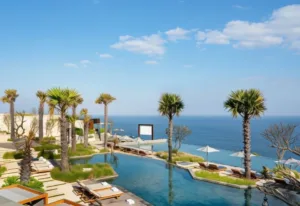
The south of the island has high limestone cliffs, and the beaches hide in coves beneath them, reached by stairs.
What’s good: the most striking views on the island and the best surfing. The atmosphere is calmer than in the west, while there are still plenty of good cafés and bars with sunset views.
What to bear in mind: it is hard here without a bike or car — everything is scattered, and the descents to the beaches are steep. The waves are serious, and most beaches are unsuitable for swimming with children. The exceptions are Padang Padang and Melasti, where it is calmer.
Nusa Dua: for those who need a calm sea
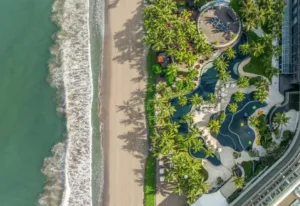
A closed resort zone with large hotels, well-kept beaches and a lagoon protected by a reef.
Who it suits: families with children, elderly parents, anyone who needs a gently sloping calm sea without waves and currents. There are few such places in Bali, and this is the best of them.
Downside: sterility. Outside the hotel grounds there is almost no life, and you won’t see the real Bali here. The compromise is to live here but go out regularly.
Sanur: an underrated option
A calm eastern shore with a long promenade that is pleasant to walk and cycle along.
What’s good: the sea in the lagoon is calm, prices are lower than in Seminyak, the crowd is adult and family. Fast boats to the islands of Nusa Penida and Lembongan leave from here.
What to bear in mind: at low tide the water goes far out, and swimming turns into a walk through the shallows. It is worth checking the tide schedule in advance.
Ubud: Bali without the sea
The cultural centre of the island among rice terraces and jungle. Here are temples, craft villages, yoga studios, waterfalls and the monkey forest.
What’s good: it is the only place where Bali feels like a distinct culture rather than a resort. Greenery, a few degrees cooler, beautiful villas in the jungle for a reasonable price.
The main limitation: there is no sea and it is an hour and a half away. Going to Ubud “for a beach holiday” is a common mistake.
Another nuance: the centre of Ubud ceased long ago to be a quiet village — it has traffic jams and crowds. It is better to settle 10–15 minutes from the centre, among the fields.
Seasons and how they affect the choice
Bali has two seasons, and they change not only the weather but which area turns out to be a good one.
Dry season, April – October. Sun, less humidity, a calm sea in the east. The peak falls in July and August: prices are higher, accommodation is snapped up in advance, the roads are dense. This is the best time for the west coast and Uluwatu.
Rainy season, November – March. Downpours are usually short and come in the second half of the day, and there is still plenty of sun. The greenery is brighter, prices lower, fewer people. But there is an important detail: currents wash rubbish brought by the ocean onto the western beaches — Canggu, Seminyak, Kuta — and it looks unpleasant. At this time the east and the centre win: Sanur, Nusa Dua, Ubud.
Separately, remember Nyepi — the Balinese day of silence in March. For twenty-four hours nothing works on the island, including the airport, and you cannot leave the hotel grounds. It is an amazing experience, but you cannot plan a flight or move on these dates.
Transport: how to get around
It is transport that turns the choice of area into the decisive question, so let’s go through the options.
A bike. The most common way. Rental costs 60,000–100,000 Rp a day. Important: for legal riding you need a national licence with a motorcycle category and an international driving permit, and the police in Bali check documents regularly. Without a licence insurance does not work in an accident — and traffic here is dense and unfamiliar.
Taxis via apps. Both cars and motorbikes work, with fixed and low prices. But there is a local peculiarity: in a number of areas, especially around Ubud, informal restrictions from local taxi drivers apply, and the app may not find a car or the driver may ask to meet off to the side. This is not a glitch but an established practice.
A driver for the day. Costs 600,000–900,000 Rp for 8–10 hours for the whole party. The best option for trips round the sights: you don’t need to drive on mountain roads yourself and look for parking.
On foot. Realistic only in Sanur, Nusa Dua and the centre of Ubud. In other areas there are almost no pavements.
If you rent accommodation for a long time
Renting for a month or longer is a separate story with its own rules.
The price drops severalfold: what costs 900,000 Rp by the night comes to about 8–12 million for a month in total. Haggling is always appropriate, especially in low season and when paying several months ahead.
What to look at before paying. Check the internet yourself, not from the description — if you work remotely this is critical, and speed varies greatly even within one street. See the accommodation in the rain if you can: leaks and damp show up precisely then. Ask about water and electricity — whether they are included in the price and whether there are outages. Ask about noise: construction next door can spoil a month, and building in Bali is constant.
And one more thing: villas in the jungle look wonderful in photographs, but there are more insects and humidity and the roads are worse. For a short trip this is romance, for a long one daily life.
Neighbouring islands
Many spend a week in Bali and don’t realise that the clearest water is nearby.
Nusa Penida is a wild island with limestone cliffs and famous viewpoints. The roads are bad, so it is better to take a driver. It is worth at least one overnight stay: on a day excursion you will see only the most crowded places.
Nusa Lembongan is small and calm, with good snorkelling and mangroves. Ideal for two or three days of rest from the bustle of the south.
The Gilis are three islets off Lombok, reached by fast boats. There are no cars there at all, only bicycles and horse carts.
Boats leave mostly from Sanur, and the journey takes 30–45 minutes. This is, by the way, one more argument for Sanur as a base.
How to choose for yourself
| What you need | Where |
|---|---|
| A first trip, a bit of everything | Seminyak + a few days in Ubud |
| With small children | Nusa Dua, Sanur |
| Remote work for a long time | Canggu, Ubud |
| Surfing | Canggu for beginners, Uluwatu for the experienced |
| Calm and nature | Ubud, Amed, Sanur |
| Nightlife | Canggu, Seminyak, Kuta |
| A minimum budget | Kuta, the outskirts of Ubud |
| Views and photographs | Uluwatu, the rice terraces near Ubud |
How much accommodation costs
| Type | Price per night | Where |
|---|---|---|
| A guesthouse, a simple room | 200,000–400,000 Rp | everywhere except Nusa Dua |
| A good 3–4★ hotel | 600,000–1,200,000 Rp | Sanur, Seminyak, Ubud |
| A villa with a pool | from 900,000 Rp | Canggu, Ubud, Uluwatu |
| A resort hotel | from 2,000,000 Rp | Nusa Dua, Uluwatu |
| A monthly rental | from 6,000,000 Rp | Canggu, Ubud |
The difference between areas is substantial: for the same villa in Ubud they will ask a third less than in Seminyak. A long rental is almost always several times better value than a nightly one.
Daily life: what differs by area
A few everyday things that affect comfort more than the view from the window.
Medicine. Decent clinics are concentrated in the south — in the Kuta, Denpasar and Nusa Dua area. Ubud has small clinics, and the east of the island has practically nothing. If you travel with children or with chronic illnesses, this is a weighty argument in favour of the south. Insurance is essential: treatment in private clinics for foreigners is expensive.
Money. There are ATMs everywhere, but it is better to withdraw at bank branches rather than at free-standing machines in the street — there are skimming problems in Bali. Cards are accepted in cafés and hotels in the south, while at markets, with drivers and at small warungs cash is needed.
Food. Canggu and Seminyak have a huge choice of international cuisine — from vegetarian cafés to Italian restaurants — but prices to match. Ubud is cheaper with more healthy-style food. Local warungs all over the island give a full lunch for 25,000–50,000 Rp.
Internet. Mobile coverage on the island is good and cheap, and a local SIM is sold right at the airport. Those who don’t want to spend time on it on arrival arrange a plan in advance — for example through the eSIM catalogue on Trip.com with payment in roubles. Wired internet in accommodation is a lottery, and deep in the rice fields it can turn out weak, so if you work remotely check the speed yourself.
Noise. This is rarely looked at when booking, and wrongly: besides construction, religious ceremonies are loud in Bali, and in tourist areas music from bars is audible until late. If you sleep lightly, choose accommodation not on the main street.
Mistakes when choosing an area
Underestimating the road. This is mistake number one. Distances in Bali are deceptive: the map shows twenty kilometres, but the drive is an hour and a half on narrow roads with dense traffic.
Settling in Ubud for the beach. There is no sea there at all.
Expecting a calm sea in the west. Canggu, Seminyak and Kuta are an ocean with waves and currents. For swimming these are not the best places, and for surfing they are excellent.
Taking one hotel for two weeks. It is wiser to split: a few days in the south, a few in Ubud. That way you will see a different island and won’t spend hours on the road every day.
Ignoring the season. From November to March it rains, and currents wash rubbish onto the western beaches. At this time the east coast and Ubud win.
Not looking at the location within the area. In Canggu the difference between accommodation by the beach and accommodation behind the rice fields is twenty minutes in traffic each time.
In short: frequently asked questions
How many areas to take per trip? For a week — one, two at most. For two weeks — two or three, with overnight stays rather than there-and-back outings.
Do I need transport? In Ubud and Canggu it is hard without a bike or driver. In Sanur and Nusa Dua you can manage on foot and by taxi.
Where is it best with children? Nusa Dua and Sanur — because of the calm sea. Ubud suits older children.
How much time to allow for the road from the airport? To Kuta 15–25 minutes, to Seminyak about half an hour, to Canggu and Uluwatu an hour or more, to Ubud an hour and a half. At rush hour add another half — that is no exaggeration.
Is it dangerous to swim on the western beaches? There are strong currents and waves there, and lifeguards are not everywhere. Pay attention to red flags and don’t go far if you are not sure of your abilities.
Which area is the most beautiful? Uluwatu for views and the surroundings of Ubud for nature. But “beautiful” and “convenient” rarely coincide in Bali.
Where is it cheapest to live for a long time? The outskirts of Ubud and the northern part of Canggu: a monthly rental there is noticeably lower than in Seminyak at a comparable level of accommodation. But allow for transport costs — it is a drive to the beaches from there.
Can I do without booking on the spot? In low season — yes, accommodation is easy to find on the spot and to bargain for. In July, August and New Year dates you need to book in advance: good options are snapped up months ahead.
Is it worth going to the neighbouring islands? Nusa Penida and Lembongan — yes, the water is clearer there and there are fewer people. Boats leave from Sanur, and the journey takes 30–45 minutes.