In Chongqing the metro runs straight into a residential building, a lift takes you down to the “ground floor” that turns out to be the ninth, and the navigator vanishes in the middle of a flyover. The city stands on hills at the confluence of two rivers, the Yangtze and the Jialing, and by the laws of the terrain everything here is unlike in flat metropolises: streets go uphill, roads dive into tunnels and skyscrapers grow out of slopes. In the evening this chaos turns into a light show, and at dinner a red broth boils on the table that makes your eyes water. For a traveller Chongqing is one of China’s most spectacular cities, but you have to get used to its vertical logic. This “what to see in Chongqing” guide will help you put together an itinerary for one to three days: what is worth seeing, how transport works, where to stay and why it is better not to come in summer.
- The main things: Hongyadong in the evening, the metro in a building at Liziba station, the cable car over the Yangtze, the Chaotianmen embankments, hotpot.
- How many days: 2 days for the centre, 3 — add Ciqikou or Wulong.
- When to go: March–May, October–November; summer is very hot, winter foggy.
- Where to stay: the Jiefangbei district, near the metro and the evening embankments.
- Life hack: look at the floors in the navigator and stick to the metro — taxis get stuck in tunnels.
Chongqing on the map: what kind of city it is and where it is
If you look for “Chongqing on the map of China”, it lies in the south-west of the country, in the upper reaches of the Yangtze, about three hundred kilometres from Chengdu. Formally it is not just a city but a centrally administered municipality, like Beijing and Shanghai. Its area is huge, and its population by official estimates exceeds thirty million, but noticeably fewer live in the urban part — the rest of the space is taken up by districts and villages. There is no sea nearby: the closest coast is far to the east, but there is a river along which cruise ships sail to the Three Gorges.
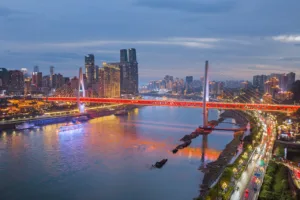
The centre is formed by the Yuzhong peninsula between two rivers — on the map it is stretched like a wedge to the point of confluence. On one side is the business district around Jiefangbei Square, on the other, beyond the bridges, the Nan’an and Jiangbei districts. An important rule: a straight line on the map does not show the real path. Between two points 300 metres apart there may be a cliff, and the road will go around it through a tunnel or along a flyover.
Relief and floors: how the “vertical” city works
The mountainous terrain determines everything. Buildings are built into slopes, and many have entrances on different levels: the “ground floor” from one street can be the sixteenth from another. A striking example is the Hongyadong complex: eleven floors, and the entrance from the Jialing riverfront leads to the lower level, while from the street above it leads to the upper. The navigator in such buildings often gets confused: the GPS signal reflects off walls, and the dot on the map jumps. So plan with a time margin and ask passers-by through a translator.
Stairs are a separate part of the city. The old neighbourhoods such as Shibati are connected by stone steps, and the farther from the metro, the more climbs. For long walks bring comfortable shoes, and it is better to leave your suitcase at the hotel. General health recommendations for the trip are in the article on pharmacies in China.
What to see in Chongqing: the main places
Hongyadong
Hongyadong is a complex on a slope above the Jialing River, styled after traditional stilt houses. By day it is shops and restaurants with a view, but the point of a visit is the evening: after dark the façades are lit with yellow lanterns and the building turns into that very “Chongqing in photos” picture shown on social networks. The complex is often compared with the scenery from Spirited Away, although the film’s authors denied it. The lighting works in the evenings, usually until about 11 p.m.; the switch-on time depends on the season. Get there by metro to Xiaoshizi station (lines 1 and 6), then walk a few hundred metres. The most beautiful angle is from Qiansimen Bridge or from the opposite embankment. At weekends it is very crowded here: come on weekdays and stock up on patience.
Liziba station and the “train through a building”
Line 2 is a monorail and passes through a residential building at the level of the sixth to eighth floors. Liziba station became famous because the train literally drives into the building. It is photographed from a platform by the river, and how it works and why the noise does not disturb residents is explained in the article “A train through a building”. You can ride Line 2 with an ordinary fare card: there are more views from the windows than on any sightseeing bus.
Jiefangbei and Chaotianmen
Jiefangbei Square with the Liberation Monument is the business and shopping heart of the centre. Around it are pedestrian streets, shopping centres and eateries. From it it is not hard to walk to the Chaotianmen embankment, where the Yangtze and Jialing meet: water of two colours — muddy brown and greenish — flows side by side without mixing. At this spot a theatre-quarter has been built, which we wrote about in the article “Chaotianmen · Chengli”.
Night views, the cable car and a cruise
The best way to appreciate the scale of the city is to rise up or cross the river through the air. The cable car over the Yangtze gives a view of the lights of both banks; details, times and tickets are on the page “Night Chongqing”. Another viewpoint is the glass gallery on the Raffles City skyscrapers, suspended at a height of about 250 metres and open to visitors: the view from there falls straight onto the confluence of the rivers. An evening cruise on the rivers starts from piers in the centre and takes an hour to an hour and a half.
Shibati, Ciqikou and the Three Gorges Museum
Old Chongqing has survived in fragments. Shibati is a neighbourhood on a slope with narrow stairs and mini-restaurants. Ciqikou is an ancient pier town in the Shapingba district: souvenir shops, tea houses, snacks; it is calmer here on weekdays. The Three Gorges Museum next to the People’s Assembly is a large exhibition about the Yangtze, the building of the dam and the resettlement of residents, suitable for those interested in the history of the region. For an immersive evening watch the show “Chongqing 1949”, and for an unusual overnight stay see the review of the quest hotel Kuimeilou.
Hotpot: why Chongqing is the capital of the fire pot
Hotpot here differs from Chengdu’s: the Chongqing broth is boiled in beef tallow with pepper and spices, thick and very spicy. The classic set for cooking is thinly sliced beef, “maodu” (tripe), duck intestines, tofu, bamboo shoots and noodles; it is customary to dip in sesame oil with garlic. If you can’t stand spice, ask for “yuanyang” — a pot with two sections, red and light; the light one rescues you after the first minutes. In the Haidilao chain the menu has pictures and the waiters are used to foreigners, but local places without English signs are usually tastier and cheaper.
Besides hotpot, try xiao mian (spicy noodles for breakfast), spicy chicken “laziji” with a heap of chilli, fried snacks by the river and sweet glutinous-rice buns. Night markets are a chance to watch local life, and for tips on choosing dishes see the article .
Chongqing in 1, 2 and 3 days
| Day | Morning–afternoon | Evening |
|---|---|---|
| 1 | The Three Gorges Museum or Shibati, a hotpot lunch | Liziba, Hongyadong, a walk along the embankment |
| 2 | Jiefangbei, Chaotianmen, Ciqikou | The cable car, a cruise, “Chongqing 1949” |
| 3 | A trip to Wulong: natural bridges and a gorge | Return, dinner near the hotel |
If you have only a day (“Chongqing in 1 day”), keep only the evening block: Liziba, Hongyadong and the illuminated embankments. In two days you will manage both the daytime places and the viewpoints. On the third day choose somewhere out of town: Wulong with its three natural bridges is the most popular trip, about two hours from the city; for lovers of rock reliefs the carved compositions of Dazu (a UNESCO site) to the west of the centre will do. Organised options are in the section “Excursions in Chongqing”.
How to get to Chongqing and get around it
By plane. The main airport is Jiangbei (CKG), with several terminals; metro lines are connected to it. The road to the centre takes about 40–60 minutes depending on the time of day. For China’s airports and check-in see the article “China’s airports”.
By train. There are several stations in the city; for high-speed trains Chongqing North (Chongqingbei), Chongqing West (Chongqingxi) and Shapingba are used most often. Choose the station carefully — the distance between them across different parts of the city is measured in tens of minutes. Tips on stations are in the article “China’s stations”. Neighbouring routes: Chengdu — Chongqing, Xi’an — Chongqing, Beijing — Chongqing. From Chongqing you can also continue towards Zhangjiajie — the section on excursions in Zhangjiajie will help plan the continuation. How to buy tickets is on the page about rail tickets.
Within the city. The metro is the main transport: lines run both underground and above it, and the fare is paid through Alipay and WeChat (see how to pay for the metro). A taxi, because of the terrain and traffic, often turns out more expensive and slower. Crossing the rivers through the air is by cable cars; buses in the centre stand in tunnels. The general rules are in the article .
Where to stay in Chongqing
For a first trip the Jiefangbei district is best: the centre, lots of metro, food and embankments. It is also where to look for accommodation with a river view. A selection is on the page “Hotels near Jiefangbei”, the general choice across the city in the section “Chongqing hotels”. A life hack: before booking, check which “floor” the entrance from the street is on and how far it is from the lift to the metro — in Chongqing this decides whether you will drag a suitcase up stairs or not.
Weather and the best time
Summer in Chongqing is one of the hottest in the country: by day the temperature often exceeds 35–40 degrees and hardly drops at night. In winter the city is often covered in fog, with little sun, though the temperature usually stays above zero. The best months for a trip are March–May and October–November: warm, without extremes, and the illuminations are better visible. Bring light clothing, and for November and winter a sweater and a waterproof jacket. China’s general seasons are covered in the article “When to go to China”, and the winter choice of destinations in the article .
Pitfalls and life hacks
- Navigation. Download offline maps and a translator in advance; tips are in the overview .
- Connectivity. Maps and taxis need the internet; an eSIM is more convenient.
- Payment. Russian cards don’t work, set up Alipay: how to pay in China.
- Weekends. On holidays at Hongyadong and on the bridges people move in a solid stream; see .
- Passport. It is needed for stations and many hotels; about entry see the article on the visa.
- Scams. Be careful with “helpers” at the station and photographers on the embankments: typical schemes.
Frequently asked questions
What to see in Chongqing in 2 days?
On the first day Liziba, Hongyadong and the embankments in the evening; on the second Jiefangbei, Chaotianmen, the viewpoints and a cruise. If there is time left, add Ciqikou.
Chongqing in 1 day: what to fit in?
Liziba, Jiefangbei, Hongyadong and the evening view from the cable car. You will have to skip the rest.
Where is Chongqing and is there a sea there?
In south-west China, at the confluence of the Yangtze and Jialing. There is no sea; the nearest coast is far to the east.
Which airport is in Chongqing?
The main one is Jiangbei (CKG). It is connected to the city by metro; the road to the centre takes about an hour.
How long is the train from Chengdu to Chongqing?
The high-speed train takes from a little over an hour to two hours depending on the service; the schedule is on the page “Train Chengdu — Chongqing”.
When is the best time to go to Chongqing?
In spring and autumn. Summer is very hot, winter is often foggy.
What is the “lying skyscraper” in Chongqing?
This is what the Raffles City complex is called, with a horizontal glass gallery at a height of about 250 metres; it has a viewing platform above the confluence of the rivers.
Chongqing or Shanghai — which to choose?
Shanghai is a sea of lights, museums and restaurants with an international taste. Chongqing is relief, spicy cuisine and non-standard pictures. For a first trip to China people more often choose Shanghai, for a second Chongqing.
Do I need a visa for Chongqing?
For Russians visa-free entry for up to 30 days applies — until 31 December 2027. Follow the updates in the article on the visa.
Read also: What to see in Chengdu · What to see in Xi’an · What to see in Guangzhou · What to see in Shenzhen · What to see in Hangzhou.
The material is current as of October 2026. Illumination hours, schedules and rules may change — check before your trip.