Japan's love hotels are a legal, law-regulated cultural phenomenon with half a century of architectural history: the Meguro Emperor castle, a Balinese resort in Tokyo and the designer Iroha in Roppongi.
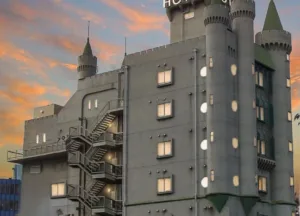
Imagine a building in the shape of a medieval castle on a quiet street of a Tokyo residential district — with turrets, an arched entrance and a neon sign that does not tell you what is inside but simply makes it impossible to confuse this place with anything else. Love hotels are one of Japan’s most recognizable and at the same time most misunderstood cultural phenomena: not brothels, not anything illegal, but a perfectly ordinary, law-regulated part of the country’s hotel market, around which a separate architectural and design culture has grown over half a century.
From roadside motels to an architectural attraction
The format appeared in the 1960s, when the rapid growth of car ownership in Japan made the very idea of a roadside motel for a short stop understandable. One of the first establishments of the modern format is considered to be Hotel Love in Osaka, opened in 1968. But the real cultural explosion happened in 1973, when the Meguro Emperor opened in Tokyo’s Meguro district — a hotel in the form of a European castle, designed by the architect Yasuhisa Kurosaka. Its 30 rooms with a gondola, children’s slides and rotating and vibrating beds became a monument to 1970s kitsch — and suddenly proved so successful that dozens of other hotels across the country began to copy this logic: the brighter and more unusual the building outside, the better.
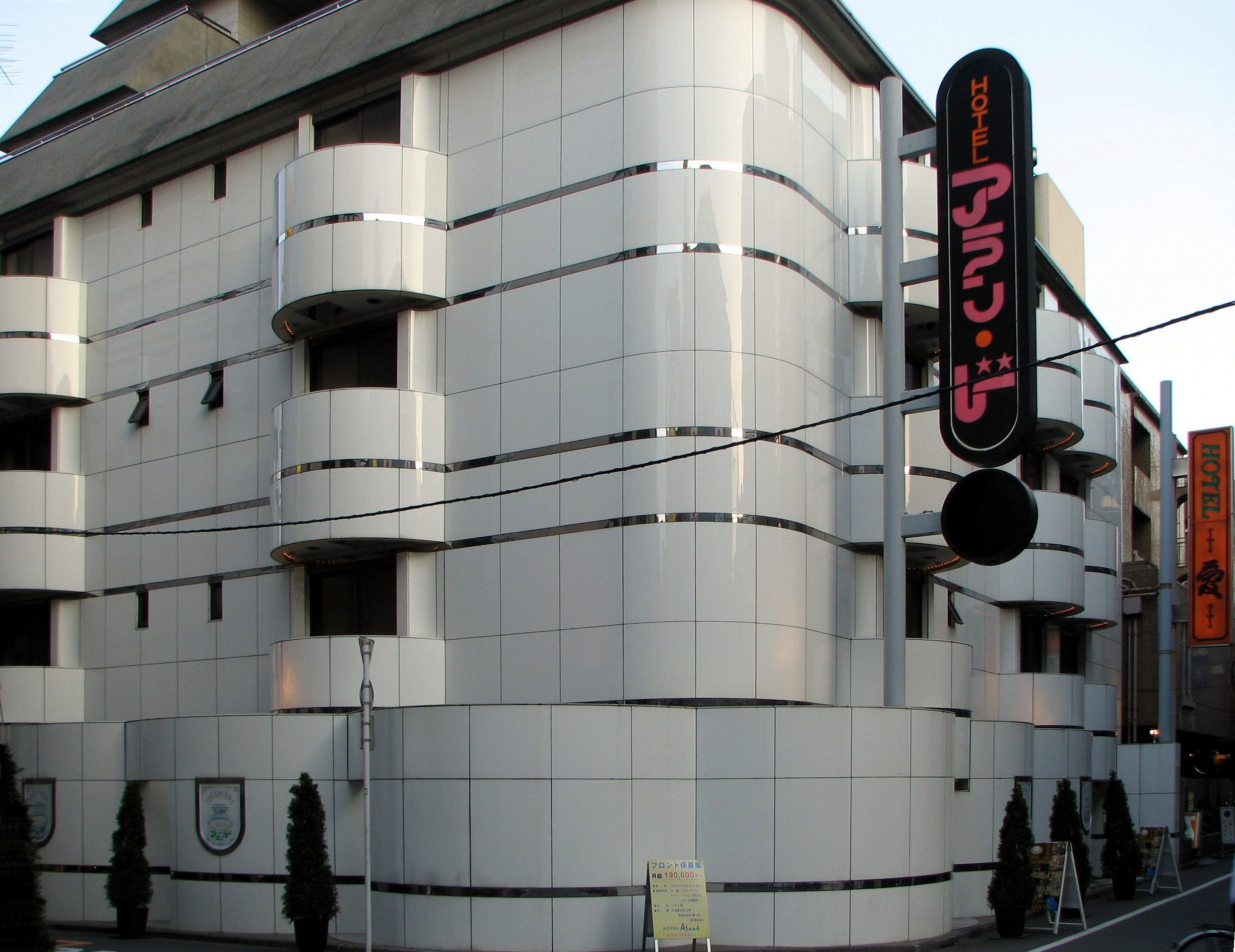
This architectural eccentricity had a perfectly pragmatic explanation. A striking facade in the form of a castle, a ship or a UFO allowed a customer to recognize a love hotel instantly without an open sign or advertising — a kind of visual code understood by locals but neutral to an outside eye. At the same time the spectacular “Western” image worked for the growing flow of tourists in postwar Japan, which aspired to associate itself with modernity.
How it works in practice
The main principle of a love hotel is privacy brought to its logical limit. The reception desk is often designed so that the guest does not see the employee’s face and the employee does not see the guest’s — a window, a panel or a semi-transparent partition. Even more often there is simply no contact with staff: at the entrance or right in the room there is a terminal through which the stay is paid for — much as you top up a phone balance. In some hotels the room door closes automatically right after you enter, and the whole visit from start to finish passes without a single spoken word.
The room is usually chosen not at the counter but from an illuminated panel with photographs of free rooms at the entrance — press the picture you like, get a key or a code. Two basic rates apply: a short “rest” (休憩, kyūkei) for 1–3 hours and a full “stay” (宿泊, shukuhaku) until morning. At 2026 prices a “rest” in a standard hotel costs 3,300–7,500 ¥, a night 8,000–20,000 ¥, and in hotels with spectacular themed rooms the bill can go over 50,000 ¥. An important practical nuance: in many hotels you cannot leave the room until the end of the paid time — if you plan to grab a bite, stock up in advance or order food through the same terminal.
Three hotels worth chasing for the building itself
Half a century after opening, the Meguro Emperor (Meguro, Tokyo) remains a living architectural monument in the “original of the genre” category — the hotel was fully renovated in 2007, preserving the recognizable silhouette of the castle but modernizing the rooms inside.
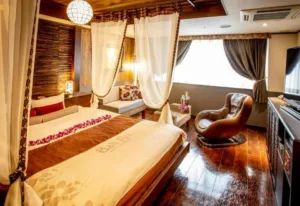
Hotel BaliAn Resort Kinshicho in the Kinshicho district takes the idea of a themed room to its logical limit with an Asian accent: furniture brought from Bali, a jacuzzi, the atmosphere of a resort villa — all of it a couple of subway stops from Tokyo’s Skytree tower, with no need to fly to the real Bali.
Design Hotel Iroha in Roppongi is an example of how the format evolves toward restrained designer taste: the building of a former upscale restaurant, reimagined by the design group Three Star Group, combines the classic attributes of the format (spacious baths, complete privacy) with Japanese aesthetics — tatami, sliding doors, washi-style lamps, terraces at the luxury rooms.
Can you just walk in to look — and is it worth going for a tourist
Formally this is a legal segment of the hotel market, regulated by the Japanese Entertainment Business Law (Fūeihō) since 1985 — there is no illegality or link to the sex industry in the legal sense here: guests come exclusively as a couple and do not buy services from the hotel. Foreign tourists are accepted without problems in large cities, especially in districts like Shibuya and in Osaka, and some of the more modern, tourist-friendly hotels (including all three listed above) can be booked in advance through ordinary booking sites like Booking.com — it is not necessary to come “off the street” and figure out the terminal on the spot.
For a traveler who is simply interested in the phenomenon and is not looking for a place to sleep in this particular format, the most harmless option is a walk through districts like Kabukicho in Tokyo with a camera (from the outside, of course) to look at the architectural facades that have become a genre of Japanese street photography in their own right.
FAQ
Is it legal? Yes, completely — love hotels have been officially regulated by Japanese legislation since 1985 on a par with other forms of entertainment business.
Are ordinary tourists admitted who are not looking for exactly this format of seclusion? Formally the room is sold precisely as a room for a couple for a certain time — you won’t be able to check in “just to look” and stay to live there as in an ordinary hotel, but you can quite well book a room as unusual temporary lodging for a night if the format suits you.
Do I need to know Japanese to check in? No — the system with terminals and a panel for choosing a room by photographs is designed to get by with no conversation at all, and large tourist-friendly hotels like those listed above can be booked in advance in English through ordinary sites.
Why do love hotels have such unusual architecture? Originally — so that a customer could recognize the establishment by its facade without an open sign, and at the same time to create an image of a “modern, Western” Japan in the postwar decades; today it is already an independent aesthetic tradition that many hotels deliberately support.
Can I leave the room for a walk during the paid time? Not always — some hotels do not allow leaving the room until the paid period expires, so check this rule of the specific hotel at check-in or in the description on the booking site.
Prices and accommodation conditions may change — check the current information with the specific hotel before booking.