An onsen is not a “hot bath” but a ritual of its own with rules that are rarely explained to a tourist in advance. Hence the typical mistakes: lathering up in the bath itself, dipping the towel in the water, getting in wearing swim trunks. This article answers the question “how to use an onsen properly” from the big-picture point of view: how an onsen differs from a sento and a spa, what kinds of baths there are (shared, mixed, private, open-air), how to behave step by step, how much it costs and where to go for hot springs. If you are going to a bathhouse for the first time and are most worried about tattoos, the towel and the water temperature, start with the separate breakdown: onsen for beginners: rules, tattoos, the towel.
Current as of October 2026. Rules and prices depend on the venue — check at reception or on the website.
What an onsen is and how it differs from a sento and a spa
An onsen (温泉) is a bathhouse on natural hot water. Under the Japanese hot springs law the water must emerge at a temperature of at least 25 °C or contain at least one of the substances listed in the law (among them sulphur, iron, carbon dioxide). It is this that allows “onsen” to be written on a sign.
A sento (銭湯) is a city public bathhouse on heated tap water, without natural minerals. The rules of behaviour in both places almost coincide, but an onsen is valued more: both for the properties of the water and for the atmosphere — the best stand in the mountains, by the sea and in historic towns. A separate format is the onsen at a ryokan, a traditional inn: many go to a ryokan precisely for the evening bath. An example is Nishiyama Onsen Keiunkan, whose water goes to all the hotel’s baths and taps; a more urban example is Hoshinoya Tokyo with a spring on the roof.
Spa complexes with pools of tap water are not considered an onsen, even if they look similar: entry there is often in swimwear and the rules are different.
How to use an onsen: the order step by step
- In the changing room leave your things in a locker or basket. Phones and cameras are not taken into the bathing zone.
- Take a small towel and go to the washing area.
- Sit on a low stool in front of a tap and wash thoroughly with soap and shampoo. Rinse off all the foam.
- Enter the water slowly. Don’t dive, don’t swim, speak quietly.
- Keep the towel on the edge or put it on your head — just not in the water.
- After 10–15 minutes get out to rest; you can go in again.
- Before returning to the changing room, wipe your body with the small towel so as not to wet the dry zone.
The main rule is to wash before, not in the bath. Soap in the shared water is considered a gross violation. First test the temperature with a hand or foot: water in an onsen is often hotter than it seems, usually 40–44 °C. Don’t bathe straight after alcohol or when unwell — sudden heat is dangerous. Tie up long hair; eating and drinking in the bath itself is not customary.
Tattoos: in short
In Japan tattoos were historically associated with the yakuza, and many onsen still do not admit people with visible designs, even tourists. The number of places where it is allowed is growing, especially in tourist towns. There are three options: find a venue that explicitly allows tattoos; cover a small design with a special sticker; book a private bath. Ask the hotel in advance. More in the separate article on tattoos and rules for beginners.
Separate, mixed and private baths
Most modern baths are separated by sex; entrances are marked with the characters 男 (men) and 女 (women), and the noren curtains are often different colours — usually blue for men and red for women. Mixed baths (混浴, konyoku) used to be the norm, today they are rare and mainly in remote traditional places; a towel or wrap is usually expected there, and the rules have to be checked on the spot. Private baths (kashikiri-buro) are booked for a set time for yourself, a couple or a family. This is a solution for those who are shy of strangers, for families with children and for guests with tattoos. Many ryokan include one or two such baths in the stay or rent them for a separate hourly fee.
Open-air and indoor baths
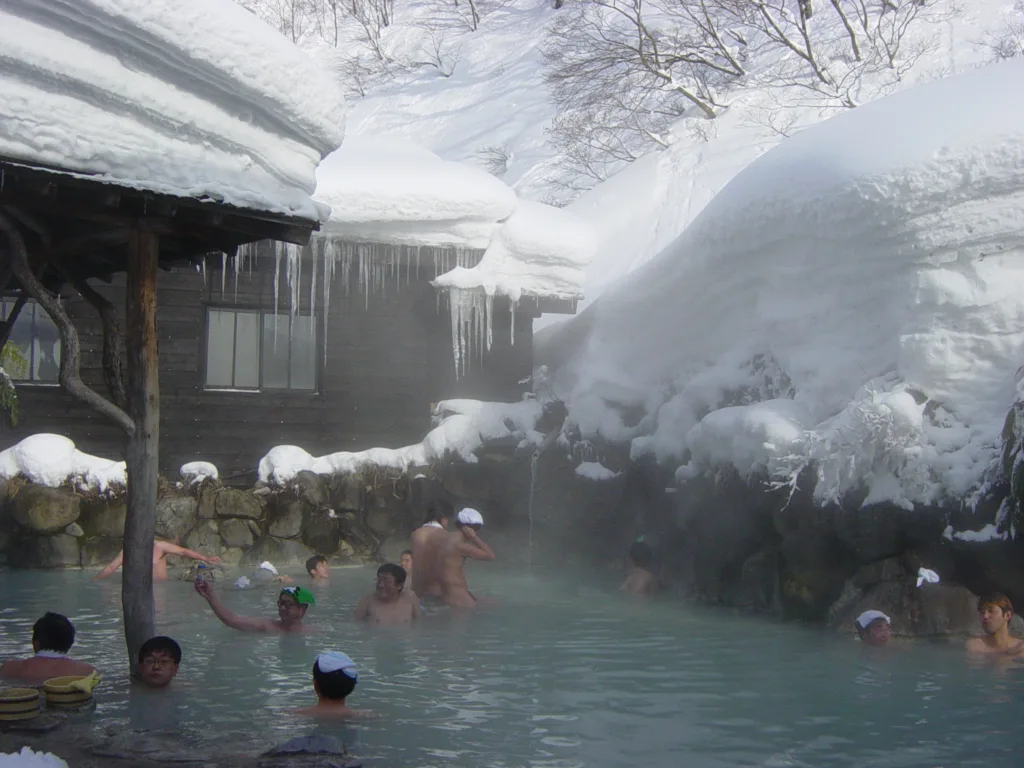
A rotenburo (露天風呂) is an open-air bath under the sky, often with a view of mountains, forest or the sea; it is the one shown in advertising photos, especially in winter, when steam rises over the water against a backdrop of snow. An indoor bath is less striking but available in any weather: open-air areas may be closed in heavy rain and during a typhoon. Large venues often offer both options.
How much an onsen costs
Public onsen and sento outside hotels are usually inexpensive — from a few hundred to about one and a half thousand yen for entry, depending on the region and level. An onsen at a ryokan is more often included in the stay (sometimes with limits on hours), and private baths are almost always paid, usually for 45–60 minutes. It is better to pay on the spot in cash: if you are from Russia, Russian cards do not work in Japan, and how payment works is covered in the guides which cards work in Japan and money in Japan.
Where to go for onsen
| Region | Feature | For the tourist |
|---|---|---|
| Hakone | mountain views, sometimes with a view of Fuji | about an hour and a half from Tokyo, suits a day or a night; more — Hakone from Tokyo |
| Kusatsu | one of the most powerful springs in the country by flow, a smell of sulphur | farther from Tokyo, a smaller flow of tourists |
| Beppu (Kyushu) | the most springs in one city, the “hell” springs jigoku for viewing, not for bathing | a flight or train is needed; see Beppu Showaen |
| Yufuin (Kyushu) | a calm atmosphere, ryokan among the mountains | often combined with Beppu |
| Noboribetsu (Hokkaido) | a volcanic landscape, “Hell Valley” nearby | logical to combine with a winter trip to Hokkaido |
Many routes build in a night or two in an onsen town as a contrast to the urban part of the trip. How to fit this into a route — see the Japan itinerary for 10–14 days, how to choose a hotel and season — the seasons in Japan. The oldest ryokan with an onsen is in the article the oldest hotel in the world. General norms of behaviour are in the article on Japanese etiquette; for an independent trip we have put together a separate guide.
Frequently asked questions
How do I use an onsen properly?
First wash on a stool at the shower, then enter the water without swimming or noise, not putting the towel in the water. After 10–15 minutes take a break, and dry yourself before the changing room.
Can I bathe in an onsen in a swimsuit?
No, in the vast majority of onsen full nudity is the rule and swimsuits are forbidden. The exceptions are individual mixed onsen and modern bath complexes in the format of spa parks.
Will I be admitted to an onsen with a tattoo?
It depends on the venue. Many traditional places refuse, but the number of tattoo-friendly ones is growing. An alternative is a concealing sticker for a small design or a private bath.
Do I need my own towel?
Usually a small towel is given out at the entrance or sold for a small fee. You can bring your own.
Can I take photographs in an onsen?
Practically nowhere; bringing a phone into the bathing zone is often forbidden.
How much does an onsen cost in Japan?
Public baths outside hotels are from a few hundred to about 1,500 yen for entry. An onsen at a ryokan is often included in the cost of the stay, private baths are paid separately.
What is the difference between an onsen and a sento?
An onsen uses natural hot water that meets the hot springs law. A sento is a city bathhouse on heated tap water.
What is a kashikiri-buro?
A private bath booked for a set time for yourself, a couple or a family. Suitable for those who are shy of a shared one and for guests with tattoos.
How long can you sit in hot water?
10–15 minutes per session is comfortable, then a break. You shouldn’t sit in hot water for hours, especially after alcohol.
Can children go into an onsen?
Usually yes, with parents in a bath of the same sex or in a private bath. Age rules are each place’s own — check in advance.