Thailand 2027: the main events of the year — the Chiang Mai Flower Festival, Songkran, Phi Ta Khon, the candle parade, the Vegetarian Festival in Phuket, Yi Peng and Loy Krathong, the Surin elephants and the banquet for monkeys. Dates, routes and tips.
There is a shot for which people fly to Thailand again and again: the black night sky over Chiang Mai, and in it thousands of warm lights that one by one break away from hands and slowly rise, until the whole valley turns into an upside-down river of light. It is quietest at this moment among the very people launching the lanterns: conversations die down, someone makes a wish, someone simply watches. Yi Peng and Loy Krathong are the most famous, but far from the only reason to come to Thailand in 2027. The country knows how to celebrate like almost no one else: with spirit masks, with wax towers carried through the streets, with a two-hundred-strong elephant parade and with a banquet for monkeys. This article covers Thailand’s most notable events of 2027 in calendar order: what they are, when, what is worth seeing and how not to be left without accommodation.
- February 5–7 — the Flower Festival in Chiang Mai (the main parade is on Saturday).
- April 13–15 — Songkran, the Thai New Year.
- Mid-June to early July — Phi Ta Khon in Dan Sai (the exact days are determined by the local medium and announced later).
- Around July 19 — the candle parade in Ubon Ratchathani (at the start of Buddhist Lent; the program is being clarified).
- July 20 — the Full Moon Party on Phangan (shifted this month because of Buddhist holidays).
- October — the Vegetarian Festival in Phuket (nine days by the lunar calendar; dates to be announced later).
- November 13–15 — Yi Peng in Chiang Mai, November 14 — Loy Krathong.
- Third week of November — the “Elephant Round-up” in Surin.
- November 28 — the Monkey Banquet in Lopburi (the last Sunday of November).
How to use this calendar
Thai festivals fall into two categories. Some have a fixed date, like Songkran, which falls on April 13–15 every year. Others are tied to the lunar calendar: their dates “float” from year to year, and some exact schedules for 2027 will be announced by the organizers only closer to the season, because the final days are determined by local authorities, and in the case of Phi Ta Khon by a village spiritual medium. So for everything lunar use a simple rule: plan the trip for a “window” of two to three weeks and check the exact dates on official tourism websites. The second rule is accommodation. Chiang Mai at Yi Peng is booked six to twelve months ahead, and prices on those days rise several times over, so it is better to decide in advance.
February: Chiang Mai drowned in flowers
In the coolest part of the Thai year, when a light mist hangs over the northern hills in the mornings, Chiang Mai holds its Flower Festival — in 2027 it is expected from February 5 to 7. The main events take place in Suan Buak Hat park: orchids, chrysanthemums, tulips and dahlias are exhibited there, and on Saturday a parade of floats assembled entirely from live flowers goes through the city streets — according to tourist resources, more than a hundred and seventy thousand flowers are used in the compositions. It is the “most peaceful” and beautiful festival in the calendar: without a crowd of drunk tourists and without splashing, but with a scent over the whole neighborhood and a choice of photographs for a year ahead. February is also the best season for northern Thailand: dry, not hot, and the nights cool enough to want to throw on a sweater. If you are going for the flower festival, allow two to three days for Chiang Mai itself and a day for the surroundings — the old city, Doi Suthep temple, craft villages.
April: Songkran — the water that unites the country
The country’s noisiest and most popular festival is the Thai New Year, Songkran. It does not move: April 13–15 every year, although in tourist cities the celebrations begin around April 10 and may last until the 20th. People splash each other with water to wash away the misfortunes of the past year; in 2023 UNESCO inscribed Songkran on the list of the intangible heritage of humanity. In Chiang Mai it is best to watch along the moat around the old city, in Bangkok on Silom and Khao San, in Pattaya on the embankment. A full breakdown of the rules, what to bring and how not to break your phone is in our piece on Songkran 2027.
Summer: spirit masks, wax towers and the “Moon” on Phangan
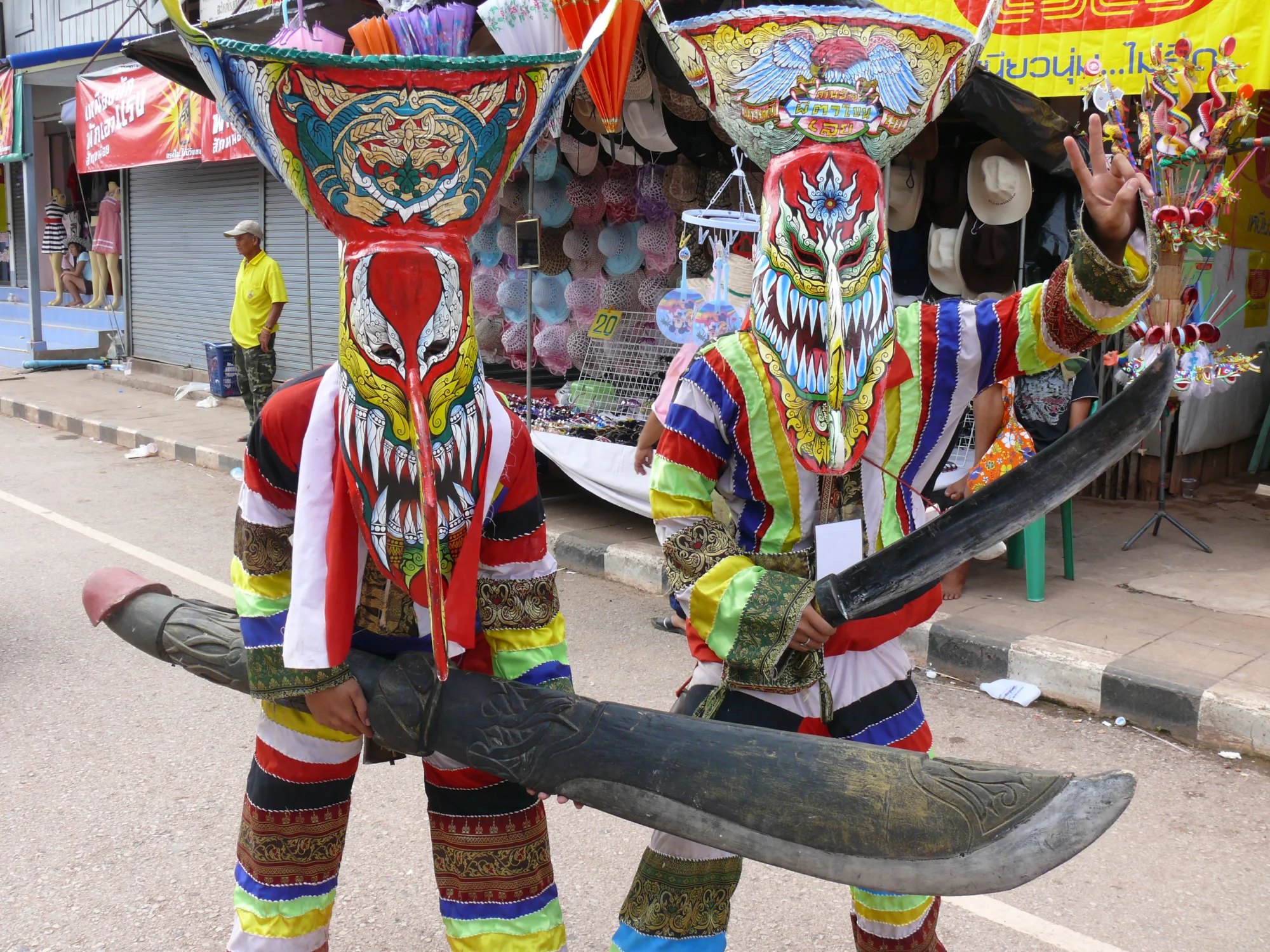
Phi Ta Khon. If you are looking for Thailand’s strangest and most authentic spectacle, here it is — in the small town of Dan Sai in Loei province, about 520 kilometers northeast of Bangkok, far from beaches and resort routes. Once a year the village turns into a “kingdom of spirits”: residents put on giant masks and colorful costumes, hang bells from their belts and pour out into the streets after the spirits — to dance, tease spectators and wave wooden phalluses, symbols of fertility. The masks are made from humble farm materials — woven rice steamers, coconut shells, paper — each takes from a week to two, and all are unique; today there are also masks in the form of superheroes or anime characters. The exact days in 2027 will be announced later — they are chosen by the village medium, usually mid-June to early July — so do not book a flight in advance without flexible conditions.
The candle parade in Ubon Ratchathani. Another festival of the northeast, Isan, is the Candle Festival: it marks the start of Buddhist Lent and is considered the largest display of wax sculptures in Thailand. Masters carve huge figures from beeswax — some taller than three meters — and then they are carried on floats through the city. The main parade in 2027 is expected around July 19, but the organizers are still clarifying the program for this date. Isan is visited by tourists less often than the north, and that is exactly why you feel the real Thailand here: rice fields, temples, spicy cuisine and hospitality without a rehearsed smile.
The Full Moon Party. In July the “Moon” on Koh Phangan is shifted too: in 2027 one of the dates is July 20, because Asalha Bucha and the start of Buddhist Lent fall on July 18–19, and restrictions on alcohol sales are introduced on such days. Entry to Haad Rin Beach is 200 baht, there are no online tickets, and safety and rules are described in detail in our piece on the Full Moon Party.
October: the Vegetarian Festival that cannot be disrespected
Phuket is associated with beaches, but once a year the island becomes one of Asia’s most serious religious stages. The Vegetarian Festival, also known as the Nine Emperor Gods Festival, takes place in the first nine days of the ninth month of the Chinese lunar calendar: in 2026 this was October 10–18, and the exact dates for 2027 have not yet been announced. On these days Thai Chinese wear white clothing, give up meat and alcohol, and in the streets of Phuket Town processions with drums, firecrackers and mediums in trance come out of the shrines. Some of the rituals — piercing of cheeks and body, walking on coals — look severe; this is not a “show for tourists” but a religious practice, so photograph carefully and with respect, keep your distance and dress modestly. Walking the Old Town on these days, it is worth trying the festival food too: plant-based versions of traditional dishes are sold on every corner, and they are often tastier than the meat ones.
November: Yi Peng and Loy Krathong — lights over the river and in the sky
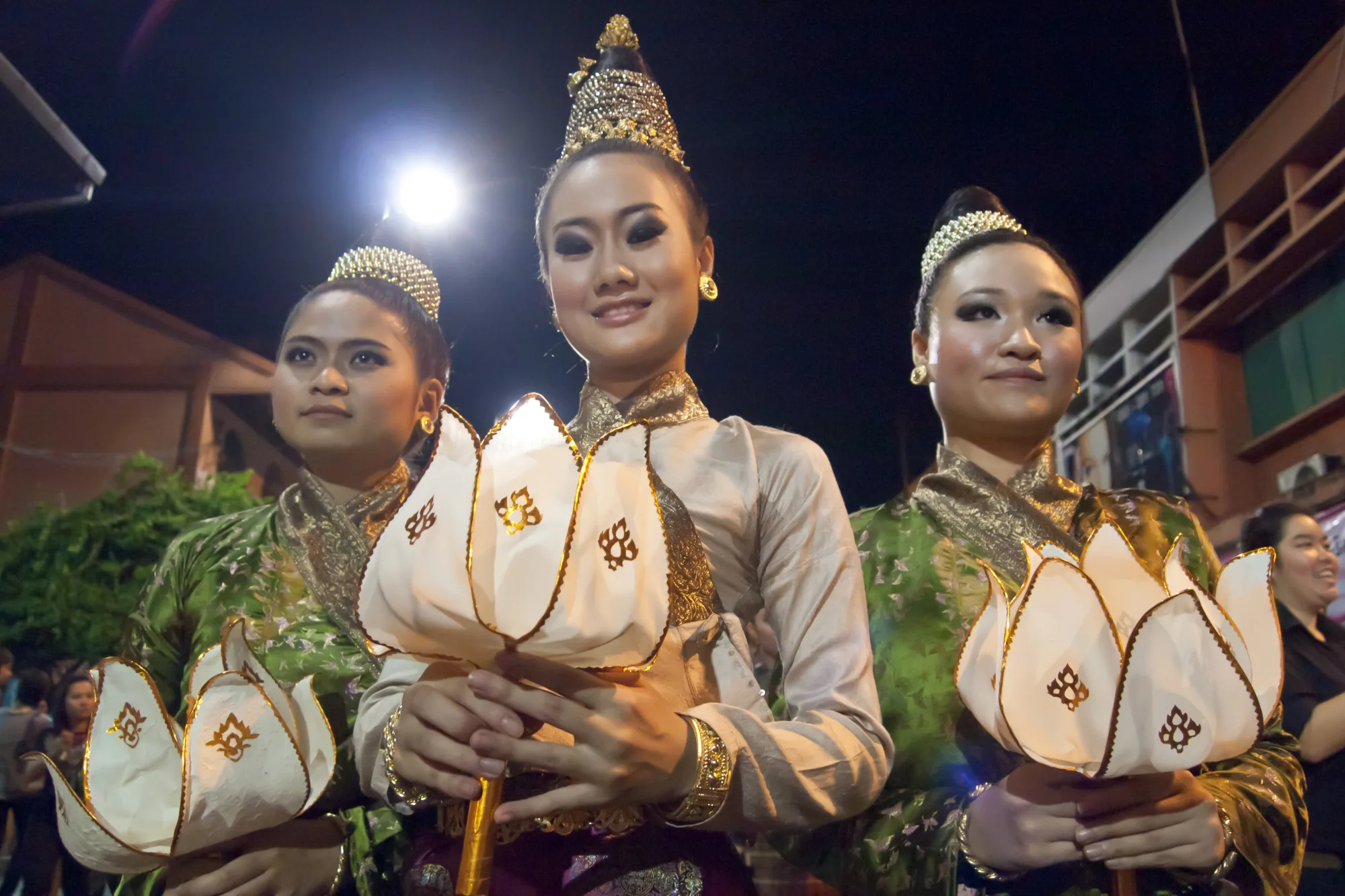
This is perhaps the most beautiful event in the Thai calendar, and also the hardest to organize. In 2027 Loy Krathong falls on the night of November 14 (the full moon of the twelfth lunar month), and Yi Peng in Chiang Mai is expected on November 13–15. In the rest of the country Loy Krathong is a water festival: people set small krathong rafts of banana leaves and flowers with a candle floating on rivers and ponds and thank the Goddess of Water. In the north, in Lanna, the same full moon is called Yi Peng and is celebrated by launching paper lanterns into the sky. In Chiang Mai these two festivals merge: water below and lights above. What it looks like, how to choose a venue and how not to get onto a “fake” tour we covered in detail in the article on Loy Krathong — which also has practical tips on choosing timing and safety.
In practice: book accommodation in Chiang Mai in advance, and it is better to launch lanterns at organized venues; remember that sky lanterns are fire, and they are not released near the airport. Float a krathong made of biodegradable materials, not plastic — many venues watch for this.
November, continued: the Surin elephants and the Lopburi monkey banquet
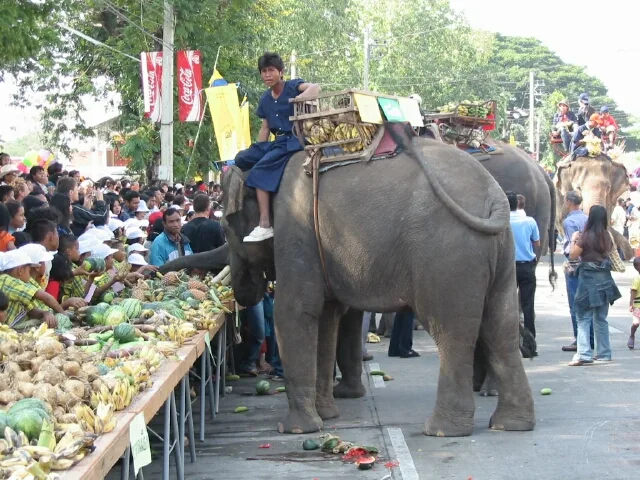
November in Thailand does not end with lanterns. In the third week of the month, usually at the weekend, the “Elephant Round-up” takes place in the city of Surin in the northeast — a festival that goes back to the royal hunts of the Middle Ages and the ancient art of the Kui people of driving and training elephants. More than two hundred elephants take part in the procession, staged battles, “football matches” and a huge elephant “breakfast” — a table laid with fruit and vegetables for the animals. Today many travelers consciously view such shows critically: if the ethics of treating elephants matter to you, check in advance how the specific show is organized and choose the “watching” format rather than “riding”.
The last Sunday of November — November 28, 2027 — belongs to quite different heroes. In Lopburi, an hour’s drive north of Bangkok, hundreds of macaques live at the ancient Khmer temple Phra Prang Sam Yot, and once a year the locals lay a festive table for them: more than four tons of fruit and vegetables, arranged in pyramids, frozen in blocks of ice and decorated like a real banquet. The monkeys fall on the treats with zest, tourists roar with laughter, and the ancient temple towers have been watching all this for several centuries. A tip: keep your phone and glasses in a zipped bag — macaques grab everything bright.
Where to spend Loy Krathong: Chiang Mai, Sukhothai or Bangkok
The choice of city changes the impression almost as much as the choice of festival itself. Chiang Mai is the most spectacular version: Yi Peng with sky lanterns and Loy Krathong with rafts on the Ping River take place here at the same time, and the city is decorated with garlands of Lanna paper lanterns, so even a chance side street looks like a set. The downsides are obvious — crowds, high prices and queues. Sukhothai is the “cradle” of the festival: by tradition it is believed that the custom of floating krathongs arose precisely here, in the ancient capital, and in the historical park, among the ruins of temples, evening programs with light and traditional performances are held; it is noticeably quieter and without Chiang Mai’s scale, but with a feeling of history. Bangkok is an option for those who do not want to leave the capital: krathongs are floated on the Chao Phraya River and in parks, and there are plenty of restaurants with views and evening cruises on the banks. If you are going to Loy Krathong for the first time, the most honest advice is to choose Chiang Mai, but reserve accommodation in advance and decide on a lantern launch venue.
Separately about families. The Flower Festival, Songkran (with caveats about water and heat), Loy Krathong and the Candle Parade go well with children: they are bright, safe and beautiful spectacles. But the Vegetarian Festival in Phuket, where there are scenes of piercing and self-harm in a state of trance, is not suitable for small children — it is important to decide in advance what you are ready to show a child. Pay attention to the budget too: on the days of the main festivals hotel prices in festival cities, as a rule, rise several times, airfares on domestic flights go up, and decent places are snapped up months ahead. The best strategy is to book with free cancellation and monitor prices.
Three routes for the 2027 festivals
“Flower north” (5–6 days). February, Chiang Mai: three days of the flower festival, walks around temples and markets, a trip to mountain villages. The calmest option, ideal for a first trip.
“Lights of November” (8–10 days). Yi Peng in Chiang Mai on November 13–15, then a flight to Bangkok and a trip to Surin for the elephants (third week of the month) and to Lopburi for the monkeys on November 28. One of the busiest routes of the year — three completely different festivals on one stretch of the calendar.
“Thailand of rituals” (7 days). October, Phuket: nine days of the Vegetarian Festival with an overnight stay in the Old Town. Suits those looking for depth rather than a beach holiday.
Practical tips
Weather is an important factor: from June to October it is the rainy season, and you come to the summer festivals under downpours; bring a raincoat and a waterproof cover for your equipment. On festival days hotels and domestic flight tickets get sharply more expensive, and on major Buddhist holidays restrictions on alcohol sales are introduced, so stock up in advance if that matters. Respect temple rules: shoulders and knees covered, shoes removed. And leave an “empty” day in your route — Thai festivals like to drag on, and the best moment often happens where it wasn’t expected.
FAQ
Which Thai festival of 2027 is the most beautiful? Yi Peng and Loy Krathong on the night of November 14: thousands of lanterns in the sky of Chiang Mai and krathongs on the river.
When is Songkran in 2027? April 13–15 — the dates do not change; in tourist cities the celebrations may begin around April 10.
When is the Vegetarian Festival in Phuket in 2027? In October; the exact dates will be announced later, they are determined by the lunar calendar.
Can I see Phi Ta Khon without a guide? You can: Dan Sai is a small town, but the dates need to be checked in advance because the local medium determines them; take accommodation with flexible cancellation.
When should I book hotels for Yi Peng? Six to twelve months ahead: in Chiang Mai it is one of the busiest periods of the year.
What is the Monkey Banquet? A festival in Lopburi on the last Sunday of November: a table of more than four tons of fruit and vegetables is laid for the macaques.
The dates and programs of many festivals are tied to the lunar calendar and may change — check the official tourism websites and the organizers.