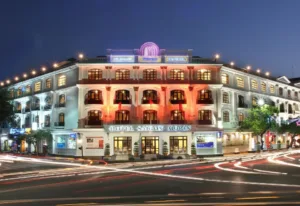
Saigon Morin Hotel was built in 1901 — in 1957 the building was confiscated to house Hue University, a center of student protests until 1975, and during the Tet Offensive of 1968 it was held by the Front for Liberation for a month.
Built in 1901 and passed to the Morin brothers in 1907, the hotel was confiscated by the government of Ngô Đình Diệm in 1957 and transformed into the main building of the newly founded University of Huế — a building that became the center of student anti-government movements until 1975. Saigon Morin Hotel returned to hotel function only in 1997.
From the Morin Brothers to the 1957 Confiscation
The building was constructed in 1901, and from 1907 it was managed as a hotel by the Morin brothers — French entrepreneurs whose surname became associated with the establishment and has survived until today’s name. In autumn 1957, already after the departure of the French from Indochina, the government of Ngô Đình Diệm confiscated the building and transferred it to the newly founded University of Huế, transforming the former hotel into the main academic building.
Center of Student Protest Until 1975
As a university building, the former hotel remained for almost two decades, until 1975, the center of student anti-government movements in Huế — a period encompassing much of South Vietnamese political turbulence of the 1960s and early 1970s. This chapter in history radically differs from its original purpose for a building that began as an elegant colonial hotel.
A Month Under Control of the National Liberation Front
During the Tet Offensive of 1968 – one of the turning points of the Vietnam War – the building was under the control of forces from the National Liberation Front for about a month before being recaptured by American troops. This episode makes the history of the building a literal chronicle of key turns in the war, rather than a distant backdrop to it.
Return to Hotel Function in 1997
The hotel only reopened as a hotel in 1997 – exactly forty years after the 1957 confiscation – which makes its history almost symmetrical: forty years as a hotel before confiscation, and now nearly three decades as a hotel after restoring its original function.
On the Banks of the Hương River, Opposite the Imperial Palace
The hotel’s location – on the banks of the Hương (Fragrant) River, directly opposite the Hue Imperial Palace on the other bank – makes it one of the best spots in the city for nighttime views of the historic center of Vietnam’s former imperial capital.
What Guests Say
Guests in reviews describe the hotel as “charming, in a French colonial style, with a rich history,” noting its excellent location on the riverbank opposite the palace and fantastic breakfast in the garden. One guest described at length the nighttime view of the palace ruins across the river and the ancient city of Hue’s kitchen, preserving the charm of the French colonial era, calling the hotel a place that “anyone who feels a little nostalgia will love.” There is also serious honest criticism: one guest detailed rude treatment by staff during breakfast due to confusion over their spouse’s registration, while another noted the administrator’s unkempt appearance and the dated amenities in the room – details worth weighing alongside the prevailing positive impressions of most guests.
What’s Next
Another hotel in the Hue region that grew out of a local project is Alba Wellness Valley on springs discovered by a French doctor in 1928.
Prices, service inclusions, and details of hotel programs may change – please check the latest information before booking.