Hashima (Gunkanjima) is an abandoned coal island off Nagasaki with the highest population density in human history, a Bond villain's lair and a UNESCO site with a difficult history of forced labour.
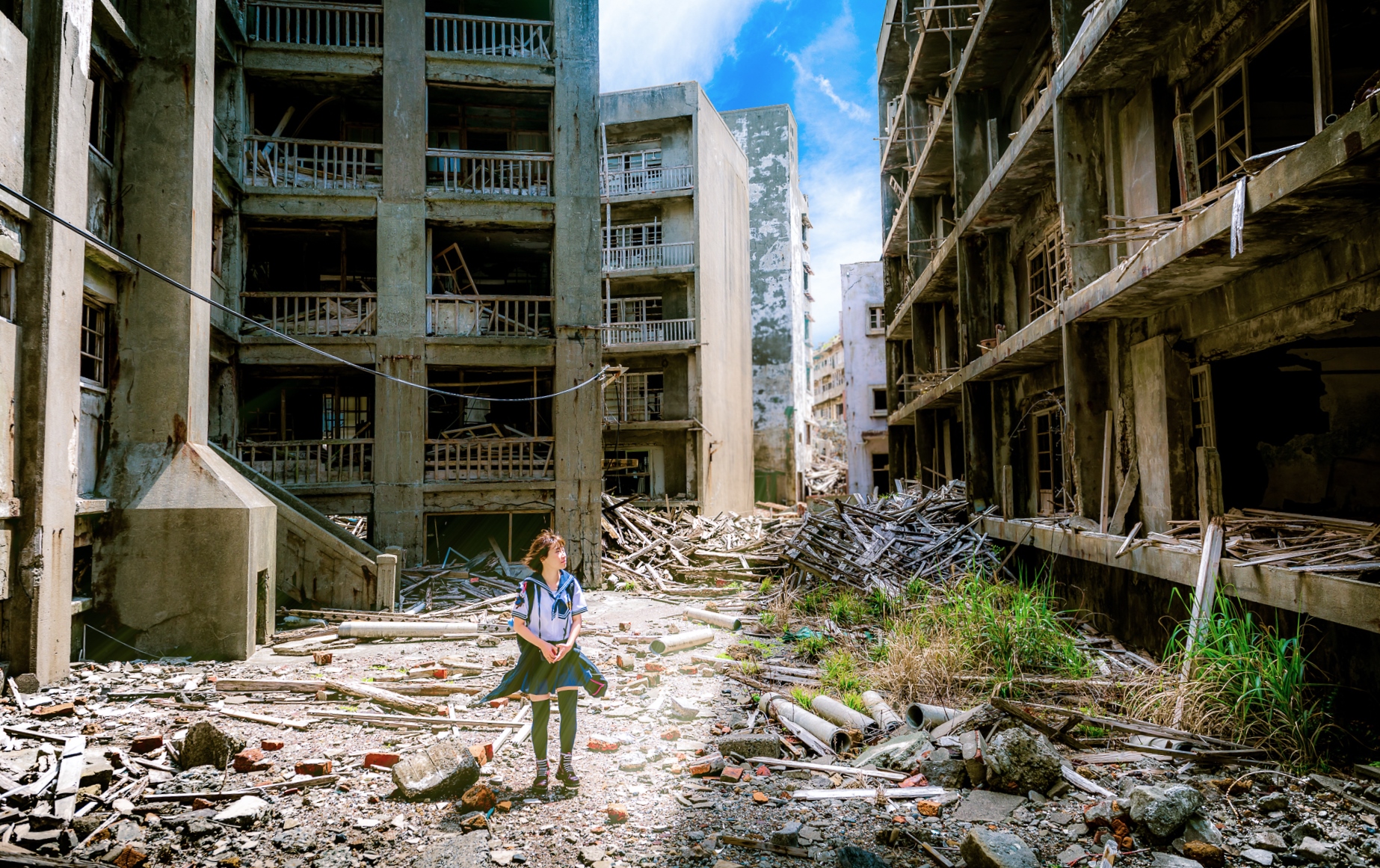
The silhouette of this island looks so much like a warship that fishermen nicknamed it “Gunkanjima” — “Battleship Island” — before it appeared in a single guidebook. Today Hashima is one of the most recognisable abandoned places on the planet: grey concrete blocks of high-rises crowding right up to a rock in the middle of the sea, empty window openings in which the wind whistles, and an absolute, ear-splitting silence where half a century ago more people were crammed per square kilometre than anywhere else in human history.
The island that coal built
Coal mining on Hashima began in 1887, and from 1890 the island passed into the ownership of the industrial giant Mitsubishi and became one of the key coalfields of the era of Japan’s rapid industrialisation — the very one that turned the country from a closed feudal state into a world industrial power within a few decades. To mine coal more efficiently, the island was literally built up and out with artificial embankments, and on the freed patch of land residential high-rises were erected — including one of the country’s first large reinforced-concrete apartment buildings, built back in 1916, decades before such construction became the norm on mainland Japan.
By 1959, at the peak of mining, more than 5,000 people were crammed onto an island of little more than six football pitches — the highest population density ever recorded anywhere in the world. There was a school, a cinema, a barber’s, shops, a temple and even a small garden on the roof of one of the buildings — an attempt to recreate at least a semblance of greenery where there was physically no soil for a vegetable bed.
A page the island tried to keep quiet
This industrial triumph has a far darker side, which must be stated honestly rather than glossed over for the sake of striking shots. From the 1930s until the end of the Second World War, conscripted Korean workers and Chinese prisoners of war were forced to work in Hashima’s mines — in extremely harsh conditions, underground, with the cruel treatment characteristic of Japan’s wartime mobilisation policy. According to documentary data, at least 800 Koreans were sent to the island, 134 of whom, according to available information, died on the island itself.
When in 2015 Hashima, together with 22 other Meiji-era sites, was inscribed on the UNESCO World Heritage list, Japan promised South Korea and UNESCO itself to honestly reflect the history of forced labour on information boards at the sites. That promise was not fulfilled — for a long time there were effectively no materials on the island or in the adjacent information centre telling the fate of the Korean and Chinese workers, which drew official criticism from UNESCO in 2021. When planning a trip, remember: in front of you is not just a striking backdrop for photos but a place with a difficult, not fully spoken-out history — and keeping this in mind while reading the sign at the gangway is as important as taking a good shot of a ruined façade.
It all ended in one year
In the 1960s Japan began a mass switch from coal to oil, and demand for Hashima’s output fell rapidly. In January 1974 Mitsubishi officially announced the closure of the mine — and within just a few months the island where thousands of people had lived not long before was completely empty. Residents left their flats almost in haste, taking only the essentials — which is why present-day Hashima makes such a strong impression: furniture, household appliances and children’s toys in many buildings remained where they were left half a century ago, slowly crumbling under the salty sea wind and typhoons.
How to get to the island today
You cannot land on Hashima on your own — the island is officially open to visits only as part of organised excursions, which depart from the Ohato pier in Nagasaki port (for some operators — from the Tokiwa terminal). The tour takes about three hours: a boat ride one way, about an hour on the island itself along fixed, fenced routes (wandering freely among the crumbling buildings is forbidden for safety reasons) and the return trip. The cost usually consists of the fee for the visit itself (about ¥4,500) and Nagasaki’s municipal fee (¥310) — in total roughly ¥4,800–6,500 depending on the operator. Excursions with an English-speaking guide with the largest operator, Yamasa, run on certain days of the week — check the schedule in advance if you are counting specifically on English-language accompaniment. An important nuance: landing on the island is not always possible — in heavy seas or if the pier is damaged, the tour turns into a sightseeing cruise around the island without landing, with no guarantees in advance.
FAQ
Is it true that a James Bond film was shot here? Yes, Hashima’s ruined industrial landscape inspired the villain’s lair in the film “Skyfall” (2012) — although the scenes themselves were shot in a studio rather than on the island itself, it was after the film’s release that a mass worldwide audience learned about Gunkanjima.
Can I go inside the ruined buildings? No, free movement around the island is forbidden for safety reasons — excursions follow fenced, specially reinforced paths, and the buildings themselves are visible from outside but not accessible for entry.
Is landing on the island guaranteed? No, in bad weather or rough seas the landing is cancelled and the tour turns into a sightseeing cruise around the island without going ashore — take this risk into account when planning, especially if you are travelling specifically for this excursion.
Is it worth going with children? Formally excursions are not forbidden for children, but some operators have age and physical restrictions (difficulty of landing, no railings on part of the route) — check with the specific operator before booking.
Why is the island called “Gunkanjima”? Because of its characteristic silhouette — from a certain angle the island built up with high-rises really does resemble the outline of a battleship, which gave it an unofficial but far better-known name than the official “Hashima”.
Tour schedules, prices and the possibility of landing depend on the weather and the operator — check the current information before your trip.