Cambodia 2027: the year's main events — Khmer New Year on 14–16 April, Visak Bochea on 20 May, Pchum Ben, the Bon Om Touk water festival on 12–14 November and the Angkor marathons. Dates, customs, routes and practical tips.
A river that flows backwards is not a metaphor. Once a year, when the rainy season fades and the Mekong gives its water back, Tonle Sap, the “Great Lake”, reverses its current and carries the water back down the river towards Phnom Penh. Cambodians mark this moment as only they can: in November the capital’s embankment turns into a giant arena, narrow dragon boats with dozens of rowers race on the water, fireworks thunder over the Royal Palace, and millions of people gather on the banks. Bon Om Touk — the water festival — is the loudest event in the Cambodian calendar, but not the only one: in 2027 Cambodia also holds the spring Khmer New Year with water and sand mounds, the May Visak Bochea with lights in the pagodas, the fifteen-day Pchum Ben, when the country remembers its ancestors, and a few smaller events. Let’s go through everything in order.
- 14–16 April — Khmer New Year (Chaul Chnam Thmey).
- 20 May — Visak Bochea, the birth, enlightenment and passing of the Buddha.
- May — the Royal Ploughing Ceremony (dates announced later).
- 8 August — the Angkor Empire Marathon in Siem Reap (according to running calendars).
- September — October — Pchum Ben, fifteen days of remembering ancestors (dates announced later).
- 9 November — Independence Day.
- 12–14 November — Bon Om Touk, the water festival in Phnom Penh.
- Early December — the Angkor Wat half marathon (in 2026 — 6 December; the 2027 date has not yet been confirmed).
How Cambodia’s calendar works
Cambodian holidays rest on three pillars: the Buddhist calendar, the lunar calendar and the rhythm of water. It is water that defines the year: in spring, before the rainy season, the harvest ends and the New Year comes, in autumn, when the rivers are full, the country remembers its ancestors, and in November, when the water begins to recede, it marks the start of the fishing season. That is why Cambodian holidays are not “attractions for tourists” but part of everyday life, into which you are readily admitted if you behave respectfully. A practical detail: almost all big holidays are official days off, which means that during holidays many Cambodians leave Phnom Penh for their home provinces, the capital empties, while in provincial towns and by pagodas it gets crowded. The dates of Pchum Ben, the Royal Ploughing Ceremony and a number of other events are determined closer to the season, so in this article they are marked as approximate.
14–16 April: Khmer New Year, three days instead of one
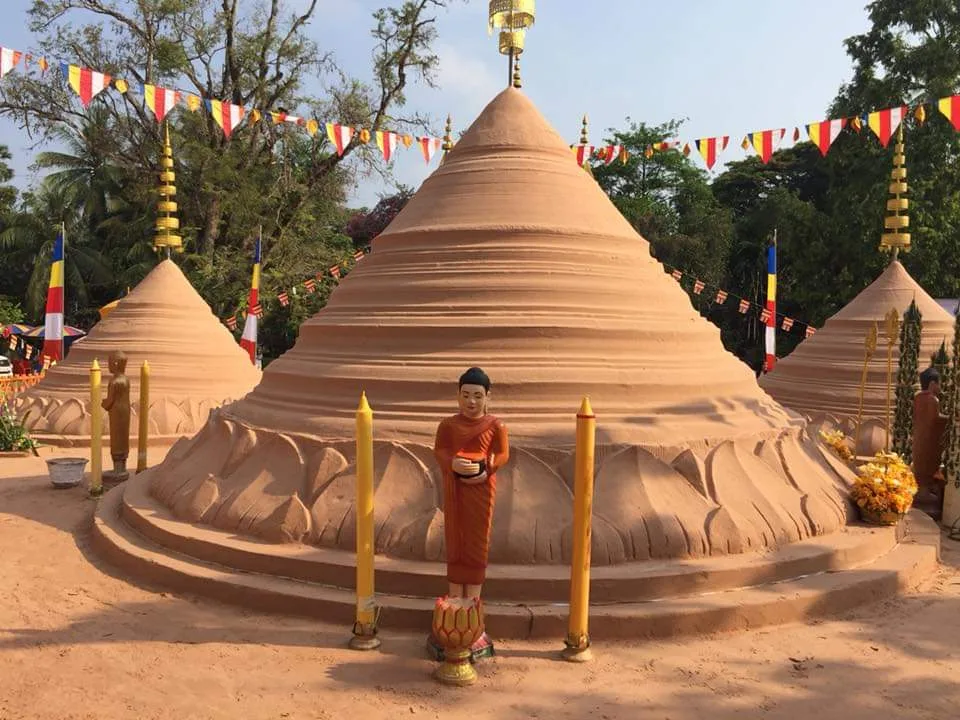
Chaul Chnam Thmey — “entering the new year” — will last from 14 to 16 April in 2027. It falls in the hottest season, at the end of the harvest before the rains, and is the country’s most family-oriented holiday: cities empty, people go to villages, temples are full. Each of the three days has its own name and its own meaning. The first is Moha Songkran: to greet the new heavenly angel, hosts clean the house, light candles and set out treats in front of the house. The second is Virak Wanabat: a day of mercy, when people help the poor, servants and the homeless, and in temple courtyards “sand mounds” are built — symbolic pagodas of sand for which merit is gifted. The third is Virak Loeng Sak: monks and laypeople wash statues of the Buddha with scented water, and young people respectfully pour water on the hands of their elders to receive a blessing — it is believed that this way water will be sent to the country for the whole next year.
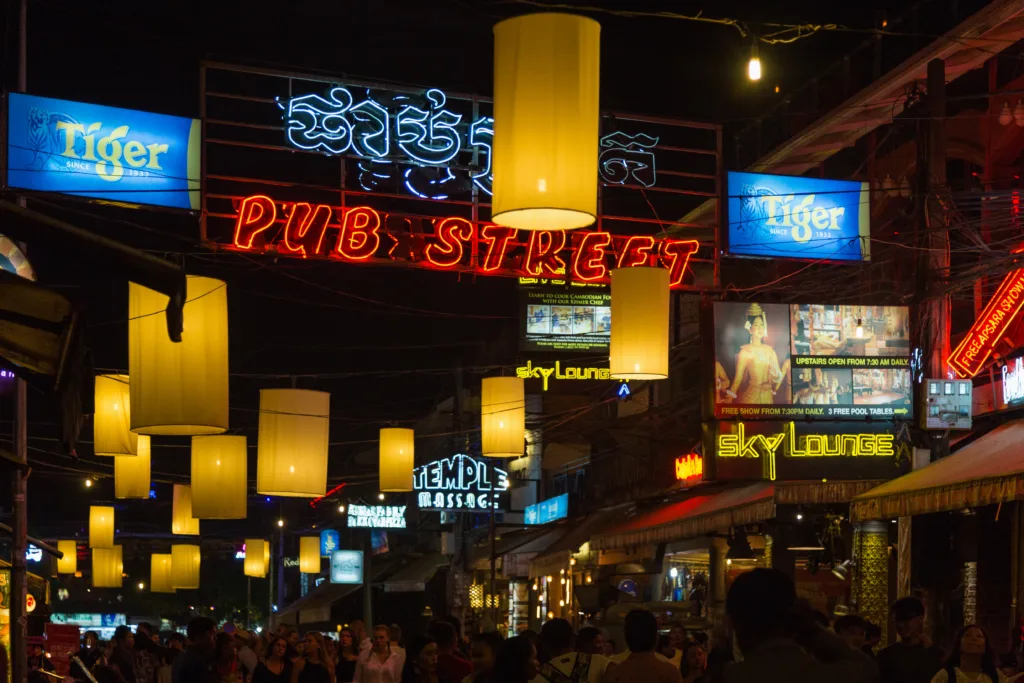
Separately — about water in its merriest form. As in neighbouring Thailand, on New Year’s days Cambodians douse one another to wash away the misfortunes of the past year: in Siem Reap it is noisy on Pub Street, children run about with buckets. On these same days at the Angkor complex Angkor Sankranta takes place — a modern festive programme with concerts, games and a mass of people that gathers guests from across the country. If you go to Siem Reap in these days, book accommodation several months ahead and plan the temple tour for the very early morning: by noon the heat and the flows of people become almost unbearable. How to build the days at Angkor itself — tickets, the best temples, sunrise — read in our guide to Angkor Wat and in the section on Cambodia’s nightlife.
20 May: Visak Bochea and the royal furrow
Visak Bochea is celebrated on the full moon of the sixth lunar month — the day on which, according to tradition, the Buddha was born, attained enlightenment and entered parinirvana. In 2027 the holiday falls on a Thursday, 20 May. It is a quiet and beautiful day: at sunset candles and lamps are lit in pagodas, monks read texts, and people come with flowers, incense and lotuses to meditate and listen to sermons. It is worth going specially for the holiday for those interested in the spiritual side of the country: it implies no bright show but gives a rare chance to see how Cambodians relate to faith.
In May the Royal Ploughing Ceremony also takes place — a traditional rite for the start of the sowing season. Oxen yoked to a plough walk across a ceremonial field and, by custom, “choose” in front of them one of the symbolic portions — rice, maize, beans, sesame, grass, water, wine — from which the harvest and weather for the year are predicted. The exact date and place will be announced closer to the ceremony, but if you are in Phnom Penh in May, it is a chance to see a royal ritual that has survived since the Angkor era.
September — October: Pchum Ben, fifteen days with the ancestors
Pchum Ben is a religious festival that lasts fifteen days and reaches its culmination on the fifteenth day of the tenth month of the Khmer calendar, at the end of the Buddhist Lent. It usually falls at the end of September or in October. It is believed that in these days the doors to the world of the dead open, and the souls of the departed — up to seven generations — return to the living in search of food and prayer. People go to pagodas at dawn, bring monks food and offerings, and the merit from these gifts is transferred to ancestors. Pchum Ben is not a noisy holiday but a very personal one: it brings families together, and even the busiest city-dwellers return to their home villages. For a traveller this is a time to behave more quietly than usual: not to hold parties near temples, to dress modestly and not to photograph people during prayers without permission. If you find yourself in the country in these days, go at dawn to the nearest pagoda — the impression of a quiet ritual will be remembered longer than any show.
12–14 November: Bon Om Touk — a festival worth flying for
Finally, the main event. Bon Om Touk is a three-day water festival held at the full moon at the end of October to November, and in 2027 it is scheduled for 12–14 November. It marks the reversal of Tonle Sap: normally the river flows to the Mekong, but in the monsoon season the Mekong overflows and “pushes” water back into the lake, which grows several times in size; when the rains subside, the water goes back and the river again changes direction. The tradition is believed to go back to the 12th century, to the reign of Jayavarman VII: then the festival was a way of celebrating the start of the fishing season, appeasing the gods and ensuring a good catch and rice harvest. Today it is a huge national holiday celebrated across the country.
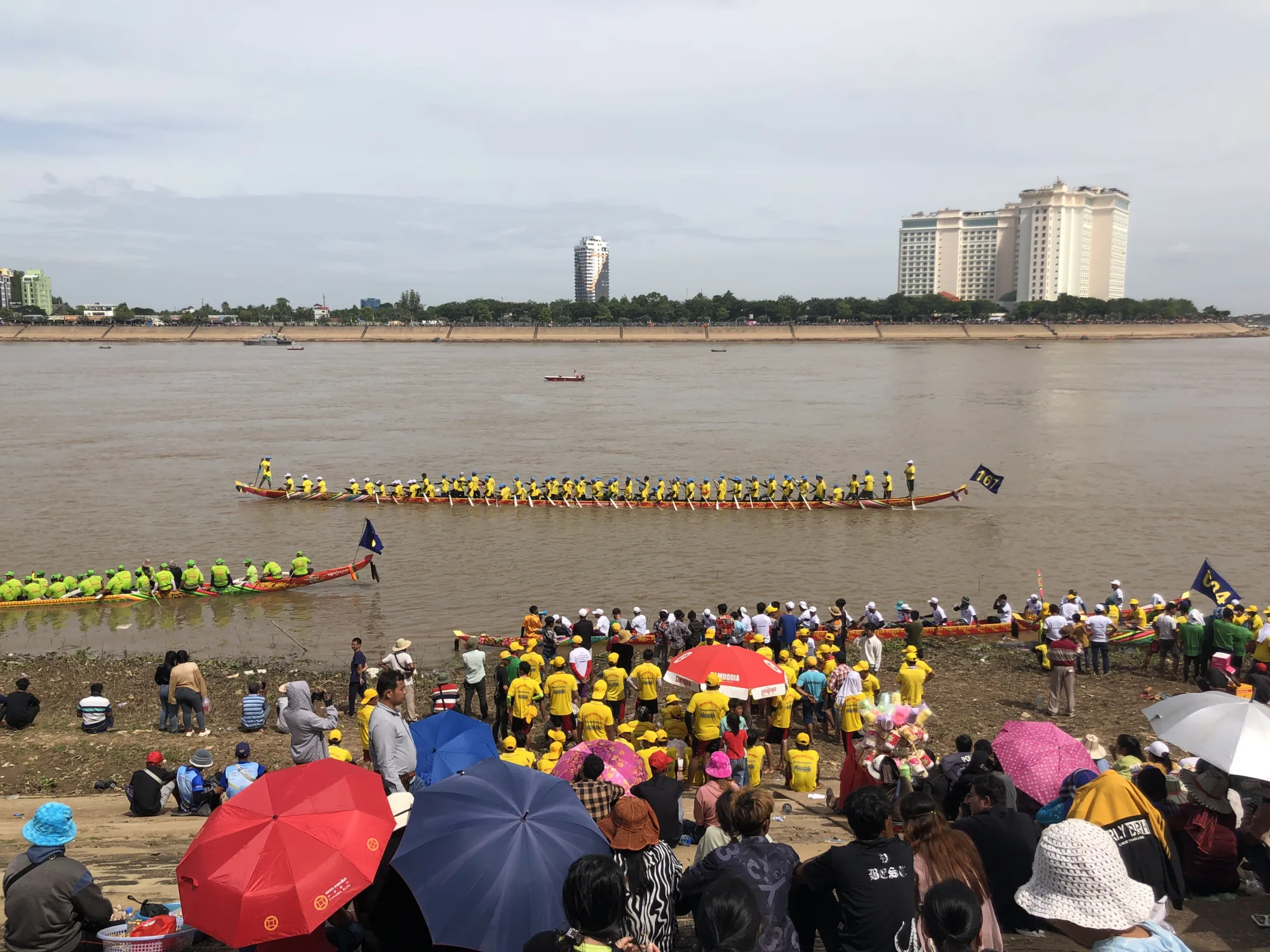
The main thing is the dragon-boat races on the Tonle Sap River in front of the Royal Palace in Phnom Penh. Narrow, beautifully painted boats with twenty and sometimes eighty rowers race along the embankment to the crash of drums, and spectators gathered on the bank roar so that it can be heard several blocks away. Teams come from the provinces, each with its own boat and colour, and victory is a matter of local pride. When darkness falls, fireworks fill the sky over the river, and festivities and night markets run along the embankment. In these days millions converge on Phnom Penh: the city is overcrowded, and accommodation prices go up. Practical tips: book a hotel in advance and preferably near the embankment, take a place on the bank from the morning, bring water and a hat, don’t carry your phone and documents in view — there are pickpockets in the crowd — and think through your return in advance: after the fireworks tuk-tuks and taxis are snapped up instantly.
The reversal of the river is a topic you can touch with your hands. If you come for the festival or a week earlier, drop in on Tonle Sap: in November, when the water begins to recede, the floating villages near Siem Reap look different from the height of the rains, and on the lake you can see how people live whose whole year depends on the water level. More details in our guide to the floating villages of Tonle Sap.
Sport and more: the Angkor marathons
Angkor is also a stadium. The Angkor Wat International Half Marathon is held in early December — in 2026 the 31st run is scheduled for 6 December, and the 2027 date is confirmed later — and the course passes the most famous temples. According to running calendars, the Angkor Empire Marathon will also take place in Siem Reap on 8 August 2027. If you run, choose December: in August it rains and is hot and humid. If you don’t run, come to watch: the temples at dawn in a crowd of runners look new.
What to try: the taste of Cambodian holidays
The festive table in Cambodia is a topic for a trip of its own. At Khmer New Year and at Pchum Ben, in every home and every pagoda people make num ansom and num kom — rice cakes of glutinous rice with banana or beans, wrapped in banana leaves and steamed. They are brought to pagodas as an offering to monks and then shared with the family. At Bon Om Touk, ak ambok appears on the embankment stalls — flat crispy rice that is pounded and served with banana and coconut: it is one of the tastes of the water festival. Plus fresh fish from Tonle Sap: the end of the rainy season is the time of the best catch, so in restaurants and at stalls fish dishes, from amok curry to fried lemongrass, are especially fresh. If you go for the festival, don’t miss the morning markets: it is there that you can try home cooking without “tourist” markups.
And about photographs. Cambodians readily pose for photos, but during religious ceremonies, especially at Pchum Ben and Visak Bochea, it is better to ask permission or shoot from a distance without disturbing those praying. Don’t use a flash in pagodas, don’t enter an area fenced off for monks, and remember that sitting higher than a monk or pointing your feet at an altar is considered an insult. These are simple rules, but they are what distinguish a guest who is invited to stay for lunch from one who is simply tolerated.
A separate date that is easy to miss is 9 November, Independence Day, when the country celebrates liberation from the French protectorate. It coincides with the start of preparation for Bon Om Touk, which means that in the first half of November Phnom Penh looks at once like a ceremonial capital and a festive stage: the streets are decorated with flags, concerts are held on squares, and in the evenings the embankment hums. If you manage to come in these days, you will catch the city in its best form and with the most generous mood.
Three routes for the holidays of 2027
“New Year at Angkor” (5–6 days). April, Siem Reap: early mornings in the temples, days in the shade and swimming, evenings at the Angkor Sankranta festival. In the evening — Pub Street. Book accommodation in advance and take the heat into account.
“The River Festival” (6–7 days). November: Phnom Penh at Bon Om Touk (12–14 November), then a trip to Siem Reap and Tonle Sap when the water begins to recede. One of the busiest routes of the year. In Phnom Penh, find time separately for the Tuol Sleng museum: it is a heavy but important place that helps you understand modern Cambodia.
“Quiet Cambodia” (7–8 days). September — October: Pchum Ben in a village province, Kratie with its Irrawaddy dolphins and the Koh Rong islands, where glowing plankton is visible in these months. Suitable for those who want quiet and are not afraid of rain.
Practical tips
Dress modestly: in temples and pagodas shoulders and knees are covered. During holidays ATMs and exchange offices sometimes run empty, so keep US dollars in small notes — they are accepted everywhere in Cambodia. The heat in April is the strongest of the year: drink water, wear a hat and plan things for morning and evening. It is more convenient to get around Phnom Penh and Siem Reap during holidays by tuk-tuk through apps like PassApp or Grab: the price is visible in advance, and the driver doesn’t try to “catch” festive demand. Bus tickets between cities on holiday days sell out several days ahead, so buy in advance, and allow a margin for the road: before major holidays the highways are jammed. And leave an “empty” day in the route: Cambodian holidays like to stretch, and the most memorable things happen when you are invited as a guest and you are not in a hurry.
FAQ
When is Khmer New Year in 2027? From 14 to 16 April — three days: the arrival of the angel, a day of mercy and the washing of the Buddha statues.
When is Bon Om Touk in 2027? 12–14 November; the main events are the dragon-boat races on Tonle Sap in front of the Royal Palace and the fireworks.
What does Bon Om Touk celebrate? The reversal of the Tonle Sap River’s current at the end of the rainy season and the start of the fishing season; the tradition is said to go back to the 12th century.
When is Visak Bochea in 2027? On Thursday, 20 May: the birth, enlightenment and passing of the Buddha.
How long does Pchum Ben last? Fifteen days, with the culmination on the fifteenth day of the tenth month of the Khmer calendar; exact dates will be announced later.
When is it best to go to Cambodia? From November to April — the dry season; for Bon Om Touk, book accommodation no later than a month ahead.
The dates and programmes of many holidays are tied to the lunar calendar and may change — check the official Cambodian tourism sites.