Ichinoyu Honkan in Tonosawa, Hakone – a ryokan dating back to 1630, one of the “Seven Sources” of the Edo period and depicted in Hiroshige’s ukiyo-e prints. History, onsen, honest guest reviews.
In the town of Tonosawa, at the entrance to the resort area of Hakone, stands a ryokan that has been welcoming guests for longer than most modern countries have existed. Ichinoyu Honkan opened in 1630 – three years before the Tokugawa shogunate definitively closed Japan off from the outside world for almost two and a half centuries. Since then, the ryokan has been managed by the same family, and it became part of classic Japanese visual art long before foreign tourists began soaking in its hot springs.
A Spring Known Even Before the Edo Period
The Hayakawa River valley at the foot of Mount Hakone has long been famous for its hot springs, and as early as the beginning of the Edo period—that is, in the first half of the 17th century—the tradition of “Hakone Shichito” (seven springs of Hakone) developed, which included the Tonosawa spring. Ichinoyu – literally “first bath” or “spring number one”—was founded in 1630 as an inn near this spring, and it is precisely this date that makes it one of the earliest documented hospitality businesses throughout the entire valley.
By the 18th–19th centuries, Hakone resorts located on the old Tokaido road, connecting Edo (present-day Tokyo) with Kyoto, became a stop for travelers, officials, and pilgrims descending from the mountains to the coast. Tonosawa, with its springs, was among the places that were already perceived at that time as places of rest, rather than just treatment—a rarity for that era when hot springs were more often associated with medical, rather than tourist purposes.
A Hotel Painted by Hiroshige
Hakone’s hot springs, including Tōnosawa, feature in classic Japanese woodblock prints (ukiyo-e) – particularly the works of Utagawa Hiroshige, one of the most famous masters of *fūkei-ga* (landscape printmaking) from the first half of the 19th century. Hiroshige became renowned for his series depicting views along the Tōkaidō route, and Hakone’s resort valley with its hot springs was a recognizable, widely reproduced motif for artists of that era – much like postcard views are today. The fact that Ichinoyu is associated with these images isn’t a marketing legend, but rather a natural consequence: the hotel has been located on the very same spring that captured those landscapes for almost four centuries.
The building standing here today, of course, isn’t the same as the one from 1630 – wooden structures of that age in seismically active Japan rarely survive in their original form without renovations. But the principle of operation — a *ryokan* situated directly on a hot spring source and managed by the same family line — has remained unbroken.
Onsen: Communal, Private & Right in Your Room
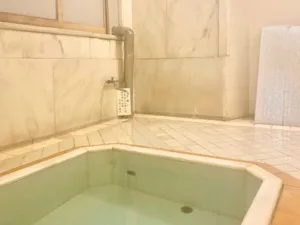
The main reason to come here isn’t the architecture, but the water. The *ryokan* offers several bathing formats: communal gendered onsen, available to all guests with no time limit; a separate private (family) onsen, which is booked in half-hour slots upon arrival; and, in some room categories, your own onsen right in the room – a format known in Japan as *kashikiri-buro*, particularly appreciated by couples or families who don’t want to share their bathing space with others.
An evening at a *ryokan* of this type typically revolves around a *kaiseki* dinner — a multi-course seasonal meal served in your room or a separate dining hall – and, according to guest reviews, the lobby offers unlimited complimentary drinks, including alcoholic beverages, which is surprisingly generous for a modest two-star *ryokan*.
An Honest Compromise: Atmosphere vs. Renovation
The age of the building shows, and guests are honest about it – in reviews of the *ryokan*, the same duality is repeatedly mentioned: delight at the atmosphere coexists with comments on the condition of the finishes. Some note peeling paint and mildew in the bathroom; others complain about occasional hot water interruptions — a rare irony for a hotel whose sole real draw is, precisely, hot water. Yet, practically no one disputes the main thing: the *ryokan* possesses an authentic character that you simply can’t buy in a new building.
What Guests Say
- “An old traditional ryokan founded in 1630. Rooms are in Japanese style. There are public onsens, a private (family) onsen, and their own onsens in some rooms. […] The staff is friendly and helpful, speaks English. In the lobby there are unlimited free drinks, both non-alcoholic and alcoholic.”
- “I fear I won’t have enough words to describe how wonderful this place is. Our trip included Tokyo, Kyoto and Hakone, and this ryokan turned out to be the most expensive per night among all stops. But it paid off 100%. […] We stayed in a room with a private onsen that we used whenever we felt like it.”
- “The hotel is old but has its own atmosphere. We were very pleased with the unlimited drinks, kaiseki dinner and breakfast. […] We enjoyed our stay and want to come back again.”
- “This is a very quiet and peaceful hotel, although it’s only one station from Hakone-Yumoto. […] The hotel is very old, but that’s what gives it its unique charm.”
- “I would like to see some improvements in the cosmetic repairs: the paint on the walls and ceiling of the bathroom is cracked, there’s a bit of mold; also, there was no hot water.”
What’s Next
Planning a trip to Hakone and planning your first visit to an onsen? Read our guide to Japanese hot spring etiquette: it breaks down the rules that aren’t always written in hotel descriptions, from washing before bathing to tattoos.
Prices, room composition and reception hours may change – please check the latest information before your trip.