GREEN×EXPO 2027 in Yokohama: a guide to the international horticultural exhibition from 19 March to 26 September — tickets from 4,900 yen, the best months, getting there from Tokyo, the heat and where to stay.
A hundred hectares of land where antennas and barbed wire stood not long ago, and now ten million flowers. That is how GREEN×EXPO 2027 can be described — an international horticultural exhibition that from 19 March to 26 September 2027 will turn a former American military communications facility into the biggest garden in Japan’s history. In spring six hundred cherry trees of forty varieties will bloom here, in April tulips, in summer lilies, hydrangeas and sunflowers, in autumn bellflowers, and all of it can be seen on one ticket, stretching your visit over half a year. For travellers this is a rare event: Expos in Japan are not held every year, and a specialised horticultural exhibition of this scale even less so. This guide has everything you need to know before the trip: ticket prices, the best months, how to get there from Tokyo, tips on heat and queues, and where to stay.
- Dates: 19 March to 26 September 2027, 192 days.
- Place: the former Kamiseya communications facility in the Seya and Asahi wards of Yokohama; about 100 of the 242 hectares are used for the exhibition.
- Tickets: adult one-day advance ticket — 4,900 yen (valid until 18 March 2027, saving 600 yen), full season pass — 28,000 yen, evening ticket — 3,500 yen for 4.5 hours; a paper ticket costs 100 yen extra.
- Important: entry is only possible with a ticket and a reserved visit date.
- Expected attendance: about 15 million people.
- Getting there: from Yokohama Station to Seya on the Sotetsu line about 21 minutes plus 10 minutes on a shuttle.
What GREEN×EXPO is and why it is rare
GREEN×EXPO 2027 is an international horticultural exhibition whose theme is worded as “Scenery of the Future for Happiness”. The organisers promise to show how flowers, greenery, agriculture and food change the life of cities and what it means to coexist with nature in an era of climate change. The idea itself is not a “tulip fair” but a large-scale demonstration of garden art, technology and culture from dozens of countries gathered on a hundred hectares. For comparison: that is about the size of a small district. Japan hosts such an event for the first time after a long break, and the organisers expect around fifteen million visitors.
The history of the place is impressive too. The former Kamiseya communications facility is a huge area of two hundred and forty-two hectares that the American military returned to Japan in 2015. For more than half a century it was a closed zone, and now it is open to everyone: about a hundred hectares have been given to the exhibition, and the rest will later become a city park. It is symbolic that a garden will grow on a site tied to military history. For a traveller it is also a reason to see an ordinarily inaccessible piece of Yokohama — a city that many tourists only fly through on the way from Tokyo.
What to see: season by season
The main difference of the exhibition is that it changes. Every month you can see a different landscape here, so choose your date by the flowers, not by the calendar.
March – April: cherry trees and tulips. The opening on 19 March coincides with the sakura season, and guests will be met by about six hundred cherry trees of forty varieties. April brings the peak of tulips and spring flower beds. This is the most beautiful and most crowded time of the exhibition: the best shots and the longest queues.
May – June: lilies and hydrangeas. In early summer lilies and hydrangeas bloom, the gardens have already come fully into their own, and the weather remains comfortable. Many travellers call this period optimal in terms of the balance of beauty, heat and crowds.
July – August: sunflowers and heat. In summer the garden fills with sunflowers of many varieties, but the heat in Japan at this time is extreme: the site is open, with little shade. In these months the best option is an evening ticket or a late entry.
September: bellflowers and the finale. In September autumn flowers — bellflowers — bloom, and the programme prepares for closing. The weather is milder, the crowds smaller, and the festive atmosphere of the finale adds a sense of occasion.
Pavilions and “villages”
Besides flowers, the exhibition is built around themed spaces. The organisers’ set includes “villages”: the Urban GX Village, which shows technologies that support a “green” society; the Craft Village — traditional Japanese crafts that grew up in harmony with nature; the Farm & Food Village — how agriculture, food and human well-being are connected; and the Kids Village — a children’s zone where a child learns to understand nature and the planet’s future through play. A separate showcase is the Japanese Government Exhibit: technologies for solving environmental problems, Japanese gardens and traditional arts — ikebana and bonsai.
The exhibition’s flagship is the Horticultural Culture Pavilion (the name is provisional), whose design is overseen by the architect Kengo Kuma. It will show the special Japanese aesthetic and plant-growing techniques that go back to the Edo era: large compositions of ornamental plants and bonsai. For those interested in Japan as a culture rather than just a set of sights, it is one of the main items on the programme. In addition, the exhibition has many national pavilions: the programme announces national participants’ days for dozens of countries and organisations, so you can land on a celebration dedicated to exactly the country you are interested in.
Separately, about the mascot. The official mascot of the exhibition is Tunk Tunk (also written “Tonk Tonk”); a collaboration with Sanrio has been announced, so families with children will have something to do.
Tickets and prices: how not to overpay
Entry is only possible with a ticket and a reserved visit date — you can’t “just walk in off the street”. The main options look like this. The adult one-day ticket in advance sale costs 4,900 yen including tax; it goes on sale ahead of time and remains available until 18 March 2027 — that is, until the day before the opening — and the saving compared with the price during the exhibition is 600 yen. The season pass for the whole run costs 28,000 yen and pays off if you come five or six times: it is an option for residents of Tokyo and Yokohama and for those who want to see the exhibition in different seasons. The evening ticket for 3,500 yen gives four and a half hours: it suits those who have already spent the day in central Yokohama and want only the illuminated gardens. A paper ticket costs 100 yen more than an electronic one, and it is easier to buy online on the exhibition’s official site. Ticket sales for exhibition days run from 19 March to 26 September 2027.
Tip: if you are going for the peak of sakura and tulips, book your date as early as possible: the most popular days, especially weekends, may sell out. And if you want to save money and see the garden in peace, choose weekdays in May or June.
Getting there from Tokyo and Yokohama
The exhibition is in south-western Yokohama, in the Seya ward. The nearest station is Seya on the Sotetsu line: from Yokohama Station it takes about twenty-one minutes, and from there a shuttle bus runs to the entrances, taking about ten minutes. Allowing for transfers, shuttle queues and entry control, it is sensible to budget about an hour and a half for the whole one-way journey from Tokyo. Other routes are possible too: from Tokyo Station to Yokohama it is convenient on the express line, then change to the Sotetsu. Because of the limited capacity of the shuttles, the morning and evening rush hours are the hardest: arrive for the opening, and leave with a margin if you don’t want to stand in a queue.
For those travelling by car, parking is a separate topic: spaces are limited and, according to the organisers, require reservation, so check the current rules on the official site. For foreign travellers the easiest way is by train and shuttle.
When is the best time to come
The choice of date depends on what matters most to you. Late March – April gives the most beautiful shots and the biggest crowds: cherry trees, tulips, weekends jammed. May and June are the most comfortable period: the gardens are in full strength, crowds are smaller, but the rainy season begins in June, so bring an umbrella and waterproof clothing. July and August are the time of sunflowers and extreme heat: the site is open, shade is rare, so use the evening ticket and bring a hat, water and sunscreen. September brings autumn flowers and the finale: the weather is milder, while the last days may be crowded because of the farewell programme. If you want something unexpected, try a weekday in early May: it is usually the golden mean between beauty and comfort.
How to prepare for a day at the exhibition
The garden is huge, so a day here is a walk on foot rather than a hop between pavilions. Comfortable shoes are needed, preferably sneakers: there are many lawns and unpaved paths. Bring a backpack — a suitcase on the site is practically useless. In summer a hat, water and sun protection are a must, and on hot days think about cooling products. Indoor exhibits, such as the Horticultural Culture Pavilion, are best left for the middle of the day, when it is hottest outside and there are the most people. Charge your phone: the ticket, the reservation and the map are all in it. And remember about food: there will be cafés and stalls on the site, but at peak season queues are long, so bring water and a light snack.
Where to stay
For several days it is most sensible to stay in Yokohama itself: the Minato Mirai area with a view of the port and the Ferris wheel, the Kannai area near the historic quarter or the Shin-Yokohama area next to the bullet train. From any of them the exhibition is easy to reach. Tokyo is an option for those who combine the Expo with a city programme: the train ride takes longer, but the choice of accommodation is wider. You can also stay in Kamakura — a quiet seaside town south of Yokohama that combines well with a trip out of town. Book in advance, especially for late March – April, when sakura lovers flock to the city.
How to round out your trip to Yokohama
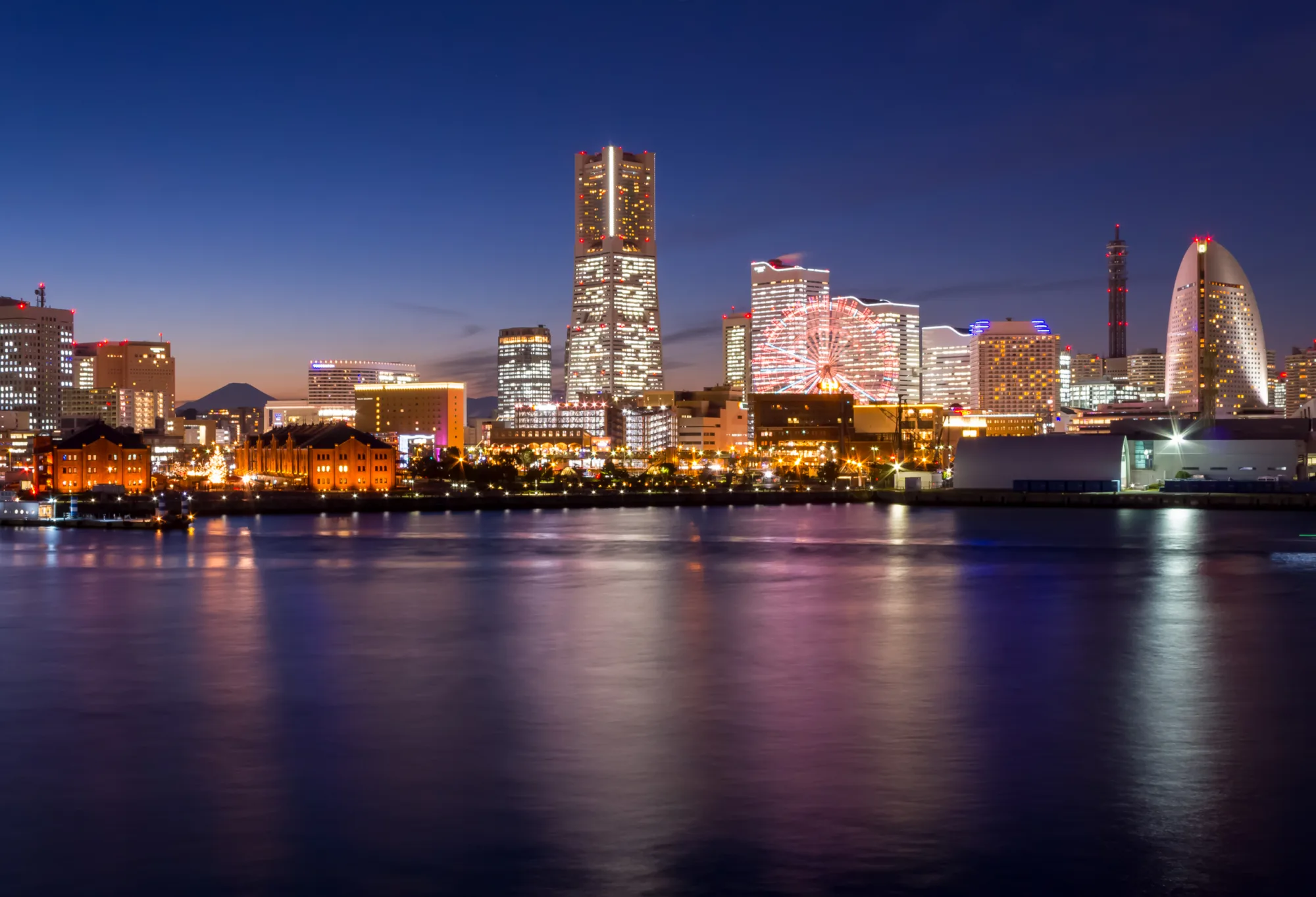
Yokohama is worth a trip in its own right. In the evening it is worth strolling around Minato Mirai, where illuminated skyscrapers are reflected in the water. Look into the historic Sankeien garden — check its opening hours and blossom on its website. Walk through Chinatown and along the waterfront. And if you come in spring, add the sakura of Tokyo, Kyoto and Nara to the route: a consolidated calendar of events is in our article on the main events in Japan in 2027, and in July the climb of Mount Fuji awaits nearby.
Three ready-made itineraries
“One day” (Tokyo — Yokohama). A morning train to Seya, three or four hours in the gardens, lunch, then Minato Mirai in the evening. Best in May or September.
“Spring: sakura and Expo” (5–7 days). Kyoto and Nara in the first week of April, then Tokyo and a day at the exhibition, an evening in Minato Mirai. The most beautiful option, but difficult to book.
“Summer: an evening in the garden” (3–4 days). Yokohama with an overnight stay, an evening ticket to the exhibition in the heat, a walk along the waterfront and to Kamakura. Suits those who are not afraid of the rainy season.
Trip budget per person
To avoid guessing, estimate expenses in advance. The ticket is from 4,900 yen per day; if you plan two visits in different seasons, the 28,000-yen season pass will pay off only with frequent visits, so for a tourist who comes once a one-day ticket is usually better value. Add the journey to the ticket: the train from Tokyo to Yokohama and a transfer to the Sotetsu line, plus the shuttle — check current fares in the carriers’ apps. Food on the site is usually more expensive than in the city, so it is better to bring a snack. The biggest item is accommodation: in spring, in sakura season, prices in Yokohama and Tokyo rise, and it makes sense to book several months ahead with free cancellation.
For photographers: when and where to shoot
Flower gardens like soft light, and the best time for shooting is the first hours after opening and the evening. In the daytime, especially in summer, the light is harsh, and on open lawns there are many people. In spring come on a weekday for the opening and shoot the cherry trees without the crowd; in June catch the hydrangeas after rain — wet petals look especially expressive; at the end of summer sunflowers are good at sunset. The evening ticket gives a chance of shots with illumination, but a tripod in a crowd is usually out of place, so bring a fast lens. Respect other guests: don’t block paths and don’t step into flower beds.
If it rains
The weather in Japan is changeable, and the rainy season falls in June. Bring a light raincoat or a folding umbrella, and waterproof shoes. Rain does not cancel the exhibition: hydrangeas and lilies, on the contrary, look brighter, and the crowd thins out. The covered pavilions — the Horticultural Culture Pavilion and the national exhibits — will be a plan B for the heaviest hours. At the same time look at the official announcements in advance: in case of extreme weather the organisers may change the operating hours.
Who to go with: couples, families, elderly parents
For families with children the exhibition is convenient: there is a children’s zone, lots of room to run and play, and the visit is easily broken into stages with a break for rest. For elderly parents the main challenge is distance and heat, so choose May, September or an evening ticket and don’t try to see everything in a day. For couples an evening visit with illumination and dinner in Minato Mirai will do. For solo travellers it is easiest to fit the exhibition into a route between Tokyo and Kyoto: a day in the gardens, a night in Yokohama, then on by bullet train to the west.
FAQ
When is GREEN×EXPO 2027? From 19 March to 26 September 2027, 192 days, in Yokohama.
How much does a ticket cost? An adult one-day advance ticket is 4,900 yen, the season pass 28,000 yen, the evening ticket 3,500 yen; a paper ticket is 100 yen more.
Do I need to reserve a date? Yes, entry is only possible with a ticket and a reserved visit date.
When is the best time to go? For sakura and tulips — late March and April; for comfort — May and June; in summer an evening ticket is better.
How do I get there from Tokyo? By train to Yokohama, then on the Sotetsu line to Seya station and by shuttle; budget about an hour and a half one way.
Is it suitable with children? Yes: there is the Kids Village, and the exhibition’s mascot collaborates with Sanrio characters.
Ticket prices, schedules, transport and the exhibition programme may change — check the official GREEN×EXPO 2027 website.