Zenkoji's once-in-six-years gokaicho in Nagano runs from 4 April to 19 June 2027. What is on show, how the sacred pillar works, what tickets cost and how to get there.
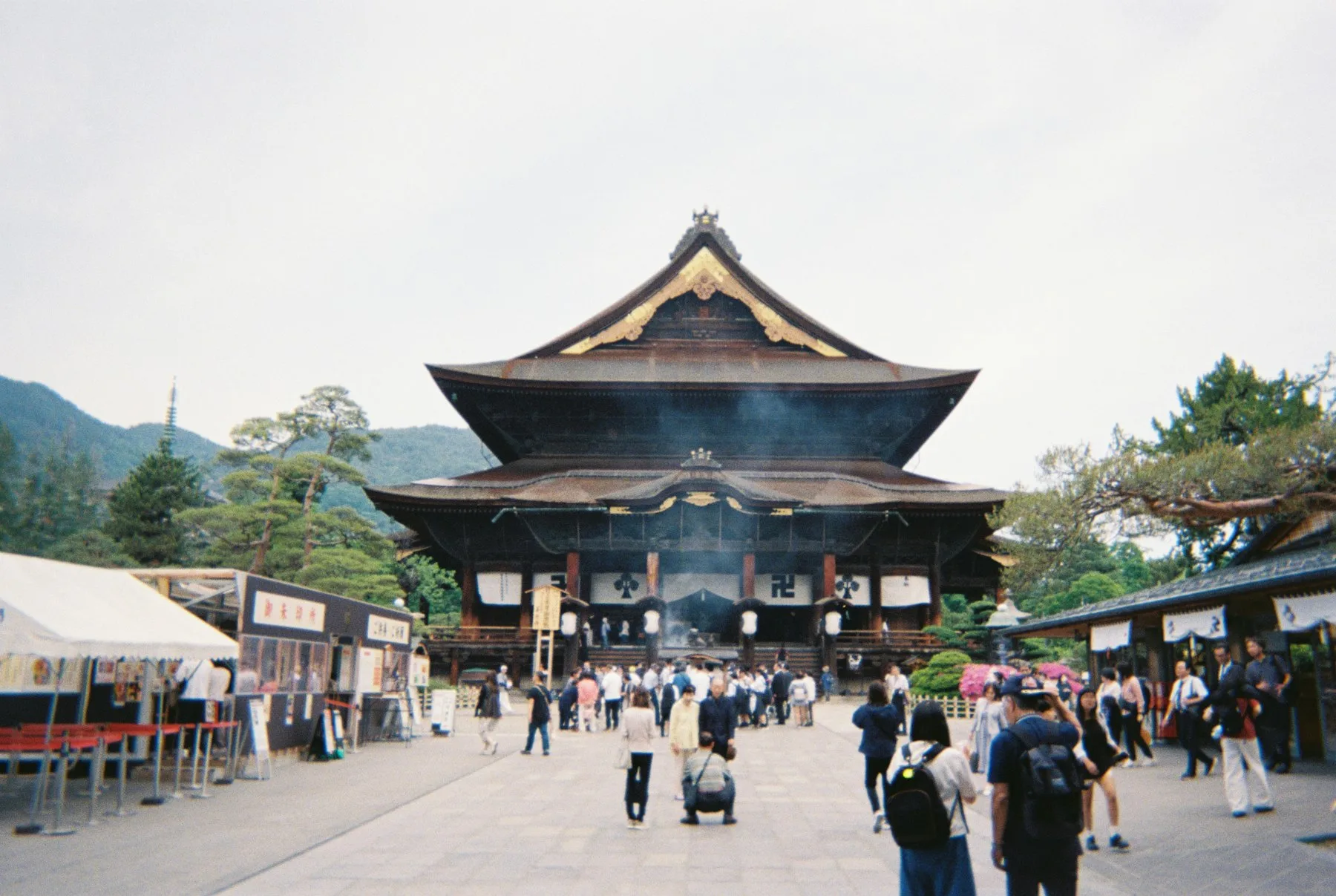
Picture a square in front of a huge wooden temple. Incense smoke drifts over the roof, people stand at the steps looking up, and in the middle of the square rises a pillar that you almost feel you must lay a hand on. A cord runs from the pillar to the main hall. It links the pillar to the hand of a statue that, in ordinary years, nobody sees. This is Zenkoji in Nagano during gokaicho, a rare ceremony held once every six years. Tradition holds that touching the pillar brings the same merit as touching the sacred image itself. The next one takes place in 2027, from 4 April to 19 June.
Below we explain what exactly happens in Nagano, how the programme is organised, what things cost according to the latest published data, how to get there from Tokyo and what has not been announced yet. Where information is missing, we say so: the data is current as of 24 November 2026.
- Dates: from Sunday 4 April to Saturday 19 June 2027, 77 days in all.
- What is shown: not the main sacred image but its “stand-in” (the maedachi honzon); the main image stays hidden.
- The ekō-bashira pillar: it can be touched around the clock and is lit from sunset until 21:00.
- 2027 tickets: prices and ticket types have not been announced yet. Since 1 April 2026 an inner-hall ticket costs 800 yen for an adult.
- From Tokyo: about 1 hour 30 minutes by the Hokuriku Shinkansen to Nagano, then a bus of around 15 minutes to the Zenkoji-Daimon stop.
What gokaicho is and why people talk about it all year
The word “gokaicho” (御開帳) literally means “opening of the doors”. In Japanese Buddhist temples it denotes a period when a secret or rarely shown sacred image is opened for worship. Zenkoji’s case is unusual. The temple’s main image, a statue of Amida with two bodhisattvas, is said never to be shown: it is considered an absolutely hidden image and is kept in a closed shrine. So during gokaicho its “stand-in”, the maedachi honzon, is brought out for worship; according to a Japanese travel blog it was made in the Kamakura period. That is what pilgrims see.
Preparations begin long before April. In summer 2026 the town of Matsushiro, which by tradition supplies the sacred pillar, held the ceremony of the first axe-stroke on the tree. Matsushiro is part of Nagano today, but the link between that district and the temple is very old. According to JR East, the tradition goes back to the 1707 rebuilding of the main hall, when a family from Matsushiro supervised the work. The pillar is carried through the streets in processions in the costumes of noble families, and people help to pull the cord.
Gokaicho 2027 dates and key ceremonies
The official gokaicho 2027 period runs from 4 April (Sunday) to 19 June (Saturday), 77 days. For comparison, the previous ceremony, according to the same blog, ran from 3 April to 29 June 2022, or 88 days. The dates were announced as early as November 2024.
The schedule of the main rites that the blog quotes from the temple’s events page:
- 28 March 2027 (Sunday): ceremony of receiving the ekō-bashira pillar;
- 3 April (Saturday): ceremony of moving the maedachi honzon;
- 4 April (Sunday): opening ceremony, the kaibyaku daihōyō;
- 24 April (Saturday): mid-period courtyard ceremony in the Tendai rite;
- 8 May (Saturday): mid-period courtyard ceremony in the Jōdo rite;
- 19 June (Saturday): closing ceremony, the ketsugan daihōyō;
- 20 June (Sunday): ceremony of returning the maedachi honzon.
The blog also mentions several other events, for example a flower festival on 5 May and ceremonies at neighbouring temples, but these dates are not in the quote from the official site, so treat them as unconfirmed. Not yet announced are the date the pillar is erected in the square, the o-neri parade, the carrying in of portable shrines and the opening hours of the morning service and the inner hall for 2027. Follow updates on the official event site, gokaicho.com.
What you will actually see: the maedachi honzon and the daily services
Put very simply, the pilgrim’s rhythm of gokaicho looks like this: morning, a service, the shrine doors open, and at noon a curtain is lifted for a few minutes. Every day during the services, as the blog writes citing the official page, the curtain is raised and for a moment the lapis-coloured pedestal and shrine are visible to the faithful. The shrine doors are opened during the morning service and closed for the evening service at 17:00. Exact hours for 2027 have not been published. In 2022, according to the blog, the morning service began at around 6:00 and later moved to 5:30. Treat that as a guide, not a timetable.
The inner hall, as described, covers about 150 tatami mats and lets you sit close to the sacred image. Beneath the main hall runs a corridor in total darkness called kaidan-meguri. You feel your way along the wall and look for the “lock of paradise”. It is not an attraction, but for many visitors this passage becomes the strongest impression: you walk for a few minutes and cannot see anything around you. Do not bring bulky bags: the corridor is narrow and people go in a line.
The ekō-bashira pillar and the cord of good ties
It is this pillar that turns gokaicho into a spectacle visible from the square. According to JR East, the pillar is about ten metres tall, is set in front of the main hall and is connected by a cord called the “zen-no-tsuna” to the hand of the maedachi honzon. Touching the pillar is said to bring the same merit as touching the sacred image. The blog, citing the official page, adds that five Sanskrit syllables are written on the pillar, standing for space, wind, fire, water and earth, and that it can be touched 24 hours a day; the lighting runs from sunset until 21:00.
A special tree was chosen for 2027. According to the blog, which cites the Matsushiro tourism association and local television, the first axe-stroke ceremony took place on 3 July 2026 at Nakamura Shrine in Matsushiro. It is a cedar about 35 metres tall, 2.8 metres in girth and more than 250 years old. Felling is planned for 8 October and the ceremonial handover to the temple for 28 March 2027. By comparison, the 2022 pillar was smaller: 30 metres and about 150 years old, and it came from Suzaka.
What tickets cost and what is still unknown
Some caution is needed here. The temple has not yet announced prices for the gokaicho 2027 period itself. Citing the official price page, the blog gives the current rates in effect since 1 April 2026:
- inner hall, kaidan-meguri and the Sanmon gate: 800 yen for an adult, 300 yen for a middle or high school student, 100 yen for an elementary school pupil, free for pre-school children;
- the sutra repository: 500 yen for an adult (the English page says it is closed for a building inspection, so check on site);
- a combined worship ticket including the museum: 1,500 yen for an adult, 600 and 200 yen for students.
The official gokaicho FAQ page still shows the 2022 price of 600 yen. For a 2027 budget, assume at least the current figures and check the official site closer to April. We found no reservation system for the inner hall, kaidan-meguri or the pillar in the sources; parking cannot be booked.
How to get to Zenkoji from Tokyo
The trip takes less than half a day. The Hokuriku Shinkansen runs from Tokyo to Nagano station in about 1 hour 30 minutes. From the station’s first bus stand a local bus leaves towards Zenkoji, getting to the Zenkoji-Daimon stop in about 15 minutes for 190 yen according to the official page. From there it is about a five-minute walk to the main hall. If you arrive on a weekend, leave the hotel early: buses are packed on such days.
There is also the tourist loop bus “Binzuru-go”, which stops at the station and at the Daimon gate. You board at the rear and get off at the front, and you take a ticket on boarding. Only 1,000-yen notes can be changed on board, so have small change ready. If you drive, parking lots 1 to 5 are near the temple: according to the blog, a car costs 600 yen for the first two hours and 300 yen for each further hour. Parking cannot be reserved. JR East mentions four lots while the blog says five, so check on site.
Will it be crowded, and how to choose your time
The temple receives many pilgrims in ordinary years too. According to the blog, around 6.36 million people visited Zenkoji in 2022, and 7.1 million including all six affiliated temples. The crowd forecast for 2027 on the official site is marked “in preparation”, as is the transport information. Rely on sensible rules: weekdays are better than weekends, early morning is better than midday, and the pillar is easier to photograph in the evening under the lights, when the crowd thins out. We give no figures for queue times at the pillar: the sources do not provide them.
What to see nearby
The main hall of Zenkoji is a National Treasure of Japan. According to JR East the building is about 27 metres high, 24 wide and 54 deep, and it was rebuilt in 1707. Inside are the statue of Binzuru, which by custom people stroke to heal illness, the image of Enma, king of the underworld, and the “pure glass mirror” near the exit. Close by are a BEAMS JAPAN shop in the amulet area and the main store of the spice maker Yawataya Isogoro on Daimon street. For a stroll, Shiroyama Park east of the temple is known for its cherry blossoms. If you have an extra day, the neighbouring area has the snow-monkey onsen park, the Shibu hot springs and the town of Obuse; we have not prepared detailed descriptions yet.
If you are planning a spring trip around Japan, see how gokaicho lines up with the cherry blossom season in our 2027 cherry blossom guide and with other events in the Japan events calendar for 2027.
How to plan a day in Nagano
A practical scenario looks like this. Leave Tokyo on a morning Shinkansen so that you reach Nagano before ten. Walk to the temple not along the main shopping street but round to the Sanmon gate entrance, leave luggage in the station lockers and allow at least two to three hours for the temple. Go into the inner hall, do the kaidan-meguri and leave the pillar for sunset. Shinkansen trains run back from Nagano to Tokyo all day, but on a Sunday evening they can be full, so buy a ticket in advance. If you come for several days, it is worth staying overnight and returning in the morning: the temple looks quite different in the morning than at midday.
What we do not know today
As of 24 November 2026 the following have not been announced: ticket prices for the gokaicho 2027 period, the schedule of daily services and the inner hall’s opening hours, the date the pillar is erected, traffic restrictions around the temple, the schedule of auxiliary buses and the crowd forecast. We also found no confirmed Shinkansen fares from Tokyo to Nagano in the sources we rely on, so we give no figures. As soon as information appears on the official site we will update this article.
Sources
- JR East article on Zenkoji gokaicho (media.jreast.co.jp, updated 4 September 2026): media.jreast.co.jp.
- Detailed breakdown of the schedule and tickets in the Japanese travel guide Watabi (updated 26 August 2026): watabi.org.
- Official gokaicho site: gokaicho.com.
Information is current as of 24 November 2026. Ceremony dates and prices may change; check the temple’s official site before travelling.
Cover photo: Unsplash.